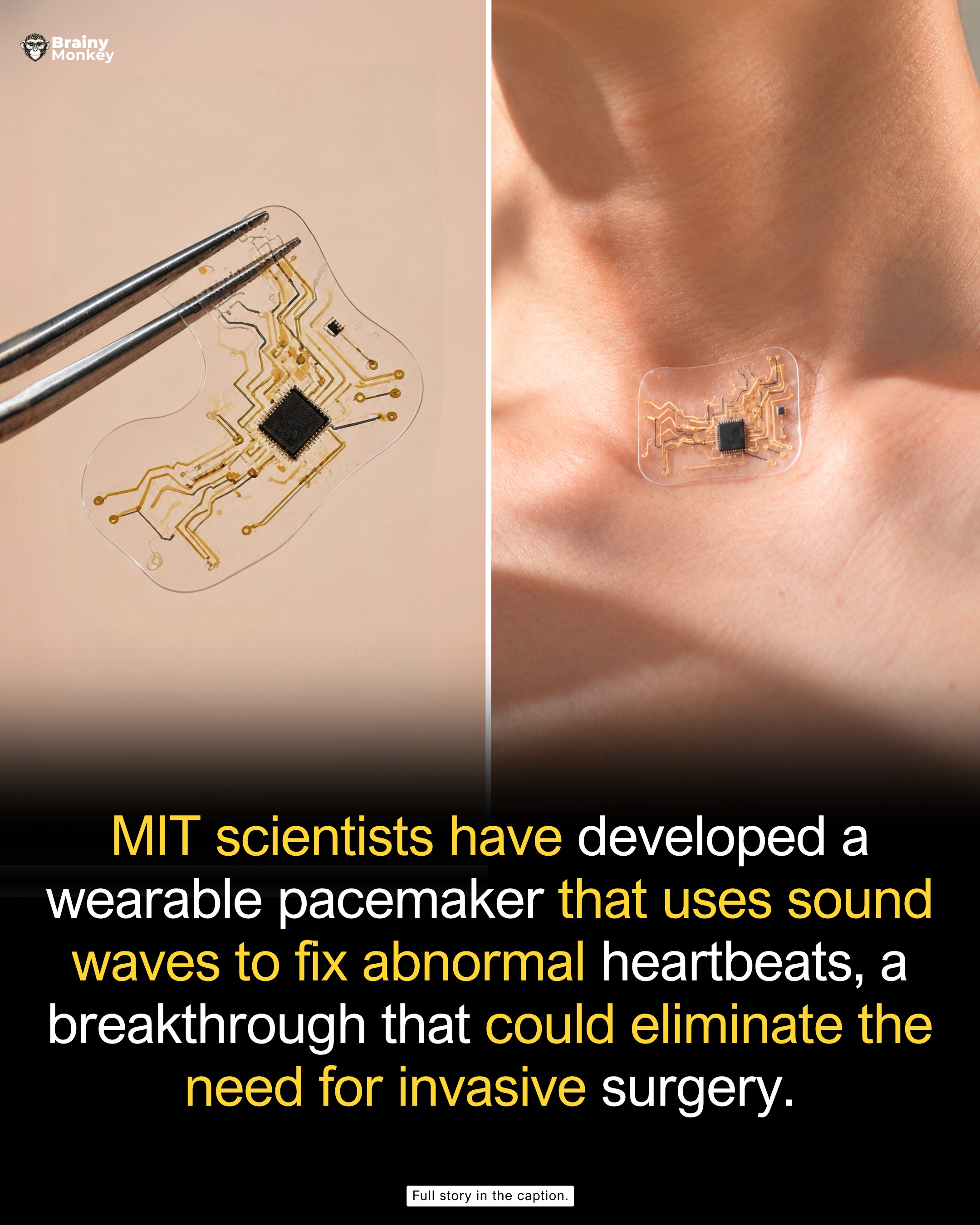
NOTICE: MIT’s wearable pacemaker is only a research project. It is not available for public use. MIT scientists have developed a wearable pacemaker that could redefine how abnormal heart rhythms are treated. The device, comparable in size to a postage stamp, uses ultrasound to stimulate the heart through the skin. This method promises to reduce the need for invasive procedures, marking a significant advancement in cardiac care.
A Pacemaker On Your Skin
Traditional pacemakers require surgical implantation and include a pulse generator with batteries and wires. The device created by MIT scientists, conversely, is a compact, flexible patch. Worn on the chest, it emits ultrasound waves that are precisely targeted to stimulate the heart. These waves penetrate the skin, allowing the patches to restore normal cardiac rhythms without the need for implanted wires or batteries. It can regulate irregular heartbeats from outside the body. This breakthrough was spearheaded by MIT professor Xuanhe Zhao, who envisions a future where managing abnormal heart rhythms can be as straightforward as applying a sticker. The device's minimal size and lack of implanted parts are revolutionary. Only about the size of a postage stamp. This eliminates the need for invasive surgery and post-operative recovery. Instead, patients might be able to regulate their heartbeats with a device worn on the skin. This adds to the list of new minimalist medical devices reducing post-op recovery time and scarring.
A Future Without Surgical Implants
Pacemakers are integral in treating arrhythmias. Heart rhythms can be managed to achieve optimal health for those diagnosed with such conditions. Around 3 million adults in the U.S. live with pacemakers. MIT’s wearable device was engineered in lab tests and animal studies. It successfully managed the rhythm of engineered human heart cells and restored normal heart rhythms in animals quickly. It is potential to revolutionize how heart conditions are managed. How often do we see a device so small taking over a major field in healthcare? If widely implemented, the patch could change the landscape for medical professionals treating heart conditions, and patients living with pacemakers. This technology would eliminate the need for surgical procedures, significantly improving patient outcomes and reducing healthcare costs.
The Science Behind
Ultrasound Waves
This wearable pacemaker uses ultrasound technology. Sound waves are sent through the skin targeting the heart. These precisely targeted waves stimulate the heart to contract and regulate its rhythm. Unlike traditional pacemakers, ultrasound eliminates the need for wires or batteries. It is both minimally invasive and potentially more comfortable for the patient.
Patch Design
The device's design makes it a leap forward in cardiac care. Flexible and compact, the patch’s technology is a boon for patients. Its compactness and flexibility allow for seamless integration into daily life. The patch looks and feels like a sticker. This means patients can wear it comfortably and potentially forgo the discomfort and risks associated with invasive surgeries.
Clinical Research
MIT teamed up with scientists, etymologists, and physicians. They worked on the project in lab tests and animal trials. The device was used to stimulate human heart cells. In this research, it showed promising results. It can regulate heart rhythms. It is important to note that although promising, more trials and research is needed for this technology to be implemented in clinics.
Bridging the Gap
Long-Term Impact
The real challenge is implementing this technology in medical centers. It is bound to have long-term effects on how we treat such conditions. The patch could revolutionize care. It means procedures would be less invasive. Patients would have much more to feel comfortable with.
Regulatory Hurdles
Although MIT’s wearable pacemaker shows promise, several regulatory hurdles must be overcome. All medical innovations face issues like this. Extensive testing is needed to ensure the patch works as intended in patients. This includes clinical trials that check for safety and efficacy. Approval from the U.S. Food and Drug Administration (FDA) and other global regulatory bodies is a considerable challenge. These bodies ensure that the patch is safe, does not harm the body, and works efficiently. Medical providers have to undergo several protocols to validate it can be used widely.
Patient Compliance
If implemented, another challenge is patient compliance. It is hard to get patients to use new tech and devices. Patients need to be educated. They have to know the patch is safe and effective. How they should use it in everyday life. Understanding this will be a huge step. Educating them about how it works will help healthcare providers and patients.
Sticking to the Future
People who have pacemakers today might someday wear a sticky patch instead. MIT’s research could reduce the discomfort and risks of traditional pacemakers and surgical procedures. It is pivotal in modernizing how we treat heart conditions.
Questions readers ask
How does the wearable pacemaker from MIT actually work?
The wearable pacemaker uses ultrasound waves to stimulate the heart. It emits these waves through the skin, targeting the heart to regulate its rhythm. The device's design allows it to be worn like a sticker, making it a non-invasive alternative to traditional pacemakers.
What are the benefits of using a wearable pacemaker over traditional ones?
The wearable pacemaker eliminates the need for invasive surgeries and implanted wires or batteries. This means less post-operative recovery time, reduced scarring, and potentially lower healthcare costs. Plus, it's as simple to use as applying a sticker.
Is the MIT wearable pacemaker available for public use yet?
No, the MIT wearable pacemaker is currently just a research project. It has not been made available for public use yet, so it's not something you can get from a doctor or hospital just yet.
How does the ultrasound technology in the wearable pacemaker compare to traditional pacemaker methods?
Traditional pacemakers use electrical impulses sent through wires to regulate the heart. The wearable pacemaker, on the other hand, uses ultrasound waves that penetrate the skin to stimulate the heart. This makes it a non-invasive alternative that doesn't require implanted parts.
How does the patch design make the wearable pacemaker more comfortable for patients?
The patch is flexible and compact, similar to a sticker. This design allows it to be worn comfortably on the skin, integrating seamlessly into daily life. Unlike traditional pacemakers, it doesn't require surgical implantation, so patients avoid the discomfort and risks associated with invasive procedures.
Related deep dives
Similar reads based on topic and creator.




Recent articles
Fresh deep dives from the latest Reels we unpacked.




Comments
Be the first to comment.