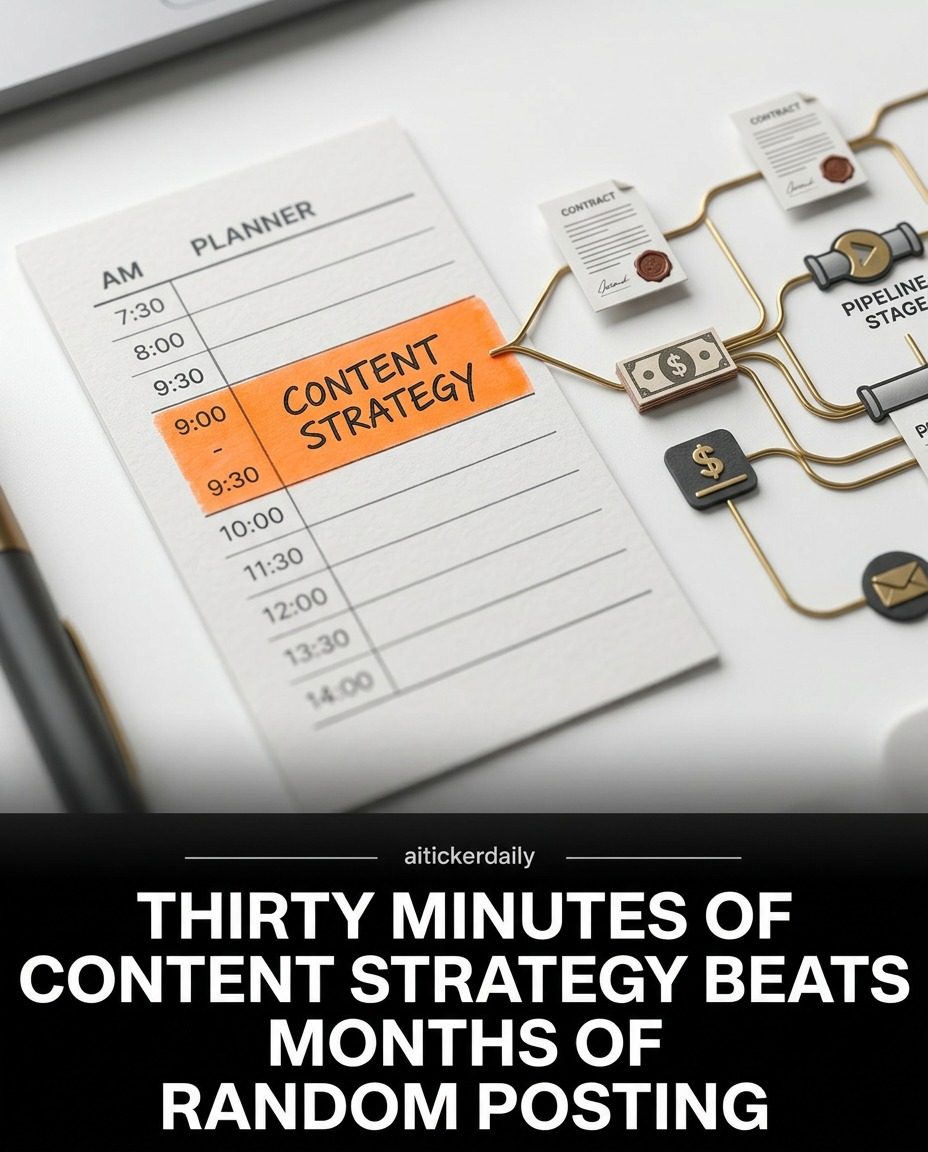
Creating a LinkedIn Content Strategy in 30 Minutes
Developing an effective LinkedIn content strategy can drive significant business outcomes, including 5-6 figure deals. The key is to avoid random posting, which often generates noise and fails to engage your audience effectively. Instead, a structured, 30-minute planning session can provide the framework needed to make future posting decisions quickly and efficiently. By following a ten-slide deck, you can cover essential elements such as the false pace problem, audience definition, content bridge, hook menu, proof architecture, reply strategy, sequence and timing, and conversion layer.
Why this Matters
In today’s fast-paced business landscape, LinkedIn has become a critical platform for professionals and organizations to connect, network, and showcase their expertise. A well-crafted content strategy not only helps in building a strong brand presence but also drives meaningful engagement and conversions.
Strategic posting, guided by a systematic approach, ensures that your content aligns with your business goals and resonates with your target audience. This methodical planning contrasts sharply with random posting, which can lead to disjointed and ineffective content that fails to capture attention or drive action.
Main Discussion
False Pace Problem and Audience Definition
The false pace problem refers to the misconception that posting frequently without a clear strategy will yield better results. In reality, it often leads to content that lacks focus and relevance.
Why is it important to solve?
An effective content strategy begins with a clear audience definition. Knowing your target audience—including their pain points, interests, and behaviors—is crucial for creating content that addresses their needs. This ensures that every post has a purpose and is tailored to your audience, increasing the likelihood of engagement and conversion.
Content Bridge Strategy
The content bridge strategy is about connecting business outcomes to your posts. This involves creating content lanes that guide your audience through different stages of awareness and decision-making. The three primary content lanes are:
- Problem-aware
- Solution-aware
- Proof
Creating Content Lanes
- Problem-aware content focuses on the challenges and pain points of your audience, positioning you as an authority in the field.
- Solution-aware content introduces potential solutions, making your audience aware of the possible ways to address their issues.
- Proof posts provide evidence that your solutions work, often through case studies, testimonials, and data-driven insights.
Creating content lanes helps in systematically guiding your audience through their decision-making journey, from recognizing a problem to implementing a solution and validating its effectiveness.
Hook Menu and Proof Architecture
The hook menu is a key element of your content strategy, focusing on creating engaging, attention-grabbing hooks that entice your audience to dive deeper into your posts. Hooks can be in the form of questions, provocative statements, or intriguing visuals.
Proof architecture involves structuring your content to include compelling evidence that supports your claims. This can include real estate stats, retention stats, and buyer quotes, which add credibility and trust to your content.
Reply Strategy
Effective content strategy goes beyond just posting; it includes engaging with your audience through replies. Treating replies as secondary content ensures that you are actively interacting with your audience, answering their questions, and providing additional value.
Tips for Reply Strategy
- Add New Information: Replies should not be afterthoughts. Use them to share new insights, updates, or additional information that adds value.
- Ask Questions: Encourage engagement by asking your audience questions in your replies. This helps in fostering a two-way conversation and gaining deeper insights into their needs and concerns.
- Allocate Time: Schedule time for reply work to ensure that you are consistently engaging with your audience. This shows that you value their input and are committed to building a relationship.
Sequence and Timing
The sequence and timing of your posts are critical for maintaining engagement and achieving your business goals. Posts should be timed strategically, considering the best times your audience is active on LinkedIn. Sequencing your content in a logical flow ensures that your audience has a cohesive experience, from initial engagement to conversion.
Conversion Layer
The conversion layer is the final step in your content strategy, focusing on turning your audience into leads or customers. This involves creating content that includes clear calls-to-action (CTAs), compelling offers, and seamless pathways to conversion.
Practical Tips
- Use a Planner: A content strategy planner can help you organize your thoughts and plan your content effectively. This could be a physical planner, a digital tool, or a custom spreadsheet.
- Repurpose Content: Maximize the value of your content by repurposing it across different platforms and formats. For example, a blog post can be turned into an infographic, a video, or a series of social media posts.
- Analyze Performance: Regularly review the performance of your content to understand what works and what doesn’t. Use analytics tools to track engagement, reach, and conversion rates, and adjust your strategy accordingly.
Important Takeaways
- Avoid Random Posting: Random posting can lead to a lack of focus and direction. A 30-minute planning session can provide the structure needed to make future decisions more efficiently.
- Create Content Lanes: Use content lanes to guide your audience through the stages of awareness and decision-making.
- Engage with Your Audience: Treat replies as secondary content to foster engagement and build relationships.
- Measure and Adjust: Regularly analyze your content performance and make necessary adjustments to optimize your strategy.
Conclusion
A well-structured LinkedIn content strategy can drive significant business outcomes, including high-value deals and strong brand presence. By addressing the false pace problem, defining your audience, creating content lanes, and engaging with your audience through replies, you can build a content strategy that resonates with your target audience and drives meaningful engagement and conversions. Following a systematic approach, such as the ten-slide deck, can help you achieve your business goals more effectively than random posting.
Questions readers ask
How can a 30-minute planning session improve my LinkedIn content strategy?
A 30-minute planning session allows you to create a structured framework for your LinkedIn content, helping you make quick, informed decisions about what to post and when. This approach saves time and ensures that your content is tailored to engage your target audience effectively, driving better business outcomes.
What is the false pace problem, and why should I address it in my LinkedIn strategy?
The false pace problem refers to the misconception that posting frequently without a clear strategy will increase engagement. Addressing this issue in your LinkedIn strategy involves creating a thoughtful content plan that focuses on quality over quantity, ensuring your content resonates with your audience and drives meaningful interactions.
How can I define my target audience on LinkedIn to maximize engagement?
To define your target audience, consider factors such as industry, job title, and professional interests. Use LinkedIn's analytics tools to gather insights about your existing followers and tailor your content to attract and engage more users within your target demographic. This focused approach helps build a community of interested professionals who are more likely to convert into business deals.
What is a content bridge, and why is it important in a LinkedIn content strategy?
A content bridge is a strategic element that connects your existing content with new ideas or topics, creating a seamless flow in your LinkedIn feed. It helps maintain audience interest and encourages continuous engagement. By using a content bridge, you can keep your audience engaged and make your content more memorable, leading to better overall engagement and more business opportunities.
What is the hook menu, and how does it enhance my LinkedIn content creation?
The hook menu is a set of attention-grabbing elements used at the beginning of your content to captivate your audience. This can include intriguing questions, bold statements, or relevant statistics. By incorporating a hook menu, you can increase the likelihood of users reading and engaging with your content, ultimately driving more meaningful interactions and business deals.
What is a reply strategy, and how can it boost engagement on LinkedIn?
A reply strategy outlines how you will respond to comments and messages on your LinkedIn posts. An effective reply strategy involves engaging with your audience in a timely and authentic manner, fostering a sense of community and encouraging further interaction. By actively participating in discussions, you can build stronger relationships with your audience, enhancing your brand's presence and driving more business opportunities.
How can I leverage a conversion layer to drive 5-6 figure deals on LinkedIn?
A conversion layer is the final step in your LinkedIn content strategy, focusing on converting engaged users into business leads. This can include clear calls-to-action (CTAs) in your posts, such as inviting users to schedule a consultation or download a resource. By strategically placing CTAs, you can guide your audience through the sales funnel, increasing the likelihood of closing high-value deals.
Recent articles
Fresh deep dives from the latest Reels we unpacked.




Comments
Be the first to comment.