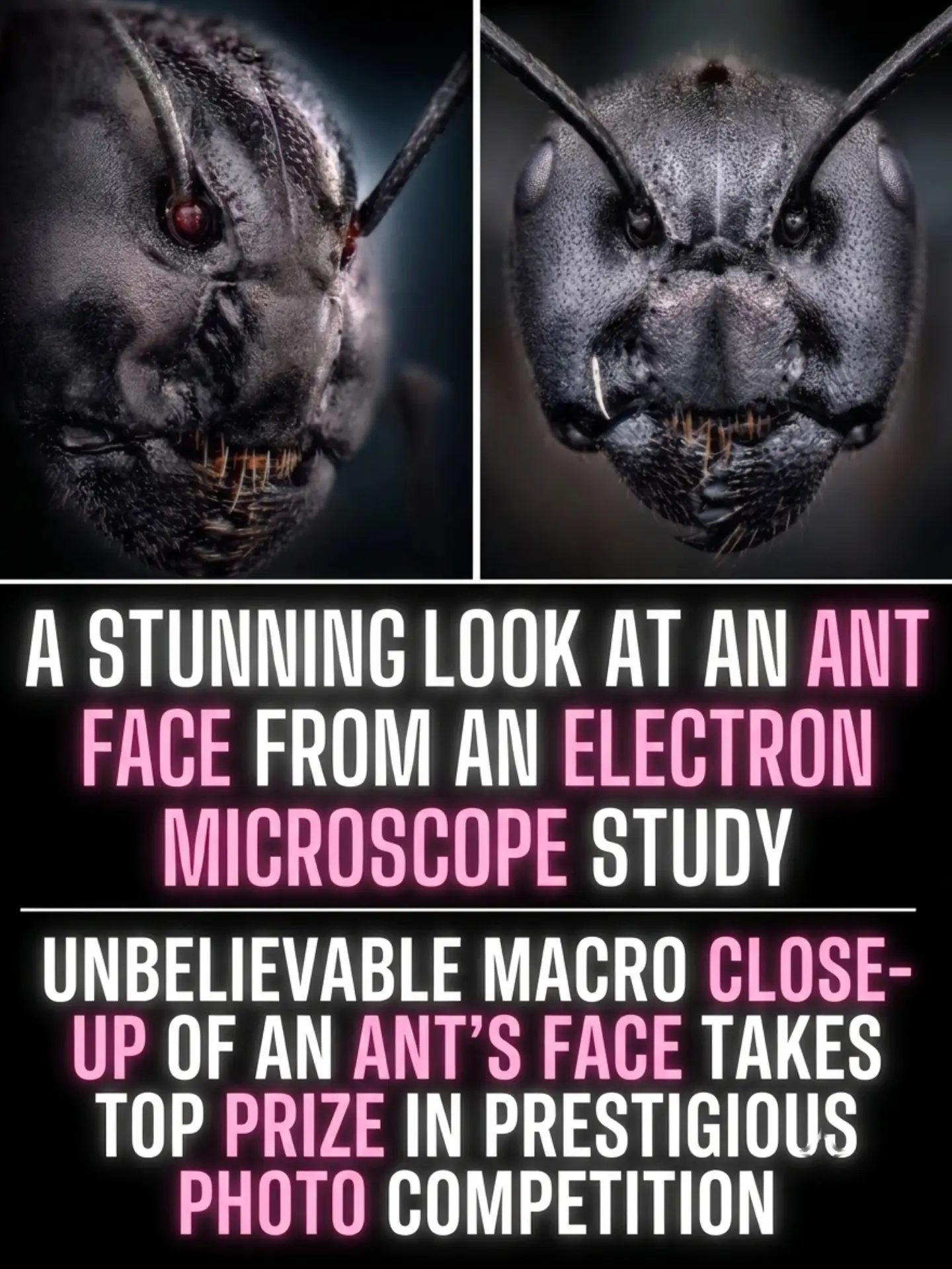
The Intricate World of an Ant's Face
A five times magnified view of a carpenter ant's face reveals a world of incredible detail. This stunning image, captured by photographer Eugenijus Kavaliauskas, won a top prize in the prestigious Nikon Small World competition. The image showcases intricate features that are typically invisible to the naked eye, offering a unique perspective on these tiny creatures.
Context: Why this matters
Insects like ants are fascinating subjects for scientific study and artistic exploration. While they may seem mundane, their tiny features hold a wealth of information about their behavior, survival strategies, and evolutionary adaptations. Macro photography allows us to delve into this hidden world, revealing details that would otherwise go unnoticed. This art form not only captivates us with its aesthetic beauty but also contributes to our understanding of the natural world.
Macro photography and the electron microscope
Unlocking the unseen
Macro photography is the art of capturing subjects at very close distances and at a high magnification ratio. In this case, the carpenter ant's face is magnified 5x its actual size to reveal the fascinating details.
Electron microscopes and photographic marvels
Electron microscopes use a beam of electrons to illuminate a specimen and create an highly detailed image. This is different from a light microscope, which uses light and lenses. Electron microscopes can magnify objects up to 2 million times, making them ideal for studying microscopic structures. This technology allows photographers to capture images that would otherwise be impossible to see with the human eye, revealing the intricate beauty of tiny organisms like ants.
The anatomy of an ant's face
Deciphering the features
At first glance, the magnified image of the ant's face might appear to be a pair of menacing eyes and sharp fangs. However, a closer examination reveals something quite different. Those "eyes" are actually the bases of the ant's antennae, which are crucial for sensing its environment. The "fangs" are tiny facial hairs that help the ant navigate and interact with its surroundings.
The role of facial hairs
The facial hairs, or setae, on an ant's face serve multiple purposes. They help the ant detect changes in air currents, which is essential for locating food sources and communicating with other ants. These hairs also play a role in sensing chemicals, allowing the ant to detect pheromones and other chemical signals.
The Nikon Small World competition
A celebration of microscopic photography
The Nikon Small World competition is an annual event that showcases the best in photomicroscopy. Photographers from around the world submit their images, which are then judged based on their visual impact, originality, and technical skill. The competition has been running since 1975 and has become a prestigious platform for showcasing the beauty and complexity of the microscopic world.
Honorable mentions
The carpenter ant image is just one of many remarkable entries in the competition. Other winners have included stunning images of cells, bacteria, and even delicate plant structures. Each year, the competition winners inspire awe and appreciation for the microscopic world, highlighting the beauty and intricacy of life forms that are often overlooked.
Practical tips for macro photography
Essential equipment
To capture stunning macro images, you'll need a good camera with a macro lens or a close-up filter. A tripod or other stabilization equipment is also essential for keeping the camera steady during close-up shots. For extreme magnification, an electron microscope or other specialized equipment may be necessary.
Techniques for success
- Lighting: Proper lighting is crucial for macro photography. Use diffused light to avoid harsh shadows and ensure even illumination. Ring lights or softboxes can be helpful for this purpose.
- Focus: Achieving sharp focus is challenging at close distances. Use manual focus and live view to fine-tune your settings. A macro rail can also help with precise adjustments.
- Depth of field: With macro photography, the depth of field is very shallow. Use a high f-stop number (e.g., f/16 or higher) to increase the depth of field and keep more of the subject in focus. Alternatively, use focus stacking to combine multiple images with different focus points.
- Composition: Pay attention to composition to make your images visually appealing. Use leading lines, frames, and other compositional techniques to draw the viewer's eye into the photo.
Important takeaways
Macro photography offers a unique perspective on the world around us, revealing the intricate beauty of tiny subjects like ants. By using specialized equipment and techniques, photographers can capture stunning images that reveal details that are typically invisible to the human eye. The Nikon Small World competition is a fantastic platform for showcasing the best in photomicroscopy, inspiring awe and appreciation for the microscopic world.
Conclusion
The magnified view of a carpenter ant's face is a testament to the incredible detail and beauty that can be found in the natural world. This stunning image, captured by Eugenijus Kavaliauskas, won a top prize in the Nikon Small World competition, highlighting the power of macro photography and the electron microscope. Through this art form, we can gain a deeper appreciation for the tiny creatures that share our planet and the intricate structures that make up their world.
Questions readers ask
What kind of ant is featured in the close-up image?
The close-up image features a carpenter ant. This species was chosen for its intricate facial features, which are highlighted beautifully in the macro photograph.
How was the incredible detail in the ant's face captured?
The detailed image was captured using macro photography and advanced imaging techniques. These methods allow for extreme close-ups, magnifying the ant's face by five times its actual size.
Who is the photographer behind the stunning ant portrait?
The photographer who captured the award-winning image is Eugenijus Kavaliauskas. He won a top prize in the Nikon Small World competition for his work.
What can be learned from studying the intricate details of an ant's face?
Examining the detailed features of an ant's face can provide insights into the insect's behavior, survival strategies, and evolutionary adaptations. These details are often overlooked due to their small size.
What are some benefits of using macro photography for capturing ant images?
Macro photography allows for extreme close-ups of tiny subjects like ants, revealing hidden details. This technique offers a unique perspective on these creatures, showcasing their complexity and beauty.
What is the Nikon Small World competition?
The Nikon Small World competition is a prestigious event that celebrates the art and science of photography. It showcases stunning images captured through the microscope, highlighting the intricacies of tiny subjects.
What types of techniques can be used to enhance the details in an ant's face?
Techniques such as electron microscopy can be employed to further enhance the details in an ant's face. These methods provide even greater magnification and clarity, revealing microscopic features that are not visible with standard macro photography.
Related deep dives
Similar reads based on topic and creator.




Recent articles
Fresh deep dives from the latest Reels we unpacked.




Comments
Be the first to comment.