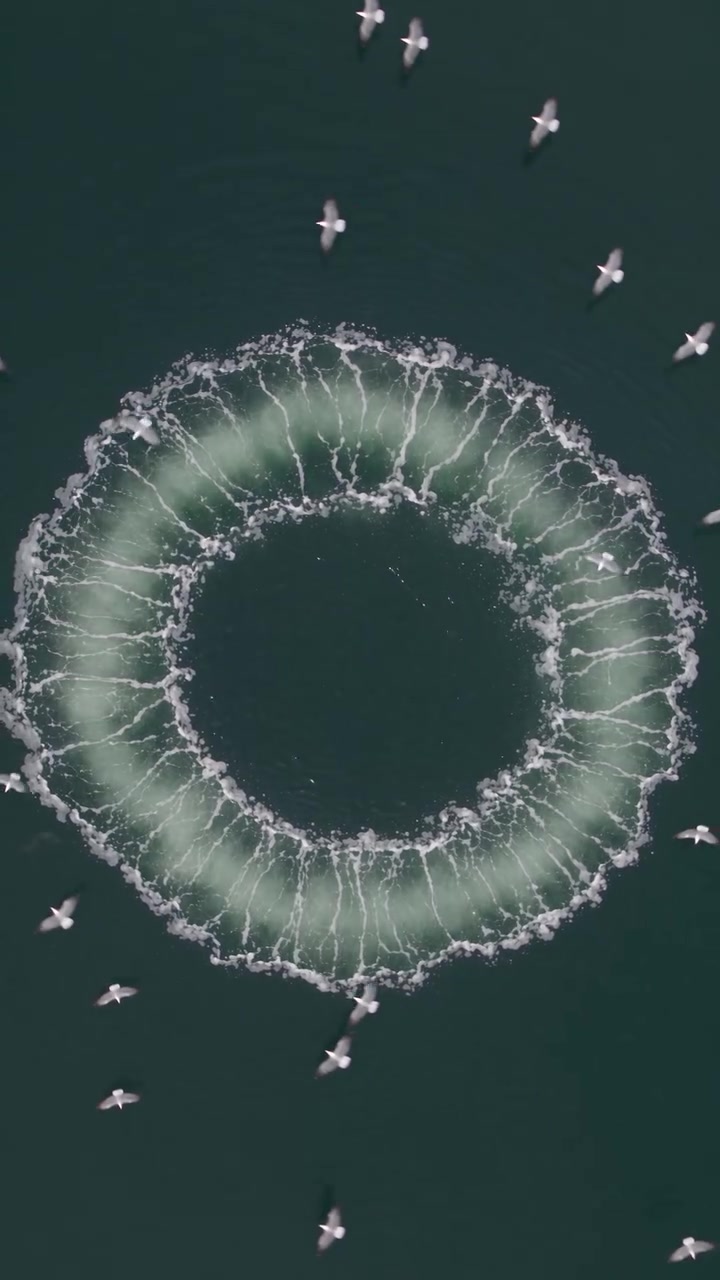
Every summer in Alaska, a team of humpback whales builds a net of bubbles that can trap entire schools of herring. Each whaler flying through this bubble curtain to entrap the fish is a sight both breathtaking and strategic. Its techniques appear as simple as swimming in a circle and blowing bubbles, yet it's anything by simple. This behavior is known as "bubble-net feeding." Bubble-net feeding is a specialized foraging strategy. Humpback whales create immense, vertical circles of bubbles under a school of small fish to push them up and trap them in a dense ball. The whales then lunge from beneath, jaws wide to inhale millions of fish in a single gulp. Each whale dive creates an unavoidable upward spiral, while another whale sings a loud call, pushing the herring into a tight ball. This synchronized behavior allows the whales to trap and consume vast amounts of food. The behavior is so precise and efficient, it seems to require training. Young whales learn it from the team. If a whale is born knowing this, nobody has yet observed it. Humpback whales will eat a ton of fish in a given day. Fish plentiful during migration, this strategy is crucial for the survival of the whales. The strategy of bubble-net feeding is a marvel of teamwork. Each whale plays a distinct role, forming the feeding net, pushing the fish into the middle, and lunging through the bubble net to catch the fish. The technique varies between pods. Some groups practice it for the most efficient trapping of the fish. Most spectacularly, every summer, they come back and repeat it.
Both amazing and skilled
The bubble-net feeding strategy is far from being a one-dimensional tactic. From the Mouth of the whales to the intricate communication between members of the pod, the entire process is a complex ecosystem that allows feeding and life.
The mouth and baleen
The mouth is the most critical part of a whale's feeding mechanism. Upon inhauling the entire school of fish, the whale does not consume the fish directly. Instead, it relies on the natural mechanism of its fiber-like organ, the baleen. This allows for the easy expelling of water while keeping hold of the school of fish within. The whale is able to completely consume the fish in the next few minutes.
How it evolved
Bubble-net feeding is not something every whale knows because it is not taught through genetics, but rather, it's taught. Through the direct experience of each whale team. This confirms that the strategy of bubble-net feeding is a fundamental part of the survival of the humpback whale.
Staggering appetite
The amount of fish that a whale needs to consume can be mind-blowing. A single mouthful of a whale holds more water than a hot tub. A whale eats a ton of fish a day, yet it fasts for months during its migration. This feeding strategy is as effective as it is crucial.
Practical guidance for the person interested in seeing bubble-net feeding
Practical guidance for a backdoor experience in whale watching:
- Plan ahead: Check the season.
- Take time: Travel to Alaska.
- Educate yourself: Learn about whale feeding.
- Respect nature: Stay on the boat.
Questions readers ask
What exactly is bubble-net feeding and how does it work?
Bubble-net feeding is a unique hunting method used by humpback whales in Alaska. It involves a group of whales swimming in a circle and blowing bubbles to create a net that traps schools of herring. The whales then lunge through the bubble net to feed on the trapped fish. It's a coordinated effort where each whale plays a specific role, making it a fascinating display of marine teamwork.
How do humpback whales learn this feeding strategy?
Humpback whales learn bubble-net feeding through experience and observation, not through genetics. Younger whales pick up the technique by watching and participating with more experienced members of their pod. This learning process highlights the social and cooperative nature of these marine mammals.
Why is bubble-net feeding so important for humpback whales?
Bubble-net feeding is crucial for humpback whales because it allows them to capture large amounts of fish efficiently. Given that a whale can eat up to a ton of fish a day, this strategy ensures their survival, especially during the summer when food is plentiful and they need to build up reserves for their long migrations.
How does the baleen in a humpback whale's mouth help with feeding?
The baleen, a fiber-like organ in the whale's mouth, plays a critical role in filtering out water while keeping the fish inside. When the whale lunges through the bubble net and takes in a large mouthful of water and fish, the baleen allows the water to be expelled, leaving the fish to be consumed. This mechanism is essential for the efficiency of their feeding strategy.
Do all humpback whale pods use the same bubble-net feeding technique?
While the basic concept of bubble-net feeding is the same, different pods may have variations in their techniques. Some groups might refine the method for better efficiency in trapping fish. This variation shows that the strategy can be adapted and improved over time, highlighting the whales' intelligence and adaptability.
Can I see bubble-net feeding in Alaska, and if so, how?
Yes, you can see bubble-net feeding in Alaska, but it requires some planning. The best time to witness this is during the summer months. You'll need to travel to Alaska and take a whale-watching tour. It's also important to educate yourself about whale behavior and feeding habits to enhance your experience. Remember to respect the whales and their natural habitat during your visit.
How do humpback whales coordinate their movements during bubble-net feeding?
Humpback whales use a combination of vocalizations and synchronized swimming to coordinate their movements. For example, one whale might sing a loud call to push the herring into a tight ball, while others create the bubble net and lunge through it to catch the fish. This precise coordination is what makes bubble-net feeding so effective and awe-inspiring.
Related deep dives
Similar reads based on topic and creator.


Recent articles
Fresh deep dives from the latest Reels we unpacked.

Comments
Be the first to comment.