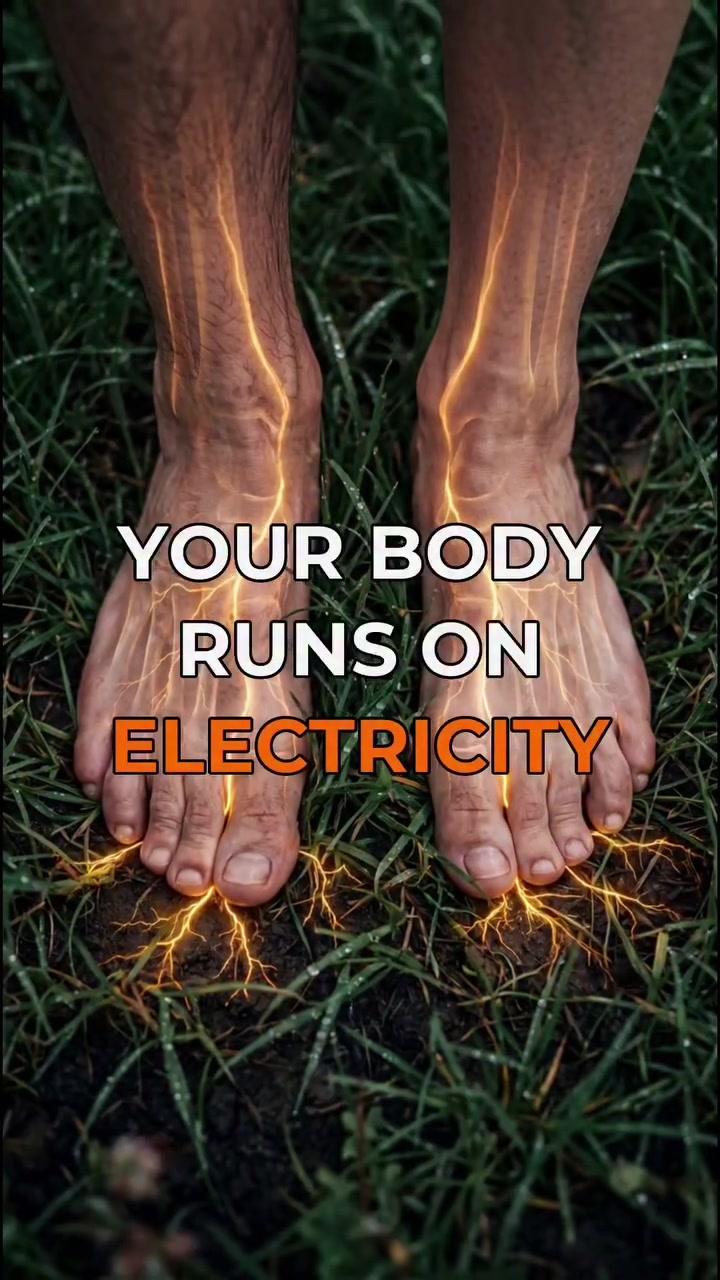
The Science of Human Electricity
Electricity courses through your entire body — from your heartbeat to the impulses in your nervous system. Since 1924, scientists have been measuring these tiny electrical signals, which are essential to every thought and action. Nobel Prizes have been awarded to researchers who specialize in measuring the voltage that runs through your body. It's not just metaphorical. It's a deeply biological fact. "Your body runs on electricity," the author captioned the social video. Voltage is generated by the movement of ions in and out of cells. This is how neurons communicate. It's how muscle tissues contract. Even the heart relies on electrical impulses to keep pumping blood. Volts aren’t on the scale of a power line, of course, but every heartbeat, every nerve impulse, and every thought translates to microscopic electrical charge. What’s fundamentally striking, though, is how the human body connects to the electrical forces of the Earth. You wouldn’t otherwise think of the Earth’s surface as a battery, but electrophysicists tell us the surface holds a permanent negative charge, which we have been tapping into for millennia. This means that when you walk around on Earth, electrons flow between your body and the ground.
Running on Voltage
Our ground contact matters. Every bodily function runs on electrical signals. Walking around in rubber-soled shoes essentially breaks that electrical connection between your body and the Earth. Rubber is an insulator. And science shows that that breaks our connection. The human body’s bioelectric environment remains connected to the Earth’s electrical system. But the insulative nature of shoes means you don’t make direct contact with the Earth anymore. This switch happened slowly, from mid-century onwards. Made evident by the shift in footwear from leather to rubber. Before that, we walked mostly on bare soles, damp leather, or skin-on-bark. It’s not a wellness trend, but a fundamental fact of human existence: ground contact is where the electrons go.
Biological Electricity in the Natural World
The phenomena — human electricity — extends beyond the body. When one looks at a tree, the root system is structurally similar to the human nervous system. The roots, like human nerves, are conductors. Trees are electrical, staying connected to the Earth’s charge. But a human disconnected. This is how "electricity" works in living systems. But no living system is isolated from the environmental context. They all need to be grounded. If you are standing on rubber-soled shoes, and take the voltage, you disconnect yourself from the natural environment. When you touch the earth with your hand or, put a bare foot on wet grass, the voltage your body was holding collapses to almost nothing in seconds. It is not a wellness claim, but a measurable fact. Humans used to do this every day. We have been doing it for 200,000 years. We just called it standing.
Insulating the Body
Rubber's insulation cuts humans off from the Earth's natural charge. A human body can become a capacitor, holding on to a small charge, which cannot be discharged. But there's a way to release it: earth grounding. But rubber on our feet has essentially disrupted this phenomenon. Remove shoes, and the voltage collapses. This doesn’t make you healthier. It is literally a measurement that you can take.
Earth's Negative Charge
The human body communicates to and from the Earth’s surface, through feet. Rubber has historically been used as an insulator, but it’s removed the electrical relationship between the body and the planet. Earth holds on to a negative charge, which is something humans interact with every day. Humans, in turn, have a positive charge, which is how we have engaged with the planet for centuries. Bring bare, damp leather, or skin-on-bark, you are directly connecting your body to the Earth.
Practical Contact Grounding
The simplest form of grounding is walking barefoot. This requires you to find a grassy, mossy, or sandy area. Go to the beach. Go to a field. Immerse yourself, allowing the Earth to restore electrical balance. Specialist grounding sheets are also available, which mimic the grass-y feel by allowing the body to draw grounding benefits from a negatively charged electric surface. But shoes, particularly rubber-soled ones, disrupt the electrical connection to the Earth. You can put a bare foot on wet grass and the voltage your body was holding collapses to almost nothing. No need for a study to justify it. It’s free and it’s good for you.
Questions readers ask
What exactly is grounding and how does it work with the human body?
Grounding is the practice of connecting your body to the Earth's natural electrical charge. When you're grounded, electrons flow between your body and the Earth, helping to balance your electrical environment. This can be as simple as walking barefoot on grass or touching the earth with your hands. This connection helps to discharge any electrical charge your body might be holding, bringing your body's electrical charge to the Earth's level.
How did the shift from leather to rubber shoes impact our connection to the Earth?
The shift from leather to rubber-soled shoes, which started in the mid-20th century, has insulating properties that prevent the flow of electrons between your body and the Earth. This means that unlike leather, which allows some conductivity, rubber isolates you from the Earth's electrical charge, potentially disrupting the natural electrical balance of your body.
Can walking barefoot really make a difference in my electrical charge?
Yes, walking barefoot can make a significant difference. When you walk barefoot on conductive surfaces like grass or sand, you allow your body to connect directly with the Earth's electrical charge. This direct contact helps to discharge any electrical charge your body is holding, aligning it with the Earth's natural charge. It's a simple way to ground yourself and potentially improve your body's electrical balance.
How does the human body's electrical system compare to that of a tree?
The human body and trees both have electrical systems that rely on conductivity. Trees, with their root systems acting as conductors, stay connected to the Earth's charge. Similarly, the human nervous system and other tissues conduct electrical impulses. However, unlike trees, humans often insulate themselves from the Earth's charge by wearing rubber-soled shoes, disrupting this natural connection. This is why grounding practices, like walking barefoot, are so important for humans.
Is grounding just a wellness trend, or is there scientific evidence to support it?
Grounding is not just a wellness trend—it's a measurable fact supported by scientific evidence. When you touch the Earth directly, the voltage your body is holding collapses to almost nothing in seconds. This has been a natural part of human existence for thousands of years, and modern science is now exploring how this connection impacts our health. It's not about trendy practices, but about understanding and reconnecting with the Earth's natural electrical forces.
Related deep dives
Similar reads based on topic and creator.




Recent articles
Fresh deep dives from the latest Reels we unpacked.




Comments
Be the first to comment.