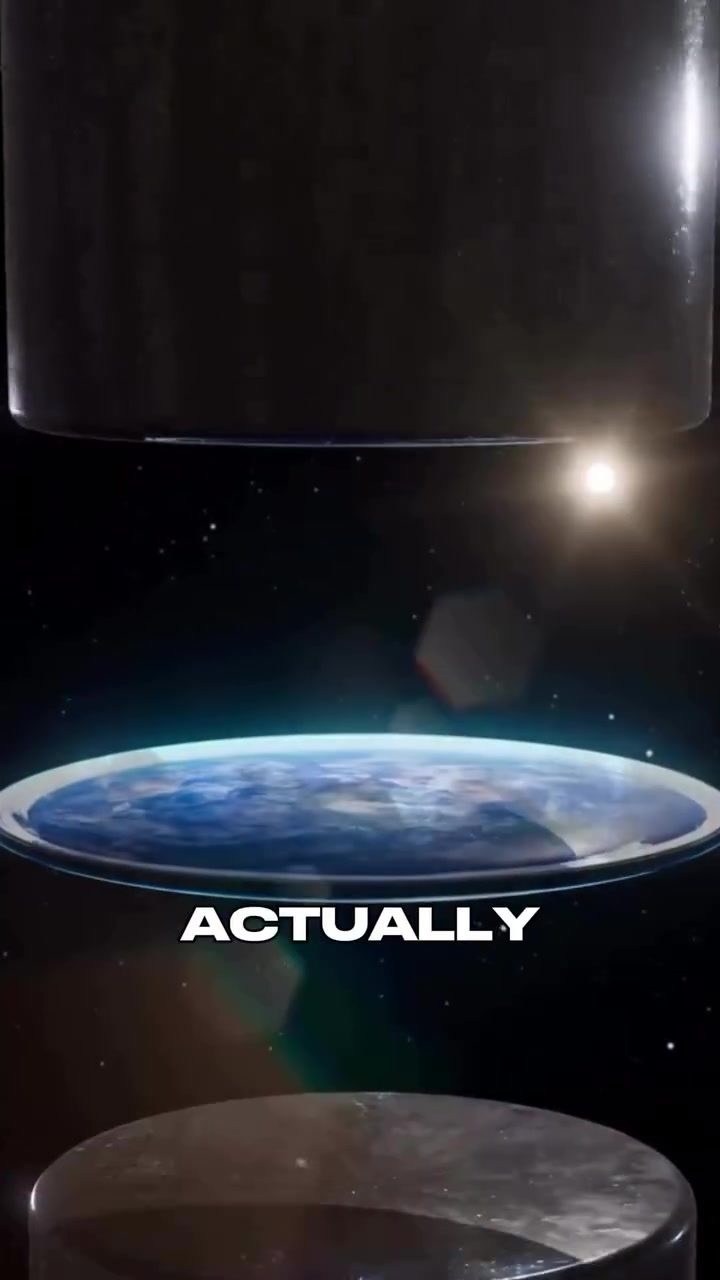
What Happens if Earth Was Flat?
Imagine a world where the Earth is flat. It's a question that has piqued human curiosity for centuries, but what would actually happen if our planet were a disc rather than a sphere? The consequences are far weirder than many might think.
Why This Matters
Understanding the implications of a flat Earth helps us appreciate the intricate balance of forces that make our planet habitable. Gravity, magnetic fields, and the movement of our molten core all play crucial roles in sustaining life. Exploring a hypothetical flat Earth scenario highlights the importance of these natural processes and the delicate equilibrium of our planet's structure.
Main Discussion
Gravity and a Flat Earth
On a spherical Earth, gravity pulls uniformly from every point on the surface. This consistent pull is what keeps us grounded and allows for the smooth rotation of the planet. However, on a disc-shaped Earth, gravity would behave differently depending on your location. In the center, gravity would pull you straight down, but as you move toward the edges, it would pull you down and sideways. This shift would have profound effects on the landscape and the distribution of water.
All the ocean water would be pulled toward the center, creating a massive pool in the middle of the Earth. Trees and other vegetation would grow diagonally, fighting against the sideways pull of gravity. Reaching the outer edges would feel like climbing a never-ending mountain, as the gravitational pull would make it increasingly difficult to move upward.
The Molten Core
A flat Earth would lack the internal layers that are present in our spherical planet. The movement of the molten liquid core is responsible for generating the Earth's magnetic field, which protects us from harmful cosmic radiation. Without this magnetic field, we would be exposed to deadly radiation, making life on Earth impossible.
The orientation of a flat Earth would also affect day and night cycles. Depending on how the disc is positioned, there could be only day or only night, disrupting the natural rhythms that govern life on Earth. Lunar eclipses, which occur due to the alignment of the Earth, Moon, and Sun, would look drastically different and might not occur at all.
Cosmic Radiation and Magnetic Fields
The Earth's magnetic field is a critical shield that deflects cosmic radiation, shielding us from the harmful effects of space. On a flat Earth, this protective layer would be absent, leaving us vulnerable to radiation that would fry our planet. Cosmic radiation is a constant threat in space, and without the magnetic field, Earth would be a barren, inhospitable wasteland.
Practical Tips
While the idea of a flat Earth is fascinating, it's important to ground ourselves in reality. Understanding the science behind the Earth's structure can help dispel myths and misconceptions. Here are a few practical tips for engaging with scientific concepts:
- Stay Informed: Follow reliable sources and experts in the field of planetary science. Keep up with the latest research and discoveries to stay informed.
- Ask Questions: Don't be afraid to ask questions and seek answers. Scientific inquiry is about exploring the unknown and challenging assumptions.
- Use Models: Earth models and simulations can help visualize complex scientific concepts. They provide a tangible way to understand the forces at play on our planet.
Important Takeaways
- Gravity Behaviors Differently on a Flat Earth: The pull of gravity would change depending on your location, affecting the landscape and the distribution of water.
- No Magnetic Field: Without a molten core, there would be no magnetic field to protect us from cosmic radiation.
- Disrupted Day-Night Cycles: The orientation of a flat Earth would affect the natural rhythms of day and night, potentially disrupting life cycles.
- Lunar Eclipses Would Look Different: The alignment of celestial bodies would change, affecting the appearance and occurrence of lunar eclipses.
- Scientific Inquiry: Engaging with scientific concepts through models and simulations can deepen our understanding of the natural world.
Conclusion
The idea of a flat Earth is a thought-provoking exercise in understanding the forces that make our planet habitable. From gravity to magnetic fields and day-night cycles, the Earth's structure is a delicate balance of natural processes. By exploring these concepts, we gain a deeper appreciation for the complexity and beauty of our planet.
Questions readers ask
How would gravity function differently on a flat Earth?
On a flat Earth, gravity would not function as it does on a spherical Earth. Instead of pulling towards the center of the planet, it would pull sideways towards the edges. This would lead to a constant movement of objects and people towards the perimeter, creating unstable and dangerous conditions for any form of life. Mountains and valleys would form in a completely different way and could cause chaos.
What would happen to water and vegetation on a flat Earth?
Water would not form oceans, rivers, or seas as we know them. Instead, it would likely pool at the edges, leaving the center of the flat Earth dry. Vegetation would struggle to grow without the consistent water supply and the varied climate zones provided by a spherical Earth's axial tilt.
How would day and night work on a flat Earth?
Day and night cycles would be vastly different. The flat Earth model would require a different explanation for how the Sun and Moon would move across the sky. Many flat Earth models suggest that the Sun and Moon are spotlights that move in circles above the plane, which would create strange patterns of light and shadow. Additionally, the lack of a spherical shape would mean that there would be no consistent day and night cycle.
What would happen to the magnetic field on a flat Earth?
The Earth's magnetic field, which protects us from cosmic radiation, is generated by the movement of its molten core. On a flat Earth, this core would not exist, leaving the planet without a magnetic field. Without this protection, life would be exposed to deadly levels of radiation from space. This would make it extremely difficult for life to evolve and survive.
What would the center of a flat Earth be like?
The center of a flat Earth would be a unique and potentially inhospitable environment. With gravity pulling sideways towards the edges, the center might be relatively flat and featureless, with few natural landmarks. It would also be much colder than the edges, as the Sun's light would spread out over a larger area. Additionally, the lack of a molten core would mean that there would be no geological activity.
Related deep dives
Similar reads based on topic and creator.

Recent articles
Fresh deep dives from the latest Reels we unpacked.




Comments
Be the first to comment.