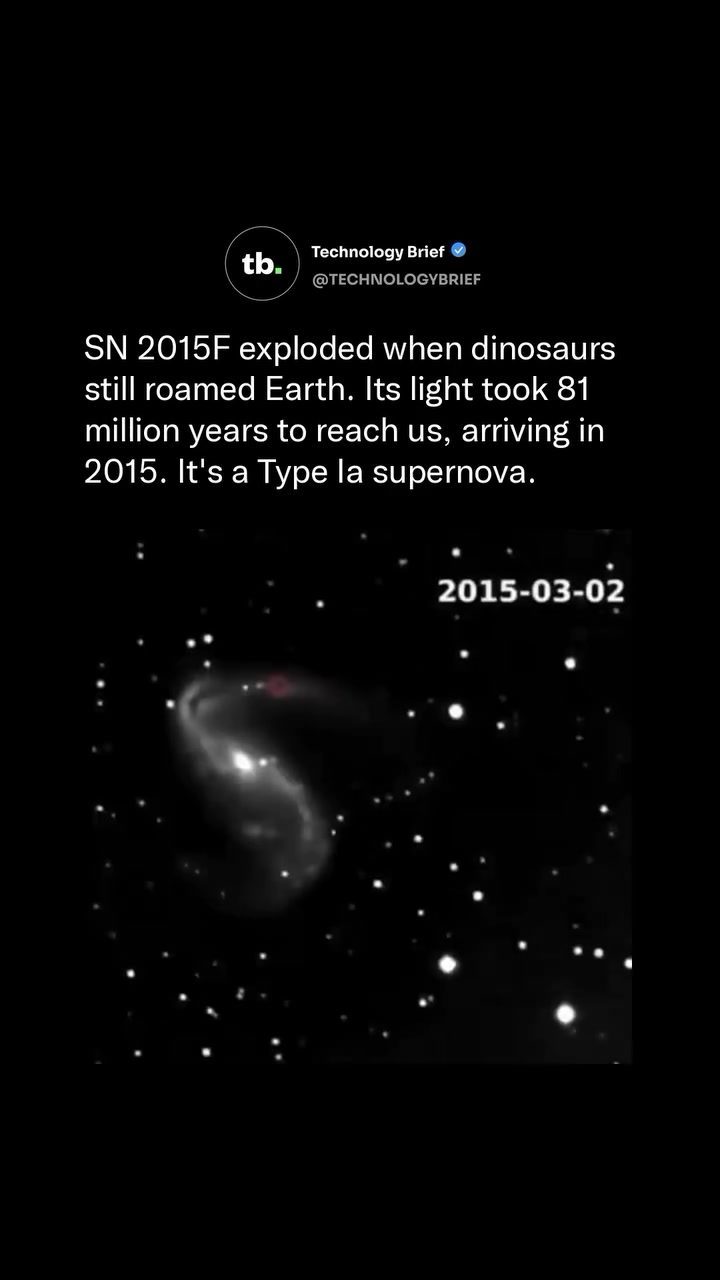
Supernova SN 2015F
Supernova SN 2015F is a Type Ia supernova that offered astronomers a rare glimpse into the cosmos, providing valuable insights into the universe's scale and the dynamics of stellar explosions.
Context/Why This Matters
Supernovas like SN 2015F are critical to our understanding of the universe. These powerful explosions occur when stars reach the end of their lives, and they release an enormous amount of energy. This energy can outshine entire galaxies and provide astronomers with a unique opportunity to study distant reaches of the cosmos. Specifically, Type Ia supernovas are known for their consistent peak brightness, making them reliable tools for measuring cosmic distances. This consistency allows astronomers to gauge the expansion rate of the universe and understand the role of dark energy and dark matter.
Main Discussion
Discovery and Timing
SN 2015F was discovered in March 2015 within the spiral galaxy NGC 2442, which is approximately 66 million light-years away from Earth. The supernova's actual explosion occurred around 66 million years ago, during the Cretaceous period when dinosaurs roamed the Earth. Despite the vast distance and the time elapsed, the light from this explosion finally reached Earth in 2015, making it visible to astronomers. The explosion was bright enough to be observed with a small backyard telescope, highlighting the accessibility of astronomical events to amateur and professional astronomers alike.
Type of Supernova
SN 2015F is a Type Ia supernova, which occurs when a white dwarf star, the dense remnant of a once-larger star, pulls in too much material from a nearby companion star. When the white dwarf reaches a critical mass, it triggers a runaway nuclear explosion, completely destroying the star. This type of supernova is unique because it always reaches nearly the same peak brightness, providing a standard candle for measuring cosmic distances. The consistency in brightness makes Type Ia supernovas invaluable in determining the scale of the universe and understanding its expansion.
Observational Timeline
Astronomers tracked SN 2015F closely from February to June 2015, capturing a time-lapse of the supernova as it grew from a faint point of light to a brilliant star within the NGC 2442 galaxy. This intensive observation period allowed scientists to study the supernova's evolution in detail. By analyzing how quickly it brightened and faded, researchers gained insights into the physics of stellar explosions. These observations are crucial for refining models of stellar evolution and understanding the underlying mechanisms of supernova explosions.
Astronomical Impact
The study of SN 2015F has contributed significantly to our understanding of supernova physics and the universe's expansion. Type Ia supernovas, like SN 2015F, are essential for cosmological measurements, helping astronomers map the universe's expansion rate and the influence of dark matter and dark energy. The bright light from these explosions allows for precise measurements, even at vast distances, offering a window into the early stages of the universe.
Practical Tips
How to Observe Supernovas
For amateur astronomers and enthusiasts, observing supernovas can be a rewarding experience. While SN 2015F was visible with a small backyard telescope, many supernovas require more advanced equipment. Here are some tips for observing supernovas:
- Equipment: Investing in a good-quality telescope with a motorized mount will help you track celestial objects more accurately. A camera designed for astrophotography can also capture supernova images for further analysis.
- Location: Choose a dark sky location away from city lights to minimize light pollution. Clear, dark skies enhance visibility and provide better conditions for observing faint objects.
- Timing: Plan your observation sessions during new moon phases, as the absence of lunar light will make it easier to see fainter stars and supernovas.
Data Collection
If you're serious about studying supernovas, consider participating in amateur astronomy projects. Organizations like the American Association of Variable Star Observers (AAVSO) often collaborate with amateur astronomers to collect data on supernovas and other celestial events. Contributing your observations to such projects can enhance your knowledge and provide valuable data to professional astronomers.
Important Takeaways
The study of supernova SN 2015F underscores the importance of these celestial events in understanding the universe. Key points to remember:
- Timing and Distance: The light from SN 2015F took 81 million years to reach Earth, highlighting the vast distances and timescales involved in astronomical observations.
- Type Ia Supernovas: These supernovas provide consistent brightness, making them valuable for measuring cosmic distances and understanding the universe's expansion.
- Observational Techniques: Tracking supernovas over time provides insights into stellar explosions and helps refine models of stellar evolution.
- Amateur Involvement: With the right equipment and technique, amateur astronomers can contribute to significant astronomical discoveries.
Conclusion
The discovery of SN 2015F and the subsequent observations have enriched our understanding of the cosmos. By studying these powerful events, astronomers gain valuable insights into the physics of stellar explosions and the scale of the universe. Amateur astronomers can also play a crucial role in this ongoing exploration, contributing to projects that advance our knowledge of the cosmos. Whether through detailed observations or community participation, the study of supernovas continues to unfold the mysteries of the universe, one explosion at a time.
Questions readers ask
What is Supernova SN 2015F and why is it significant?
Supernova SN 2015F is a Type Ia supernova that erupted 81 million years ago. It is significant because it occurred in the dinosaur era, and its light has traveled across the universe to reach us, providing valuable insights into the scale of the universe and the dynamics of stellar explosions. Additionally, its consistent peak brightness aids in measurements of cosmic distances.
How does Supernova SN 2015F help in understanding dark matter and dark energy?
Type Ia supernova SN 2015F aids in understanding dark matter and dark energy due to its consistent peak brightness. This allows astronomers to measure cosmic distances accurately and map the expansion of the universe. By studying the redshift of light from such distant supernovae, scientists can infer the presence and effects of dark matter and dark energy.
When did Supernova SN 2015F take place, and why is the timing important?
Supernova SN 2015F exploded 81 million years ago, during the Cretaceous period when dinosaurs roamed the Earth. The timing is important because the supernova's light has traveled for millions of years, providing a snapshot of the universe's past and aiding in the calculation of cosmic distances.
Where did Supernova SN 2015F occur, and how does this location impact its study?
Supernova SN 2015F occurred in a distant galaxy named NGC 2442. Since this galaxy is around 81 million light-years away, we are observing the supernova as it appeared 81 million years ago. This distance offers astronomers a unique view into the past and helps in understanding how the universe has evolved over time.
What are some uses of Type Ia supernovae in astronomy?
In astronomy, Type Ia supernovae like SN 2015F are used as standard candles for measuring cosmic distances. They are particularly useful for mapping the expansion of the universe and studying the effects of dark matter and dark energy. Their consistent peak brightness allows for accurate measurements of distance and expansion rates.
How does the explosion of a Type Ia supernova like SN 2015F compare to other types of supernovae?
Type Ia supernovae like SN 2015F are distinct from other types, such as core-collapse supernovae, because they occur in binary star systems and involve the explosion of a white dwarf star. Type Ia supernovae are known for their consistent peak brightness, making them reliable tools for measuring cosmic distances, unlike other supernovae which can vary greatly in their peak luminosity.
What can we learn from the light of Supernova SN 2015F that reached Earth?
The light from Supernova SN 2015F that reached Earth offers a glimpse of the universe 81 million years ago. By studying this light, astronomers can gain insights into the dynamics of stellar explosions, the expansion rate of the universe, and the roles of dark matter and dark energy. Furthermore, the timing of the light's arrival helps in calibrating our understanding of cosmic distances.
Related deep dives
Similar reads based on topic and creator.


Recent articles
Fresh deep dives from the latest Reels we unpacked.




Comments
Be the first to comment.