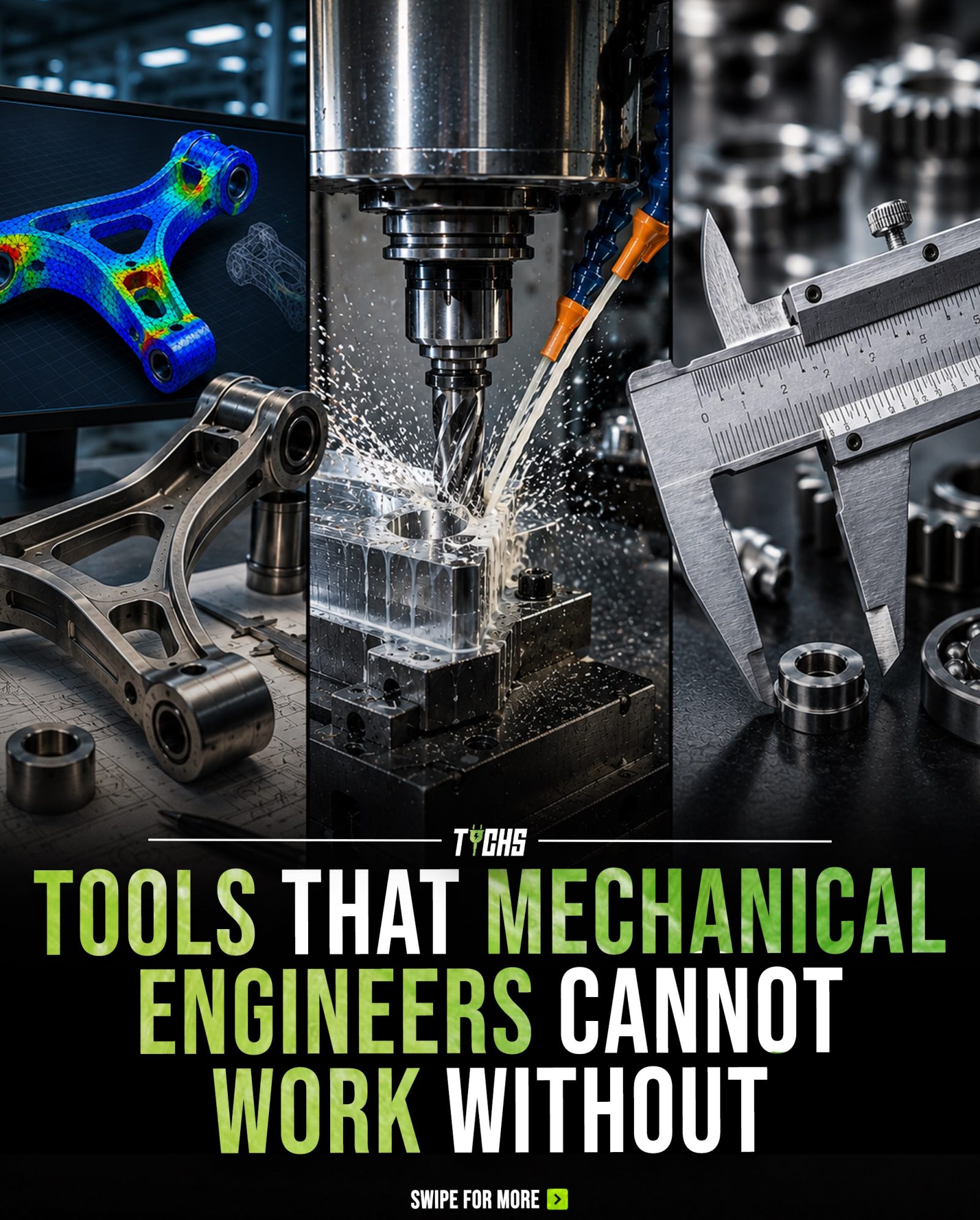
Mechanical engineering is all about precision. The tools used by mechanical engineers every day are essential for measuring, designing, testing, and manufacturing components with incredible accuracy. These tools form the backbone of modern engineering and manufacturing. From Vernier calipers and micrometers that measure tiny dimensions to CNC machines, CAD software, and FEA simulations that create complex products, these instruments ensure that components perform exactly as intended.
Tools That Mechanical Engineers Cannot Work Without
Mechanical engineers rely on a variety of specialized tools to achieve precision in their work. These tools range from simple measuring instruments to advanced machining equipment and software. Some of the most essential tools include:
Precision Measuring Tools
Precision measuring tools are crucial for ensuring that components meet exact specifications. These tools include:
- Vernier calipers: Used to measure the distance between two opposite sides of an object with high accuracy.
- Micrometers: Essential for measuring small distances and thicknesses with extreme precision.
- Feeler gauges: Used to measure small gaps and clearances in mechanical assemblies.
Machining Equipment
Machining equipment is used to shape and cut materials to precise dimensions. Some of the key tools in this category are:
- Drills and milling machines: Used for creating holes and shaping materials.
- Lathes: Used for turning large pieces of material into more precise shapes.
- CNC Machines: Computer Numerical Control (CNC) machines automate the machining process, ensuring high precision and repeatability.
3D Modeling and Simulation
Virtual tools like 3D modeling and simulation software are indispensable in the engineering design process. These tools allow engineers to:
- Create virtual prototypes of mechanical components before manufacturing.
- Perform Finite Element Analysis (FEA) to simulate how parts will behave under various conditions.
- Identify and correct design errors early in the process, which is far cheaper than finding errors in a factory.
Software Tools
Software tools are essential for designing, analyzing, and managing engineering projects. Key software tools include:
- CAD Software (e.g., SolidWorks): Used for creating 3D models and 2D drawings of mechanical components. The software helps in visualizing the design and ensuring that all components fit together correctly.
- FEA Simulation Software (e.g., ANSYS): Used to simulate the behavior of mechanical components under various conditions, ensuring that they perform as intended.
The Importance of Proper Torque
Torque wrenches are an essential tool for tightening bolts to the correct specification. Every critical bolt in a mechanical assembly has a specified torque value. Using a torque wrench ensures that bolts are tightened to the correct specification, preventing both damage from excessive force and failures from insufficient force.
Ensuring Component Integrity
Proper torque is essential for ensuring the integrity and reliability of mechanical assemblies. Using a torque wrench to tighten bolts to the correct specification helps in:
- Preventing component damage: Excessive force can break components, leading to failures and leaks.
- Ensuring reliability: Insufficient force can cause bolts to loosen over time, leading to failures and leaks.
The Engineering Design Process
The engineering design process involves a series of steps that engineers follow to create new products and improve existing ones. This process typically includes:
- Concept Development: Identifying the need for a new product or improvement in an existing one.
- Design: Creating detailed drawings and 3D models of the product.
- Prototyping: Building a physical model of the product to test its functionality and identify any design flaws.
- Testing: Conducting tests to ensure that the product meets the required specifications and performs as intended.
- Manufacturing: Producing the product in large quantities for distribution.
Tools and Processes in the Engineering Design Process
Engineers use a variety of tools and processes to design the world around us. These tools and processes include:
- Precision Measuring Tools: Ensuring that components meet exact specifications.
- Machining Equipment: Shaping and cutting materials to precise dimensions.
- 3D Modeling and Simulation Software: Creating virtual prototypes and simulating how parts will behave under various conditions.
- CAD Software: Designing and visualizing mechanical components.
- FEA Simulation Software: Analyzing the behavior of mechanical components under various conditions.
Practical Tips for Mechanical Engineers
Here are some practical tips for mechanical engineers to ensure precision and reliability in their work:
Use the Right Tools
Always use the right tools for the job. Precision measuring tools, machining equipment, and software tools are essential for ensuring that components meet exact specifications and perform as intended.
Follow Proper Protocols
Follow proper protocols for using tools and equipment. This includes using a torque wrench to tighten bolts to the correct specification and performing regular maintenance on tools and equipment.
Use 3D Modeling and Simulation
Use 3D modeling and simulation software to create virtual prototypes and identify design errors before manufacturing. This helps in saving time and money by correcting errors early in the process.
Important Takeaways
Precision is the cornerstone of mechanical engineering. The tools and processes used by engineers are essential for ensuring that components perform exactly as intended. By using the right tools, following proper protocols, and leveraging 3D modeling and simulation, engineers can create reliable and efficient mechanical components.
Key Points
- Precision measuring tools, machining equipment, and software tools are essential for mechanical engineers.
- Proper torque is crucial for ensuring the integrity and reliability of mechanical assemblies.
- The engineering design process involves a series of steps, including concept development, design, prototyping, testing, and manufacturing.
- Using 3D modeling and simulation software helps in identifying design errors early in the process, saving time and money.
Conclusion
Mechanical engineering is a field that demands precision and reliability. The tools and processes used by mechanical engineers are essential for creating components that perform as intended. By understanding the importance of precision, following proper protocols, and leveraging the right tools, engineers can design and manufacture reliable mechanical components. Whether designing aircraft, engines, robots, or industrial machinery, the tools and processes involved in mechanical engineering are the foundation of modern manufacturing and technology.
Questions readers ask
What are Vernier calipers and how are they used in mechanical engineering?
Vernier calipers are precision measuring instruments used to accurately determine the dimensions of an object. They consist of a main scale and a sliding Vernier scale, allowing for measurements down to a fraction of a millimeter. Mechanical engineers use them to measure the diameter, depth, and thickness of various components with high accuracy.
How do micrometers contribute to precision in mechanical engineering?
Micrometers are instruments designed for precise measurements, typically used for measuring the thickness or diameter of small components. They offer high accuracy and are ideal for tasks requiring measurements within a small range. Micrometers are essential in quality control and ensuring that manufactured parts meet the required specifications.
What role do CNC machines play in the manufacturing process for mechanical engineers?
CNC (Computer Numerical Control) machines are automated tools that use pre-programmed software to control the movement of cutting tools. They ensure high precision and consistency in manufacturing, allowing for the creation of complex parts with tight tolerances. CNC machines are widely used for tasks such as milling, turning, and drilling, making them indispensable in modern manufacturing.
How does CAD software aid in the design process for mechanical engineers?
CAD (Computer-Aided Design) software allows mechanical engineers to create precise 2D and 3D models of components and assemblies. Tools like SolidWorks enable engineers to visualize designs, perform simulations, and generate detailed technical drawings. CAD software enhances the efficiency and accuracy of the design process, making it easier to iterate and refine designs before production.
What are torque wrenches and why are they important in mechanical engineering?
Torque wrenches are tools used to apply a specific amount of torque to fasteners, ensuring they are tightened to the correct specification. This prevents over-tightening, which can cause damage, or under- tightening, which can lead to component failure. In mechanical engineering, torque wrenches are crucial for maintaining the integrity and safety of assembled components.
How do FEA simulations benefit the mechanical design process?
FEA (Finite Element Analysis) simulations allow engineers to analyze the behavior of mechanical components under various conditions, such as stress, heat, and vibration. By simulating real-world scenarios, engineers can identify potential failure points and optimize designs. This process helps in creating more reliable and efficient components, reducing the need for physical prototypes and iterative testing.
What are some key features of SolidWorks that make it beneficial for mechanical design?
SolidWorks is a powerful CAD software widely used in mechanical engineering for its robust 3D modeling capabilities, simulation tools, and comprehensive design libraries. It allows engineers to create detailed models, perform stress analysis, and generate accurate drawings and bill of materials. Additionally, SolidWorks supports collaboration and integration with other engineering tools, enhancing the overall design and manufacturing workflow.
Recent articles
Fresh deep dives from the latest Reels we unpacked.




Comments
Be the first to comment.