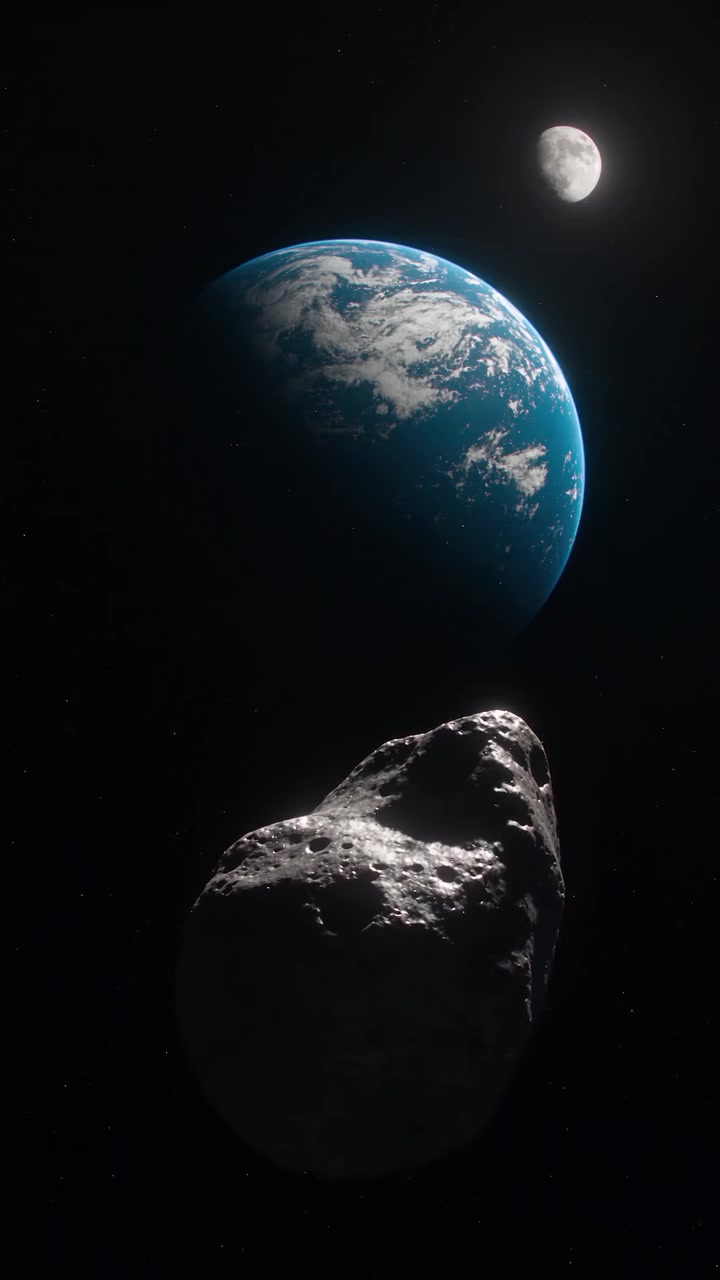
The Wobbling Satellite Called Kamoʻoalewa
Earth has a second moon. Kamoʻoalewa is about the size of a football field, it’s been orbiting us for a century, and 2027 will be the year we find out if it’s a chunk of our first moon. Okay, formally named Kamoʻoalewa, it's a true wobbler. The ratio of its orbit is 1:1 with Earth (meaning it completes a lap for every lap Earth takes around the Sun), and yet it loops, winding around us in a slower, more unpredictable dance. Some call it a quasicompanion or a quasi-satellite. Its roots could be traced from the young crater Giordano Bruno on the far side of the Moon. It might be a planetesimal, but there could be another explanation. Kamoʻoalewa only reflects light as Moon rock. A probe from China’s Tianwen-2 mission, launched in 2025, is anticipated to return with samples in 2027. The probe's work includes collecting these samples from Kamoʻoalewa. Kamoʻoalewa’s wobbly, distant orbit presents a challenge, so it’s not a straightforward task.
Spotting Kamoʻoalewa: A Century of Discovery
Speaking from the public interest, Kamoʻoalewa's discovery in 2016 fell to the Pan-STARRS1 survey in Hawaii. It was hard to spot. It took years of scanning the skies to detect it. Recalling the fascinating discovery, few noticed it before. Once spotted, scientists were curious to learn about its origins. The Pan-STARRS1 survey was crucial for monitoring these occultations. Further research found that it had been orbiting with Earth for a long time, so it's a true companion. Its existence seems crucial in the history of space exploration. Many science enthusiasts are closely following this story. In 2027, if it's a piece of the Moon, Tianwen-2 will help us learn more about the Moon’s history around Earth.
The Truth About Kamoʻoalewa
Mysteries of the second moon
Kamoʻoalewa measurement, made in 2021, presents another mystery. Its spectral data were not consistent with an asteroid's, but a lunar rock's. The connection to the Giordano Bruno impact crater on the Moon’s far side strengthens the idea that Kamoʻoalewa was blasted off the lunar surface.
How Kamoʻoalewa Moves
An artist’s rendition of Kamoʻoalewa’s path around Earth orbits similarly to that of an asteroid. It moves into space, resembling a typical asteroid’s path rather than the moon's. Gravity pulls it back into the Earth-Moon system's gravitational dance. It won't break away from Earth anytime soon, although its orbit appears to change as it travels, the Moon’s gravity affects it. This dance in Earth’s orbit seems stable. It’s stable for a hundred years—and counting.
How Human Artifacts Could Do More
The Tianwen-2’s mission to Kamoʻoalewa in 2025 and 2027 will give us new information about our celestial bodies. Kamoʻoalewa relates to Earth and Moon. The probe will offer us an opportunity to explore origins of celestial bodies while studying the composition of such bodies. The information from the probe could also add to Earth's history.
Catalyzing the Space Exploration
Kamoʻoalewa's discovery surpasses a simple exciting story. It provides lessons in astrophysics. The probe that follows up on this story will further our space exploration efforts. We’ll learn from its orbit, movement, and composition. This story has a potential to add more insight and drive us to wonder about the wonders of our universe and the beginning of life. We might find new ways to look at space. An enormous reservoir of resources could fuel rocket propulsion. A cosmic body like the moon could make travel through celestial bodies more possible.
What to Watch
Full episodes on YouTube from @DeepPlanetTV.
Questions readers ask
What exactly is Kamoʻoalewa and how was it discovered?
Kamoʻoalewa is a small celestial body, roughly the size of a football field, that orbits Earth. It was discovered in 2016 by the Pan-STARRS1 survey in Hawaii after years of sky scanning. Its orbit is unique, making it a quasi-satellite or quasicompanion to Earth.
How does Kamoʻoalewa's orbit differ from that of the Moon?
Unlike the Moon, which has a stable, predictable orbit, Kamoʻoalewa's orbit is more wobbly and less predictable. It completes a lap around Earth for every lap Earth takes around the Sun, but its path is slower and more erratic, looping around Earth in a complex dance.
What is the significance of the Tianwen-2 mission to Kamoʻoalewa?
The Tianwen-2 mission, launched by China in 2025, aims to collect samples from Kamoʻoalewa and return them to Earth by 2027. This mission is significant because it will help us determine the origins of Kamoʻoalewa and potentially provide new insights into the history of the Moon and Earth.
Why do some scientists believe Kamoʻoalewa might be a piece of the Moon?
Spectral data from Kamoʻoalewa indicates that it reflects light similarly to Moon rock, not an asteroid. Additionally, its potential origin is traced back to the Giordano Bruno impact crater on the far side of the Moon, suggesting it could be a chunk ejected from the lunar surface.
How stable is Kamoʻoalewa's orbit around Earth?
Kamoʻoalewa's orbit is considered stable for at least a hundred years. Its path is influenced by Earth and the Moon’s gravity, but it won't break away from Earth anytime soon. It will remain in a complex, wobbly dance with our planet.
Related deep dives
Similar reads based on topic and creator.



Recent articles
Fresh deep dives from the latest Reels we unpacked.




Comments
Be the first to comment.