The Inner Core and Earth's Mysterious Timeshift
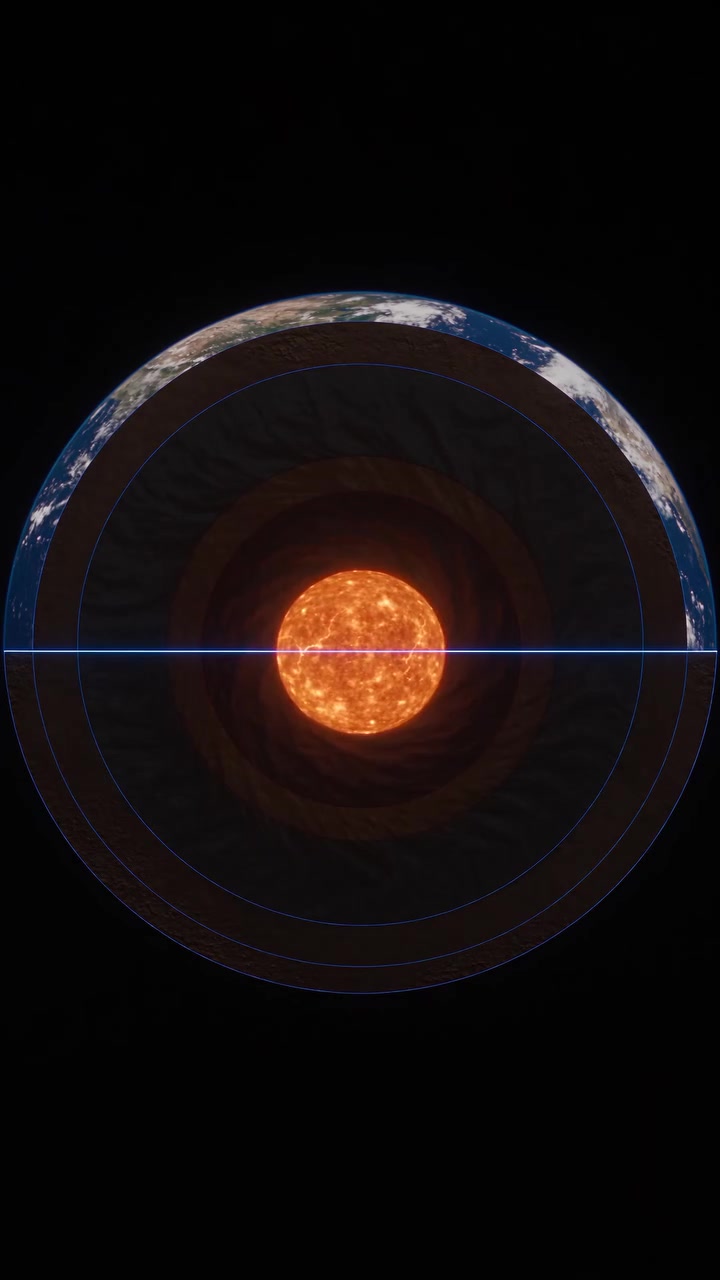
Four thousand miles below us, Earth's inner core, a solid iron ball nearly the size of the moon, spins at its own rhythm. Around 2010, it changed that rhythm, spinning slower for a while. This isn't unusual. The inner core can turn faster or slower than the planet as a whole, and what's more, this happened before, in the 1970s. This change in rhythm, known as a swing, shifts your day by a thousandth of a second, too small a change for human senses to detect. Yet this natural phenomenon captures our imagination with a mesmerizing and mysterious edge.
The Inner Core: A Mysterious and Unreachable World
Earth's inner core is the densely packed, solid iron ball at Earth's center. Earth's liquid outer core, also made of molten iron, surrounds it. How do we know something so unreachable is solid if it is unreachable? The evidence comes from earthquakes. Earthquakes send seismic waves through the Earth, which travel at different speeds through different materials. Scientists analyze these waves to understand what lies beneath the surface. When waves pass through the inner core, they behave as if it is a solid object. It is the inner core's density, and solid nature that accounts for Earth's protective shield for life. The inner core is hotter than the sun's surface, estimated to reach temperatures of about 5,400 degrees Celsius. Its surface is constantly churning, creating a magnetic field that extends beyond Earth's surface. The magnetic field protects the planet from harmful solar radiation and helps maintain a stable climate.
The Rhythm of the Earth
This solid iron ball in the planet's interior spins at its own rhythm, independent of the planet's rotation. Earthquakes repeatedly sending waves through the inner core highlights how the core changes its direction of spin. In 2009, the waves stopped changing speed, indicating that the extra spin had paused. This marks a swing in the core's rotation every 70 years. It happened in the 1970s and it just happened in 2010. We know seismic waves travel at different speeds through different materials, so by observing a change in the speed of the waves, scientists can infer a change in the inner core. Scientists have been able to track this swing in the core's movement thanks to a phenomenon called sub seismic surface waves. These are waves caused by repeated earthquakes at the same spot, such as those that occur near the South Pacific.
The Inner Core and Time
The inner core's rhythm has changed the length of the Earth day by a thousandth of a second. Since the rotation of Earth is 24 hours, this time difference is minuscule. The inner core's repeating pattern has no effect on Earth's rotation. However, scientists are still exploring how these rhythmic changes affect the Earth's surface. The Earth's rotation is affected by many factors, including the gravitational pull of other celestial bodies and the distribution of mass within the Earth. To add to that, the inner core’s variable spin is responsible for the variations in the length of the day. The Earth's rotation slows down and speeds up due to the core's own rhythm.
The Impact on the Surface and the History of This Discovery
This is a phenomenon that should already happen somewhere in our solar system. So if it is happening, it must be having some effects. Scientists are using sensitive instruments to detect the inner core's motion. “Earth’s solid iron inner core spins on its own axis. In 2009, the inner core did something strange, reversing the spin that had continued for about a decade. At this point, pioneering experiments are necessary to understand the rotation and its effects.
Understanding the Mysterious Rhythm
While the changes in the inner core's angle are unknown and a mystery, scientists are researching the effects of different elements in Earth's core. Geologists are also aware of potential hazards. The inner core’s variable volume could change the Earth’s magnetic field. Such changes would force us to reconsider global protective measures.
Where to Learn More
If you're ready to dive deep into Earth's fascinating interior, there's plenty more to explore. DeepPlanetTV's educational videos offer a deeper understanding of the Earth's layers and the mysteries of the inner core for anyone looking to learn more about our planet's inner workings.
Questions readers ask
What exactly causes the Earth’s inner core to change its spin rhythm?
The exact cause of the inner core's spin changes is still a topic of scientific investigation. However, it's known that the inner core's spin is influenced by the complex dynamics of the liquid outer core, which is made of molten iron. The interaction between the solid inner core and the liquid outer core creates a magnetic field, which in turn affects the inner core's spin. Scientists believe that the inner core's spin changes are part of a natural, long-term cycle, but the precise mechanisms are not yet fully understood.
How do scientists detect changes in the inner core's spin if it's so far beneath the surface?
Scientists use seismic waves generated by earthquakes to study the inner core. These waves travel through the Earth at different speeds depending on the material they pass through. By analyzing changes in the speed of these waves, scientists can infer changes in the inner core's spin. For instance, repeated earthquakes in the same location, such as those in the South Pacific, create sub-seismic surface waves that help track the inner core's movements.
What does the inner core’s spin change mean for life on Earth?
The inner core's spin change, which affects the length of the day by a tiny fraction of a second, has no significant impact on daily life. However, the inner core's spin and the resulting magnetic field are crucial for protecting life on Earth from harmful solar radiation. The rhythmic changes in the inner core's spin are part of the natural processes that help maintain Earth's habitable conditions, but they do not directly affect our daily experiences.
Can scientists predict when the next change in the inner core's spin will occur?
Based on historical data, scientists have observed that the inner core's spin changes roughly every 70 years. Since the last significant change occurred in 2010, the next change is expected around 2080. However, predicting the exact timing of these changes with precision is challenging due to the complex dynamics involved.
What role does the inner core play in the Earth's magnetic field?
The inner core, being a solid iron ball, interacts with the liquid outer core to generate the Earth's magnetic field. This magnetic field is crucial for protecting the planet from harmful solar radiation and maintaining a stable climate. The inner core's spin and its interaction with the liquid outer core create a dynamic magnetic field that extends beyond Earth's surface, shielding life on the planet.
What would happen if the inner core stopped spinning altogether?
If the inner core stopped spinning, it would have profound effects on the Earth's magnetic field, which is generated by the interaction between the inner and outer cores. A weakened or non-existent magnetic field would leave the Earth vulnerable to harmful solar radiation, potentially leading to significant changes in the atmosphere and climate. However, this scenario is purely hypothetical, as the inner core's spin is part of a natural and long-established cycle.
How does the inner core's spin affect the length of a day on Earth?
The inner core's spin affects the length of a day by a tiny fraction of a second, specifically by about a thousandth of a second. This change is so minuscule that it is undetectable to human senses. The Earth's rotation is influenced by various factors, including the gravitational pull of other celestial bodies and the distribution of mass within the Earth, but the inner core’s variable spin is responsible for the small variations in the length of the day.
Related deep dives
Similar reads based on topic and creator.



Recent articles
Fresh deep dives from the latest Reels we unpacked.




Comments
Be the first to comment.