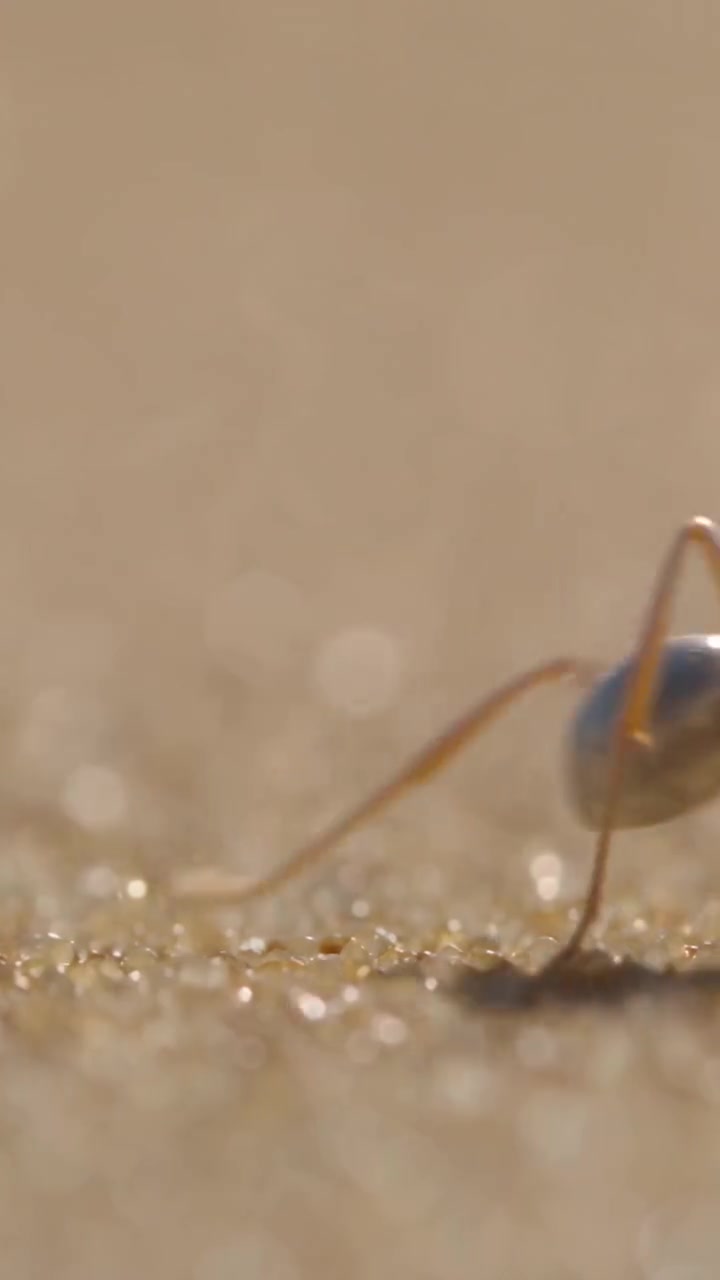
Heat Beating Ants
In the scorching desert, where temperatures soar above 60 degrees Celsius during the peak hours, most creatures seek shelter. But not the Cataglyphis, an ant species capable of withstanding extreme heat. Instead of hiding, these ants opportunistically emerge amidst the day’s harshest conditions to hunt insects killed by the sun. The Cataglyphis ant is a tiny predator irrespective of its larger pile on the ground. They possess a unique reflective coat of glassy triangular hairs that serve as natural sun shields. These hairs allow the ant to reflect sunlight and emit heat, cooling it internally by up to 10 degrees. This ingenious mechanism enables the ant to forage at the hottest part of the day, while cooler mornings and evenings are reserved for more sedentary pursuits.
Harnessing an Ecosystem Niche
The presence of Cataglyphis ants highlights the desert’s harsh realities and the foraging opportunities afforded by specific survival traits. The ants create a cycle of life and death. They prey on insects that can’t survive the heat. Food supply dictates an ant's moment to hunt, then hide before the sun’s heat scorches their organic matter again. This ant’s survival is part of a broader pattern. During peak heat, lizards have to retreat, giving "the ant that runs at noon" a few minutes a day to safely forage. The ant emerges from the colony's depths to forage for a brief period. In the desert, timing is crucial. The ants’ movement is rapid—108 body lengths per second. This speed is equivalent to a human moving at 700 kilometers per hour. By comparison, a cheetah can only reach 16 times its body length in a second. Such speed enables the ants to evade predators, locate food, and return to the shelter of their underground colonies.
The Ant's Adaptation
The ant's chief adaptation is speed. Their speed allows them to travel long distances in short periods, which is crucial given that ants never travel alone. These ants require frequent food sources to support their colonies, and their speed affords them a greater range.
An Ecosystem of Heat and Speed
Creatures in the desert are bound by the inexorable march of the sun. The Cataglyphis ant embodies the elegance of survival in the harshest conditions. They exploit a brief window of time, exploiting their extreme speed to move across the blazing sands, foraging efficiently before retreating to the safety of their underground colonies.
How to Witness these Incredible Creatures
Wildlife enthusiasts and desert explorers looking to witness Cataglyphis ants in action will find their best opportunities during the hours where sand heats past 60°C. These ants are active from the moment the sun reaches its peak to a few minutes past. The key is patience. These ants travel through the sand in a blink of an eye. These are tiny creatures when compared to mainstream life lifeforms—102 body lengths per second. This speed will allow them to avoid predators and escape the heat before the sun scorches them to death.
- Find a desert environment: Cataglyphis ants live in harsh, hot desert environments, so look for sandy, sun baked regions.
- Time it right: Watch during the hottest part of the day, when temperatures soar above 60°C.
- Bring binoculars or a camera with zoom: These ants are small, so magnification will help you observe their movements and behavior.
Why Watch
Getting outdoors and watching animals in their habitats grants a sense of awe. Spotting Cataglyphis ants for such a short window is an opportunity to understand the wonders of our ecosystems and biodiversity.
The Ants' World: Larger Than They Seem
The most powerful thing about watching these ants is understanding that even the smallest creatures forge essential roles in their ecosystems. These ants contribute to the desert cycle of death and life. They are a part of the desert’s system in ways few vertebrates are. Their ability to harness speed and evade predators in the harshest environments makes them true marvels of nature.
Questions readers ask
What exactly makes the Cataglyphis ant so resilient to extreme heat?
The Cataglyphis ant has a couple of key adaptations that help it withstand extreme desert heat. Firstly, it has a unique reflective coat of glassy triangular hairs that act as natural sun shields, reflecting sunlight and emitting heat to cool the ant internally by up to 10 degrees. Secondly, these ants are incredibly fast, moving at speeds that allow them to forage efficiently and return to their colonies before the heat becomes lethal.
How do Cataglyphis ants manage to hunt in the desert heat when other creatures can’t?
Cataglyphis ants are able to hunt in the desert heat by opportunistically emerging during the hottest part of the day to prey on insects that can't survive the extreme temperatures. They have a unique reflective coat that helps them manage the heat, and their incredible speed allows them to forage quickly and efficiently before retreating to the safety of their underground colonies.
How fast are Cataglyphis ants, and why is their speed important?
Cataglyphis ants can move at speeds of up to 108 body lengths per second, which is equivalent to a human moving at 700 kilometers per hour. This speed is crucial for their survival as it allows them to evade predators, locate food, and return to their colonies quickly, especially given the brief window of opportunity they have during the peak heat.
Do Cataglyphis ants have any predators, and if so, how do they avoid them?
While the article doesn't specify the predators of Cataglyphis ants, their incredible speed of 108 body lengths per second is a key adaptation that helps them evade predators. This speed allows them to quickly move across the desert, locate food, and return to the safety of their underground colonies before predators can catch them.
What role do Cataglyphis ants play in the desert ecosystem?
Cataglyphis ants play a significant role in the desert ecosystem by creating a cycle of life and death. They prey on insects that can't survive the extreme heat, helping to maintain the ecosystem's balance. Their foraging activity also provides food for other creatures and contributes to the overall health of the desert environment.
Can Cataglyphis ants be found in other environments besides deserts?
Cataglyphis ants are specifically adapted to live in harsh, hot desert environments. Their unique adaptations, such as their reflective coat and incredible speed, are tailored to survive in the extreme heat of deserts. Therefore, it is unlikely that they can be found in other environments, such as forests or grasslands.
Related deep dives
Similar reads based on topic and creator.
Recent articles
Fresh deep dives from the latest Reels we unpacked.
Comments
Be the first to comment.