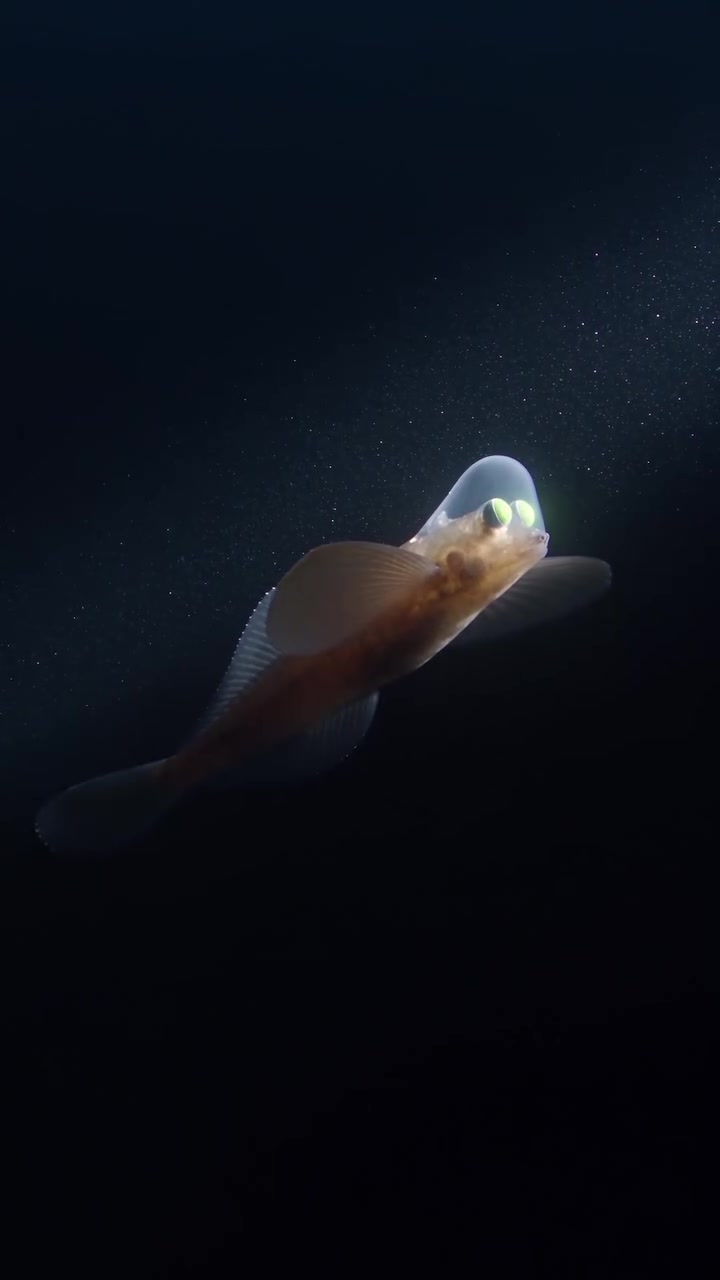
A fish lives 700 meters (2,300 feet) below the sea with a see-through head. Its eyes, trapped in a dome, face upward to catch the faint light from above. The fish snags prey, swiping from stinging jellies, its eyes protected by the dome. This fish is a barreleye fish, Macropinna microstoma, found in the deep sea. Its translucent head surrounds two green eyes inside a clear dome. The dome is connected to the fish's hunting style, allowing it to look upward for shadows of prey while drifting motionlessly in the water. The dome of the barreleye fish is a salient feature, reflecting a stunning adaptation to its environment. It points to the depths of the ocean, where the "twilight zone" (mesopelagic region) of 200-1,000 meters (650-3,300 feet) has only about 1% of the sunlight reaching the surface. This is also the region where light from above is visible, and the eyes of the barreleye fish are especially sensitive to this faint light, with high numbers of photoreceptor cells. This helps explain the discovery that when the eyes of the living barreleye fish were filmed, the eyes rolled forward inside the dome, toward its food, for hunting purposes. The barreleye fish shines a spotlight on ocean exploration. Before robot cameras could film them alive, scientists depended on dead specimens that crushed the dome, leaving their discovery obscure. The images from the robot cameras on the 2004 Monterey Bay Aquarium Research Institute's (MBARI) expedition reveal the barreleye, watching its environment with its eyes behind the dome and spots of the face that serve as nostrils.
The Evolution of Deep-Sea Adaptations
The barreleye fish boasts an unmistakable dome that supports its hunting technique. The dome itself is about the size of the barreleye’s head, which is only about 60 centimeters in length. The dome protects the fish's eyes from the stings of jellies, which it steals from, and helps the fish to spot prey in the near-darkness. The dome is also proportionate enough to allow for the fish's survival. Biologists stayed quiet for 60 years about the barreleye fish, which had been mistaken for a odd-looking squid or octopus when specimens were first collected in 1939. The real biological eyes of the barreleye are in the dome, while the other spots on the fish's head, which were found to be nostrils, were initially misidentified as eyes.
The Deep Sea Mystery
The barreleye fish is one of the few creatures that has its two green eyes sitting inside a clear dome and look straight up through its own skull. Scientists learned that when the green eyes were spotted through a robot camera, the eyes rolled forward inside the dome, toward the food, a discovery that confirms the benefit of its specialized vision. Until 2004, the dome remained unknown. The onboard camera from an unmanned submersible revealed the fish’s unique optical mechanism: the two green eyes sit inside a transparent dome.
How it Works
Seeing in the Dark
The eyes of the barreleye fish are modified to detect the faintest light. The eye itself, a long, red, tube-like structure, detects light from its environment and allows the fish to see its prey. Its dome is especially sensitive to blue-green light, which penetrates the water to a depth of about 150 miles. The dome of the barreleye is a "window" that allows the fish to look for prey in the faint light. The real eyes are tubes, and for 70 years nobody knew the dome was there. The domes are attached to the top of the barreleye, which allows for seeing prey from above, and the eyes can move inside the dome to focus on food. This is a stunning adaptation for a fish that lives in the near-darkness of the deep sea, where it catches fish.
Moving Eyes
The ability of barreleyes to move their eyes is a fascinating feature. The eyes, although protected by a dome, can roll forward inside the dome toward food. This eye movement helps the fish to spotlight its prey and spot objects, such as jellyfish, in the near darkness. The movement also helps the fish to protect its eyes from predators, allowing it to quickly move its eyes away from danger to avoid being stunned.
No One to Compete With
The barreleye fish lives where sunlight cannot reach, at a depth of 700 meters. As a result of its evolution, the barreleye fish can detect the formidable predators that lurk in this darkness as prey. The few animals that venture to this depth are predators such as squid and jellyfish. The barreleye fish, with its unique body, can hunt from this depth, using its eyes to hunt prey in the near darkness. This adaptation helps the barreleye fish to steal from its food sources, such as jellyfish and other fish, without competition.
No Stings Allowed
The dome of the barreleye fish also serves as a form of protection. The dome keeps the stings of jellyfish off its eyes, which is especially useful because the barreleye fish is known to steal food from jellyfish. This opens up new hunting strategies to the fish, since the dome also helps the fish to catch prey. The dome is clear, yet large, and allows the fish to see through its skull and eyes to hunt prey. This is an adaptation that keeps the eyes of the barreleye safe, which helps the fish to spot prey in the near darkness.
Preparing for the Barreleye Deep Dive
An average traveler cannot go to 700 meters below the ocean. An underwater cage dive is the closest alternative, but even these are limited in depth. For a glimpse into the depths with a chance to see a deep-sea creature like the barreleye, a diver would need to use an underwater cage dive. A dive to the depth of 700 meters would be limited to a short dive, with no guarantee of seeing a barreleye. Deep-sea cages can be costly, particularly if the bait is not available. It is not yet possible for divers to purchase cage dives to 700 meters to see the barreleye fish. Divers can, however, look into ocean expeditions that travel to the twilight zone. These expeditions can be booked through companies that specialize in deep-sea exploration.
- Learn More: The information about the barreleye fish is constantly changing as more is learned about these unique creatures. Find out more about ocean exploration, the barreleye fish, and its adaptations and check out the DeepPlanetTV to explore the twilight zone for yourself. While visiting, pay attention to the on-screen @DeepPlanetTV and FULL EPISODES ON YOUTUBE text for a more detailed dive.
- Join an Expedition: Sign up for an ocean expedition to see the twilight zone for yourself. Check with reputable exploration companies to find out where to go for a deep-sea dive, starting at the depths of 200 meters, which is the top of the zone.
Questions readers ask
How does the barreleye fish use its see-through head for hunting?
The barreleye fish uses its see-through head, or dome, to protect its eyes and spot prey in the near-darkness of the deep sea. The dome allows the fish to look upward for shadows of prey while drifting motionlessly in the water, and its eyes roll forward inside the dome when hunting.
What makes the barreleye fish's eyes so special?
The barreleye fish's eyes are exceptionally sensitive to faint light, which is crucial in the deep sea where sunlight is scarce. They have a high number of photoreceptor cells and can roll forward inside the dome to focus on prey.
Why was the barreleye fish's unique feature unknown for so long?
Before 2004, scientists only had access to dead specimens, which had crushed domes. It wasn't until robot cameras filmed living barreleye fish that the true nature of their see-through head and unique optical mechanism was revealed.
How does the barreleye fish's dome help it survive in its environment?
The dome protects the barreleye fish's eyes from stings of jellies, which it often steals from, and helps it spot prey in the near-darkness. It also allows the fish to look upward for prey while remaining motionless in the water.
What is the 'twilight zone' and how does it relate to the barreleye fish?
The 'twilight zone,' or mesopelagic region, is the part of the ocean between 200 and 1,000 meters deep, where only about 1% of sunlight reaches. The barreleye fish lives in this zone, and its eyes are adapted to detect the faint light available there.
What was the misconception about the barreleye fish's anatomy?
When specimens were first collected in 1939, the spots on the barreleye fish's head were misidentified as eyes. It was later discovered that these spots are actually nostrils, and the true eyes are inside the clear dome.
Is it possible to see a barreleye fish in an aquarium?
As of now, it’s highly unlikely to see a barreleye fish in an aquarium. These fish live in extreme deep-sea conditions that are difficult to replicate in captivity. Additionally, their delicate dome structure makes them challenging to keep alive outside their natural habitat.
Related deep dives
Similar reads based on topic and creator.

Recent articles
Fresh deep dives from the latest Reels we unpacked.

Comments
Be the first to comment.