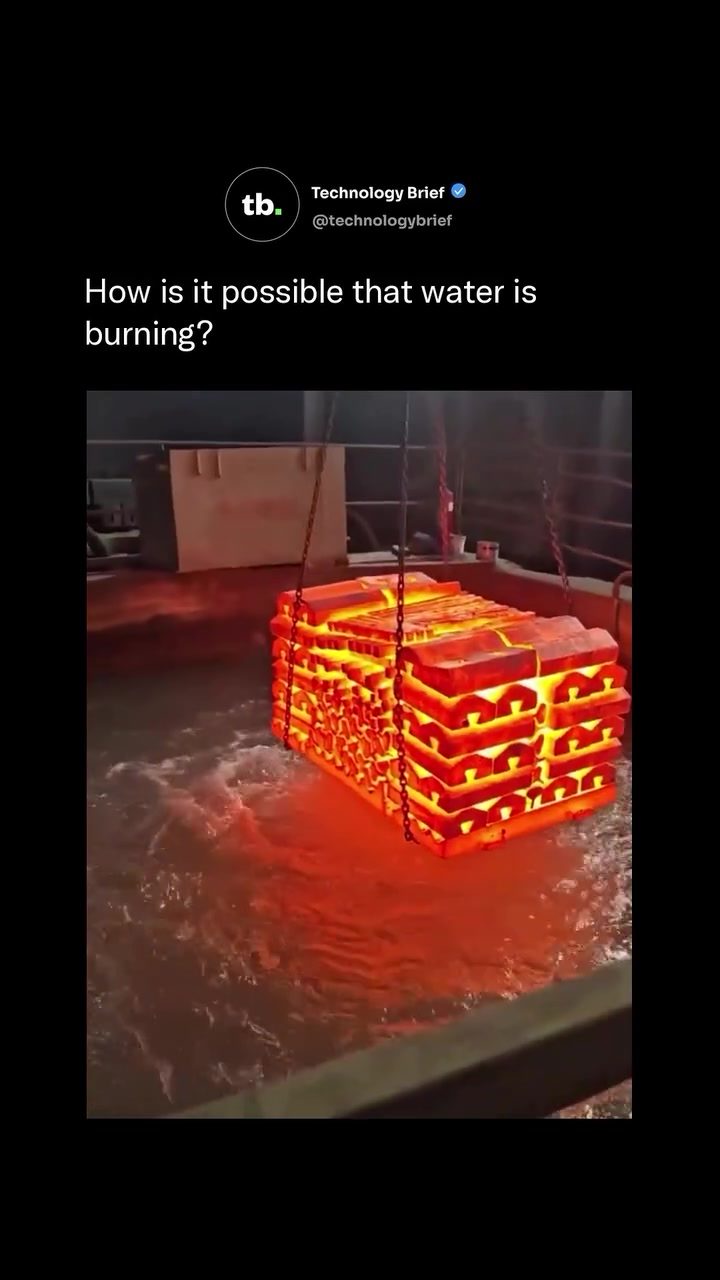
Burning Water: The Science of Quenching in Steel Manufacturing
The phenomenon of "burning" water is actually a crucial process in steel manufacturing known as quenching. This technique has been used for centuries to dramatically alter the properties of steel, making it harder, stronger, and more wear-resistant. Let's dive into the fascinating science behind this process.
Context: Why This Matters
Steel is one of the most widely used materials in the world, integral to construction, transportation, and countless other industries. The properties of steel—its strength, hardness, and durability—are determined by its internal structure, which can be manipulated through various manufacturing processes. Quenching is one such process that plays a pivotal role in enhancing steel's performance.
The Science of Quenching
The process of quenching involves rapidly cooling red-hot metal by plunging it into a liquid, typically water. This sudden temperature change causes the water to flash into steam, creating a spectacular and intense explosion of bubbles and mist. This violent reaction isn't just for show; it has a profound impact on the steel’s internal structure.
The Role of Water in Quenching
Water is the most aggressive quenching medium, producing the fastest cooling rate. This rapid cooling is essential for achieving the desired properties in high-carbon steels, which require maximum hardness. When the hot metal is submerged in water, the extreme temperature difference forces the metal's atoms into a tight formation, converting the phase known as austenite into a much harder phase called martensite. This transformation is what gives the final steel its enhanced hardness and strength.
Historical Significance
The technique of quenching dates back centuries, with ancient blacksmiths discovering that dunking red-hot metal in water made it harder. This empirical knowledge preceded any scientific understanding of the process, highlighting the ingenuity of early metallurgists.
How Quenching Works
Quenching involves several key steps and factors that contribute to its effectiveness in altering the properties of steel.
The Cooling Process
When a glowing-hot metal ingot, heated to around 850°C or higher, is plunged into water, the extreme temperature difference causes the water to instantly flash into steam. This rapid cooling locks the metal’s atoms into a tight formation, converting a phase called austenite into a much harder phase called martensite.
Rapid Cooling and Phase Transformation
The rapid cooling rate of quenching is critical for the phase transformation. When steel is heated to high temperatures, its crystalline structure changes to austenite, which is a face-centered cubic (FCC) structure. As the steel cools rapidly, the atoms do not have time to rearrange into a more stable, but softer, structure. Instead, they form martensite, a body-centered tetragonal (BCT) structure that is much harder and stronger.
Practical Tips for Effective Quenching
While quenching is a relatively straightforward process, there are several practical tips to ensure it is carried out effectively.
Choosing the Right Quenching Medium
Different quenching media can be used, including water, oil, and polymer solutions. Water is the most aggressive and produces the fastest cooling rate, making it ideal for high-carbon steels. Oil and polymer solutions, on the other hand, provide a slower cooling rate, which is suitable for steels that require less hardness and are less prone to distortion.
Preheating the Quenching Medium
Preheating the quenching medium can help reduce the risk of thermal shock and cracking. This is particularly important for large or complex-shaped parts. The preheating temperature should be carefully controlled to ensure it does not compromise the quenching effectiveness.
Ensuring Uniform Cooling
Uniform cooling is essential to prevent distortion and cracking. This can be achieved by using agitation or circulation of the quenching medium. Agitation helps to remove the layer of vapor that forms around the hot metal, ensuring continuous contact with the liquid and uniform cooling.
Monitoring the Cooling Rate
The cooling rate is a critical factor in determining the final properties of the steel. Monitoring the cooling rate can help ensure that the steel achieves the desired hardness and strength. This can be done using thermocouples or other temperature-monitoring devices placed within the quenching medium.
Important Takeaways
Quenching is a fundamental process in steel manufacturing that dramatically enhances the material's properties. By rapidly cooling hot metal, quenching converts the austenite phase into the harder martensite phase, resulting in steel that is significantly harder, stronger, and more wear-resistant.
Understanding the science behind quenching and the factors that influence its effectiveness is crucial for anyone involved in steel manufacturing or metallurgy. Whether you are a seasoned professional or a curious enthusiast, grasping the principles of quenching can provide valuable insights into the innovative techniques used to create high-performance materials.
Conclusion
The illusion of burning water is a fascinating demonstration of the quenching process, a critical step in steel manufacturing. This ancient technique has evolved over centuries, driven by the need to enhance the properties of steel. By understanding the science behind quenching and the practical considerations involved, we can appreciate the ingenuity and innovation that go into creating the materials that shape our world.
Questions readers ask
What is quenching in steel manufacturing?
Quenching is a heat treatment process in steel manufacturing where red-hot steel is rapidly cooled, typically using water. This process alters the metal's internal structure, making it harder, stronger, and more durable. It has been a key technique in steel production for centuries, enhancing the material's properties for various industrial applications.
How does water quenching work in the steel hardening process?
Water quenching involves submerging heated steel into water, causing it to cool rapidly. This sudden cooling prevents the formation of softer phases, instead promoting the creation of harder, more durable phases within the metal's structure. This rapid steel cooling is what gives quenched steel its enhanced hardness and strength.
What are the benefits of quenching in steel making?
Quenching in steel making offers several benefits. It increases the steel's hardness and durability, making it more resistant to wear and tear. Additionally, it enhances the steel's strength, which is crucial for applications in construction and transportation. This process also improves the steel's resistance to deformation under stress.
What happens if the quenching process is not done correctly?
If the quenching process is not performed correctly, such as if the cooling rate is too slow or uneven, it can lead to issues like warping, cracking, or the formation of undesirable microstructures. This can result in steel that is either too brittle or not hard enough, compromising its performance in industrial applications.
Can other liquids be used for quenching metal besides water?
Yes, while water is commonly used due to its efficiency and availability, other liquids such as oil or polymers can also be used for quenching metal. These alternatives may be chosen based on the specific requirements of the steel and the desired cooling rate, as they can provide different cooling speeds and effects on the steel's microstructure.
What factors influence the effectiveness of the quenching process?
Several factors influence the effectiveness of the quenching process, including the type of steel, its initial temperature, the quenching medium used, and the design of the quenching setup. For instance, some steels may require a faster cooling rate to achieve the desired hardness, while others may be more sensitive to thermal shock and require a more controlled cooling process.
Recent articles
Fresh deep dives from the latest Reels we unpacked.




Comments
Be the first to comment.