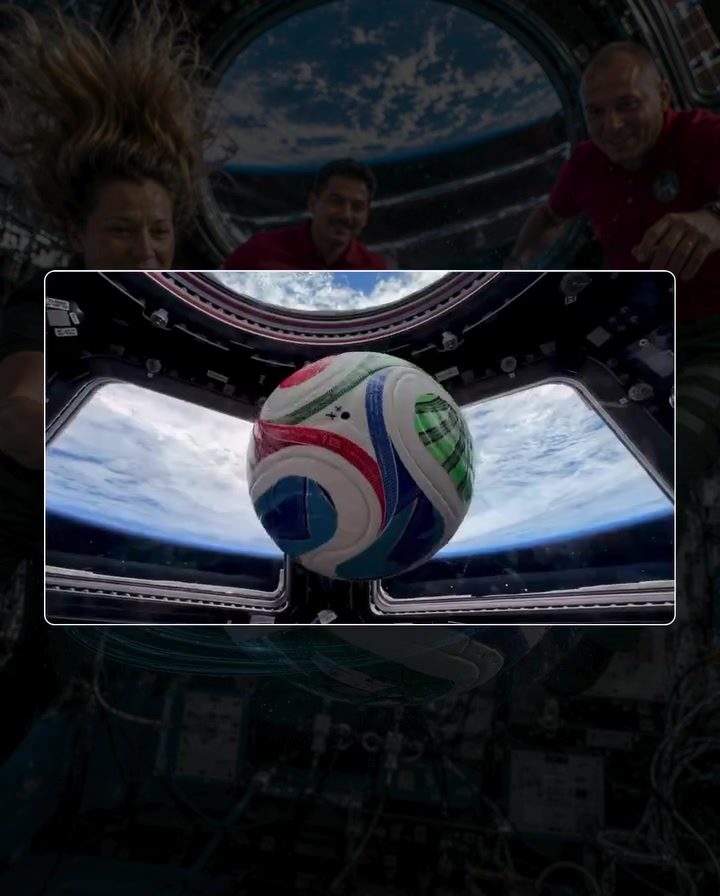
International Space Station Life and Its Impact on Sports Technology
Life on the International Space Station (ISS) is not just about conducting scientific experiments in microgravity. It is a unique environment where everyday activities take on a new dimension. Astronauts live and work in a floating laboratory, conducting experiments that are impossible to replicate on Earth. This environment, characterized by weightlessness, offers a unique perspective on how technology can be innovated and tested in ways that benefit various industries, including sports.
Why This Matters
The collaboration between NASA and Adidas highlights the synergy between space science and sports engineering. By testing smart World Cup balls in microgravity, researchers aim to refine the technology that could revolutionize the way football is played. This convergence of disciplines is not just about pushing the boundaries of what is possible in sports but also about understanding how aerospace research can enhance the performance and consistency of sporting equipment.
The Convergence of Space and Sports
NASA's Contributions to Football Technology
NASA has been at the forefront of aerodynamics research for decades. Their studies have explored how different ball designs influence movement through the air. This expertise was leveraged to test the smart ball systems developed by Adidas for the World Cup. The sensors embedded in these balls collect detailed match data, providing insights into how the added technology affects flight characteristics.
The Role of the ISS
The ISS provides an ideal setting for testing football technology. The microgravity environment allows researchers to study the dynamics of the ball in a way that is not possible on Earth. This unique condition helps in understanding the impact of the sensors and other technological enhancements without the interference of gravity. The results from these tests can be used to fine-tune the ball's design, ensuring that it maintains optimal performance during matches.
Adidas' Smart Ball Technology
Adidas has equipped World Cup balls with built-in sensors that collect detailed match data. This innovation is part of a broader trend in sports technology, where data analytics is becoming increasingly important. The sensors can track the ball's trajectory, spin, and other critical parameters, providing teams with valuable information that can be used to improve their strategies and performance.
Main Discussion
The Benefits of Microgravity Testing
Testing in microgravity offers several advantages. For one, it eliminates the effects of gravity, allowing researchers to focus solely on the aerodynamics of the ball. This can reveal how the sensors and other technological enhancements affect the ball's flight without the usual gravitational pull.
Technological Advancements in Sports
The integration of smart sensors in sports equipment is a significant leap forward. These sensors provide real-time data that can be used to improve the accuracy, consistency, and performance of the equipment. In the case of the World Cup balls, the data collected can help in designing future balls that perform better under various conditions.
The Future of Sports Engineering
As football technology becomes increasingly advanced, insights from aerospace research could play a crucial role in shaping future innovations. The collaboration between NASA and Adidas is a testament to how different fields can come together to drive technological progress. The data collected from the ISS can be used to develop more accurate and consistent smart balls, benefiting the game at all levels.
Practical Tips for Sports Engineers
For engineers and researchers in the sports industry, the collaboration between NASA and Adidas offers valuable insights. Here are some practical tips to consider:
- Leverage Interdisciplinary Research: Look beyond your field for innovative solutions. Collaboration with aerospace researchers can provide unique perspectives and technological advancements.
- Utilize Microgravity Environments: Where possible, test your innovations in environments that simulate or replicate microgravity conditions. This can provide insights that are not possible on Earth.
- Collect and Analyze Data: Use sensors and other data-collecting tools to gather detailed information about your equipment. This data can be used to fine-tune performance and improve future designs.
- Focus on Aerodynamics: Understand how different designs affect the movement of your equipment. This knowledge is crucial for creating more accurate and consistent products.
Important Takeaways
- Space science and sports engineering are converging to drive technological advancements. The collaboration between NASA and Adidas is a prime example of how different fields can come together to innovate.
- Microgravity testing offers unique advantages. It allows researchers to focus on aerodynamics without the interference of gravity, providing valuable insights into the performance of sports equipment.
- Smart sensors are revolutionizing sports technology. The data collected from these sensors can be used to improve the accuracy, consistency, and performance of sports equipment, benefiting players and teams at all levels.
Conclusion
The International Space Station (ISS) is more than just a research laboratory in orbit. It is a place where cutting-edge technology is tested and refined, pushing the boundaries of what is possible. The collaboration between NASA and Adidas to test World Cup ball technology in microgravity is a fascinating example of how space science and sports engineering can come together to shape the future of sports. As we continue to innovate and explore, the possibilities for technological advancements in sports are endless.
Questions readers ask
What is the purpose of testing smart footballs on the ISS?
Astronauts are testing smart footballs on the ISS to leverage the unique conditions of microgravity. This testing aims to improve the performance and technology of the footballs, which could lead to advancements in how they function during games on Earth.
How does microgravity affect football testing?
In microgravity, the behavior of the football changes significantly due to the absence of weight. This allows researchers to study the ball's movements, aerodynamics, and other factors in a way that is not possible on Earth, potentially leading to new insights and improvements.
What kind of technology is being tested in the smart footballs?
The smart footballs developed by Adidas include advanced sensors and tracking technology. These technologies help gather data on the ball's movement, spin, and trajectory, which can be used to enhance the overall performance of the equipment.
Why is NASA collaborating with Adidas on this project?
NASA's collaboration with Adidas showcases the potential of space research to benefit other industries. By teaming up, NASA and Adidas are exploring how the unique environment of the ISS can drive technological advancements in sports, particularly in the development of smart footballs for the World Cup.
What are the potential benefits of this collaboration for future sports technology?
The insights gained from testing smart footballs in microgravity could lead to significant advancements in sports technology. These innovations could result in better-performing equipment, enhanced gameplay, and a deeper understanding of how to optimize athletic performance.
How do astronauts conduct these tests on the ISS?
Astronauts on the ISS perform these tests by following specific protocols that allow them to gather data on the footballs' behavior in microgravity. They use specialized equipment to track the ball's movements and collect data, which is then analyzed by researchers on Earth.
Related deep dives
Similar reads based on topic and creator.


Recent articles
Fresh deep dives from the latest Reels we unpacked.




Comments
Be the first to comment.