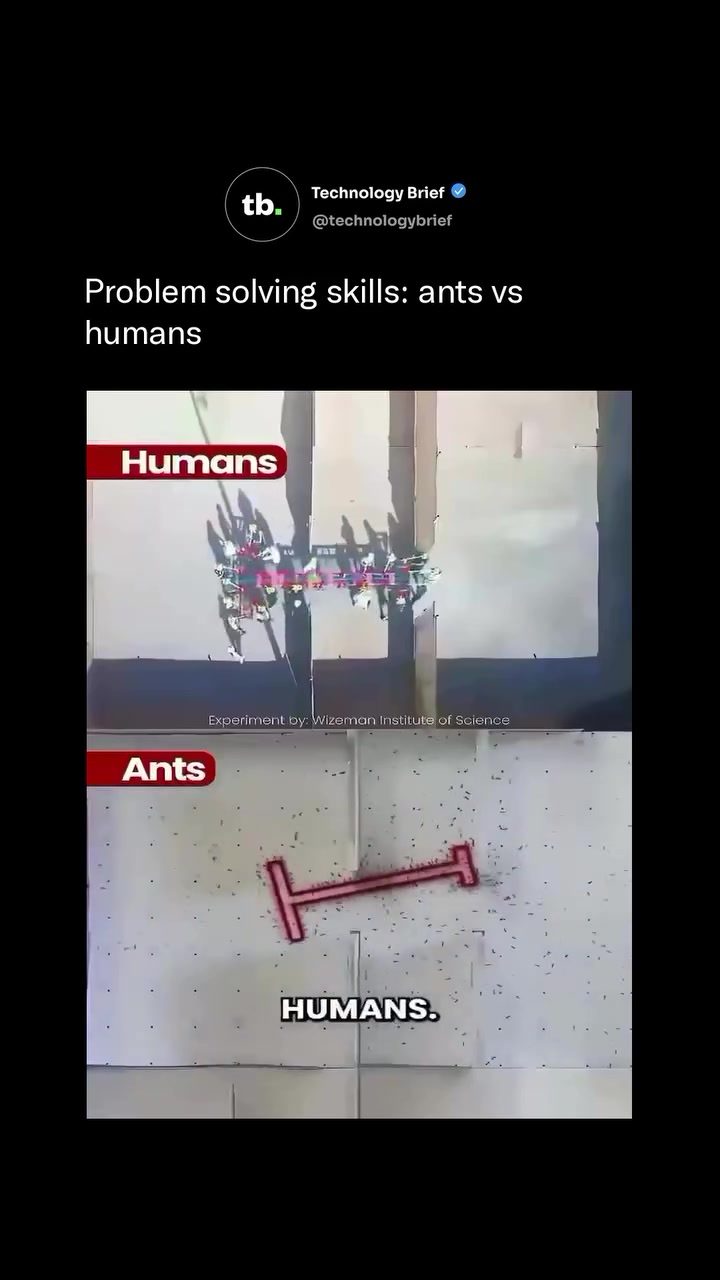
Problem-Solving Skills of Ants vs. Humans
Researchers at the Weizmann Institute of Science in Israel conducted a fascinating experiment comparing the problem-solving skills of humans and ants. The task: maneuvering a T-shaped object through a three-chamber maze. This setup, known as the "piano movers puzzle," was designed to test the collaborative problem-solving abilities of both species.
Context: Why This Matters
Understanding how different species solve problems can provide valuable insights into group dynamics, communication, and decision-making processes. This experiment highlights the strengths and weaknesses of human and ant behaviors in a group setting. The findings have implications for various fields, including robotics, artificial intelligence, and social science.
The Experiment: Setting and Rules
The experiment involved two primary participants: humans and longhorn crazy ants. The goal was to determine which species exhibited better problem-solving skills when working in groups. To ensure a fair comparison, human participants were not allowed to communicate verbally, use gestures, or rely on facial expressions. This constraint mimicked the limited communication methods available to ants, ensuring both groups operated under similar constraints.
The Task: Maneuvering the T-Object
Both humans and ants had to navigate a T-shaped object through a maze. This task required strategic planning and coordination. The maze was designed with three chambers, each presenting a unique challenge. The ants, known for their efficient and coordinated movements, demonstrated a more unified approach to the task.
The Findings: Ants vs. Humans
The results were surprising. While individual humans performed well, groups of humans struggled with what researchers referred to as a "greedy" approach. Each human participant tended to pull the object toward their preferred direction, leading to slower and less efficient progress. This behavior highlights individualistic tendencies within human groups, where personal preferences often override collective goals.
In contrast, ants acted more like a single, unified entity. The colony moved the object in a coordinated manner, pooling their efforts toward a shared path. This unified approach allowed the ants to complete the task more efficiently and effectively. The experiment showed that ants actually performed better in a group setting, exhibiting a kind of shared short-term memory that individual ants do not possess.
Group Dynamics and Collective Intelligence
The study revealed that ants get smarter as a group. Their collective intelligence allows them to develop strategies that individual ants cannot. This phenomenon is known as emergent behavior, where complex patterns and solutions arise from simple rules and interactions within a group.
The "Greedy" Pattern in Humans
The "greedy" approach observed in humans is a result of individual preferences and the lack of a unified strategy. Each person's desire to move the object in their own way leads to a chaotic and inefficient process. This behavior can be attributed to human nature, where personal goals and preferences often take precedence over collective objectives.
The Shared Goal of Ants
Ants, on the other hand, operate with a shared goal in mind. Their actions are driven by the collective well-being of the colony, rather than individual desires. This collective mindset allows them to coordinate their efforts more effectively, leading to better problem-solving skills in group settings.
Practical Tips for Humans
While ants may have the upper hand in this experiment, humans can learn valuable lessons from their behavior. The following tips can help improve collaborative problem-solving skills in human groups:
Foster a Shared Goal
Clearly define a shared goal and ensure that all participants understand and align with it. This helps to create a unified focus and reduces individualistic tendencies.
Encourage Communication
While the experiment restricted human communication, real-world settings should encourage open and effective communication. Clear and concise communication can help in coordinating efforts and avoiding the "greedy" approach.
Promote Collective Decisions
Encourage collective decision-making processes where all members have an equal say. This helps in creating a more inclusive and unified approach to problem-solving.
Implement Clear Roles
Assign clear roles and responsibilities to each member. This helps in maintaining a structured approach and reducing confusion, allowing the group to work more efficiently.
Important Takeaways
The experiment conducted by the Weizmann Institute of Science offers several important takeaways:
- Ants exhibit superior problem-solving skills in group settings due to their coordinated and unified approach.
- Human groups tend to fall into a "greedy" pattern, where individual preferences override collective goals.
- Collective intelligence and shared short-term memory play a crucial role in the ants' ability to solve problems more efficiently.
Conclusion
The comparison between ants and humans in problem-solving abilities highlights the strengths and weaknesses of both species. While humans may excel in individual tasks, ants demonstrate a more coordinated and efficient approach in group settings. Understanding these dynamics can provide valuable insights for improving collaborative problem-solving skills in various fields, from robotics to social science. By learning from the ants' collective intelligence and coordination, humans can enhance their group dynamics and achieve better outcomes.
Questions readers ask
How did the ants navigate the maze more efficiently than humans?
Ants navigated the maze by leveraging their strong sense of coordination and collective behavior. By working together, ants could efficiently manipulate the T-shaped object, pushing and pulling it in unison, while humans often struggled with this same task due to individualistic approaches and lack of synchronization.
What is the 'piano movers puzzle' and why was it used in the experiment?
The 'piano movers puzzle' involves maneuvering a T-shaped object through a maze, testing collaborative problem-solving. Researchers used it to compare how ants and humans handle complex tasks that require groupwork and coordination.
What can we learn about group dynamics from ants' problem-solving abilities?
Observing ants' problem-solving abilities reveals that their coordinated, collective efforts lead to efficient outcomes. This highlights the importance of teamwork, communication, and synchronized decision-making in tasks that require group collaboration.
How does the experiment relate to developments in technology and social science?
The findings of this experiment can offer insights into developing more effective AI and robotics, particularly in areas requiring collaborative problem-solving. It also provides a new perspective for social scientists studying human group dynamics and decision-making processes.
Why were ants and humans chosen for this experiment?
Ants and humans were chosen for their distinct approaches to problem-solving. Ants are known for their collective, coordinated behavior, while humans often rely on individualistic strategies. Comparing these two species offered a unique opportunity to examine different problem-solving methods.
What role does coordination play in ants' successful problem-solving?
Coordination is crucial for ants' problem-solving success. Their ability to work together seamlessly, with each ant contributing to the task at hand, allows them to overcome obstacles more efficiently. This coordinated effort is a significant factor in their performance in the maze navigation experiment.
How did the humans' individualistic approach affect their problem-solving in the experiment?
The humans' individualistic approach led to less efficient problem-solving. Without the same level of coordination and collective effort as the ants, human participants struggled to synchronize their actions, resulting in slower progress and less effective task completion.
Related deep dives
Similar reads based on topic and creator.




Recent articles
Fresh deep dives from the latest Reels we unpacked.




Comments
Be the first to comment.