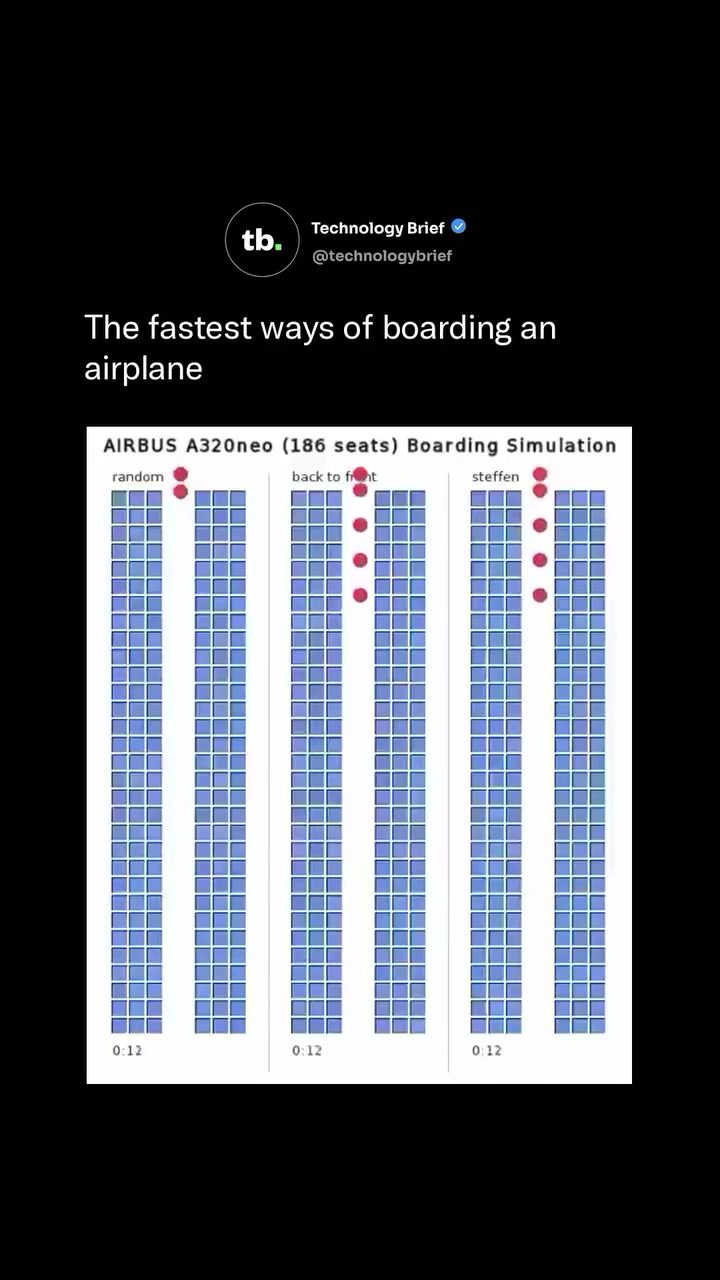
Airplane Boarding Techniques: Optimizing the Process
Airplane boarding times have significantly increased over the past few decades, with modern boarding times nearly tripling from around 15 minutes in the 1970s to as long as 40 minutes today. This has led to a greater focus on optimizing the boarding process, which has stimulated research into different boarding techniques. The simulation shows three of the most commonly discussed methods: random, back to front, and the Steffen Method.
Why This Matters
Efficient airplane boarding is crucial for several reasons. It affects the overall flight experience, reduce delays, and increase passenger satisfaction. For airlines, optimizing boarding times can lead to better operational efficiencies and reduce costs associated with delays. Additionally, more efficient boarding methods can help manage passenger flow, reduce congestion, and improve safety during the boarding process. With boarding times now lasting up to 40 minutes compared to the 15 minutes seen in the 1970s, there is a clear need for more efficient methods.
The AIRBUS A320neo: A Common Testbed
The Airbus A320neo, a popular narrow-body aircraft, is often used in studies and simulations due to its widespread use in commercial aviation. With a typical capacity of 186 passengers, it provides a practical context for evaluating different boarding methods. The simulation visualizes the boarding process on an Airbus A320neo, making it easier to compare various strategies.
The Random Boarding Method
Random boarding, as the name suggests, involves passengers boarding the plane in no particular order. The simulation illustrates how this method leads to congestion, especially at the entrance and in the aisles. Passengers often end up waiting for others to stow luggage or find their seats, leading to a slower overall process. The simulation indicates that random boarding can take up to 22 minutes and 21 seconds to complete.
The Back-to-Front Boarding Method
The back-to-front boarding method is commonly used by many airlines, despite its inefficiencies. Passengers are called to board in sections, starting from the back of the plane and moving forward. While this method aims to reduce congestion in the aisles, it often leads to bottlenecks at the entrance and near the front of the plane. In controlled experiments with 173 passengers, this method clocked in at over 24 minutes.
The Steffen Method
Developed by astrophysicist Jason Steffen in 2005, the Steffen Method is renowned for its efficiency. The key to this method is loading the window seats first in a leapfrog pattern, skipping every other row. This allows passengers to stow their luggage and sit down quickly, minimizing congestion in the aisles. After the window seats are filled, the process repeats for the middle seats and then the aisle seats. In a simulated 186-seat plane, this method finished boarding in just 11 minutes and 16 seconds, roughly half the time of the back-to-front method.
The WILMA Method
The WILMA (Window, then Middle, then Aisle) method is a middle-ground option. It involves boarding the window seats first across the entire cabin, followed by the middle seats and then the aisle seats. This method aims to balance the efficiency of the Steffen Method with the simplicity of the back-to-front approach. In simulations, WILMA cut boarding time to about 15 minutes, making it a viable alternative to both random and back-to-front methods. However, it is still slower than the Steffen Method.
Solving Bottlenecks in the Boarding Process
The boarding process is often slowed down by several factors, including:
- Luggage Stowage: Passengers taking time to stow their luggage in overhead bins can cause significant delays, especially in the aisles.
- Seating Assignments: Passengers with seats in the front of the plane may need to wait for those with seats in the back to board, leading to congestion.
- Passenger Behavior: Those who board early often take their time, leading to delays for others. This is exacerbated by passengers who use early boarding as a way to secure bin space for their luggage.
Practical Tips for Airlines and Passengers
For passengers:
- Efficient Luggage Stowage: If possible, stow your luggage under the seat in front of you. This can help keep the aisles clear and speed up the process.
- Board Quickly: Move to your seat as quickly as possible, and avoid lingering in the aisles.
For airlines:
- Implement Efficient Boarding Methods: Consider using the Steffen Method or WILMA method to reduce boarding times significantly.
- Train Staff: Ensure boarding staff are well-trained and can manage the process efficiently.
- Encourage Passengers to Board Quickly: Consider offering incentives for passengers who board quickly and efficiently.
- Use Technology: Implement technologies like self-boarding gates and mobile boarding passes to streamline the process.
Important Takeaways
Airplane boarding times have increased significantly over the years, and traditional methods like back-to-front boarding are often inefficient. The Steffen Method, which involves a leapfrog pattern for boarding, is the fastest scientifically tested method, reducing boarding times by approximately half. The WILMA method offers a middle-ground option, balancing efficiency and simplicity.
Despite the research, most airlines still rely on slower, zone-based boarding methods due to revenue from early boarding. However, adopting more efficient methods could lead to significant operational benefits and improved passenger satisfaction.
Conclusion
Optimizing airplane boarding times is a multifaceted challenge that involves understanding and mitigating various factors. By implementing more efficient boarding methods and encouraging passengers to board quickly, airlines can reduce boarding times and improve overall flight efficiency. The Steffen Method and WILMA method offer practical solutions, and their adoption could lead to significant improvements in the boarding process. It is clear that a more efficient boarding process is essential for enhancing the overall travel experience.
Questions readers ask
What are the most common airplane boarding methods?
The most common airplane boarding methods include random boarding, back-to-front boarding, and the Steffen Method. Random boarding allows passengers to board in any order, while back-to-front boarding assigns passengers seats from the back of the plane to the front. The Steffen Method uses a specific sequence to optimize passenger flow.
How does the Steffen Method work and is it the fastest airplane boarding method?
The Steffen Method involves boarding passengers in a specific sequence based on their seat numbers, allowing for a smooth and orderly flow. While it is one of the most efficient, whether it is the fastest can depend on various factors, such as passenger behavior and the specific layout of the airplane.
What impact does airplane boarding time have on overall flight efficiency?
Longer boarding times can lead to increased delays, reduced passenger satisfaction, and higher operational costs for airlines. By optimizing boarding times, airlines can improve overall flight efficiency, ensure timely departures, and enhance the passenger experience.
Why is it important to consider airplane boarding techniques?
Considering different boarding techniques is crucial for airlines to identify the most effective methods for their specific needs. This can help in reducing boarding times, improving passenger flow, and ensuring a safe and orderly boarding process. Additionally, it can lead to better utilization of resources and cost savings.
How does the airplane boarding simulation help in understanding efficiency?
Airplane boarding simulations allow researchers and airlines to test different boarding methods in a controlled environment. This helps to identify bottlenecks, optimize passenger flow, and determine the most efficient boarding techniques for real-world application. Simulations can provide insights into factors like passenger behavior and aircraft layout.
Can boarding passengers by rows improve efficiency?
Boarding passengers by rows can improve efficiency by reducing the likelihood of passengers blocking the aisle while others wait. However, the specific efficiency gained can depend on the row assignments and the overall boarding strategy. Some methods, like the Steffen Method, incorporate row-based boarding for optimal results.
What are the benefits of efficient airline boarding for passengers?
Efficient airline boarding can lead to a more pleasant travel experience for passengers, with smoother and faster boarding processes. This reduces wait times, minimizes stress, and allows passengers to settle in their seats more quickly, enhancing overall satisfaction and comfort during the flight.
Related deep dives
Similar reads based on topic and creator.




Recent articles
Fresh deep dives from the latest Reels we unpacked.




Comments
Be the first to comment.