AI/ML Engineer Interview Guide 2026: Focus on the System Layer
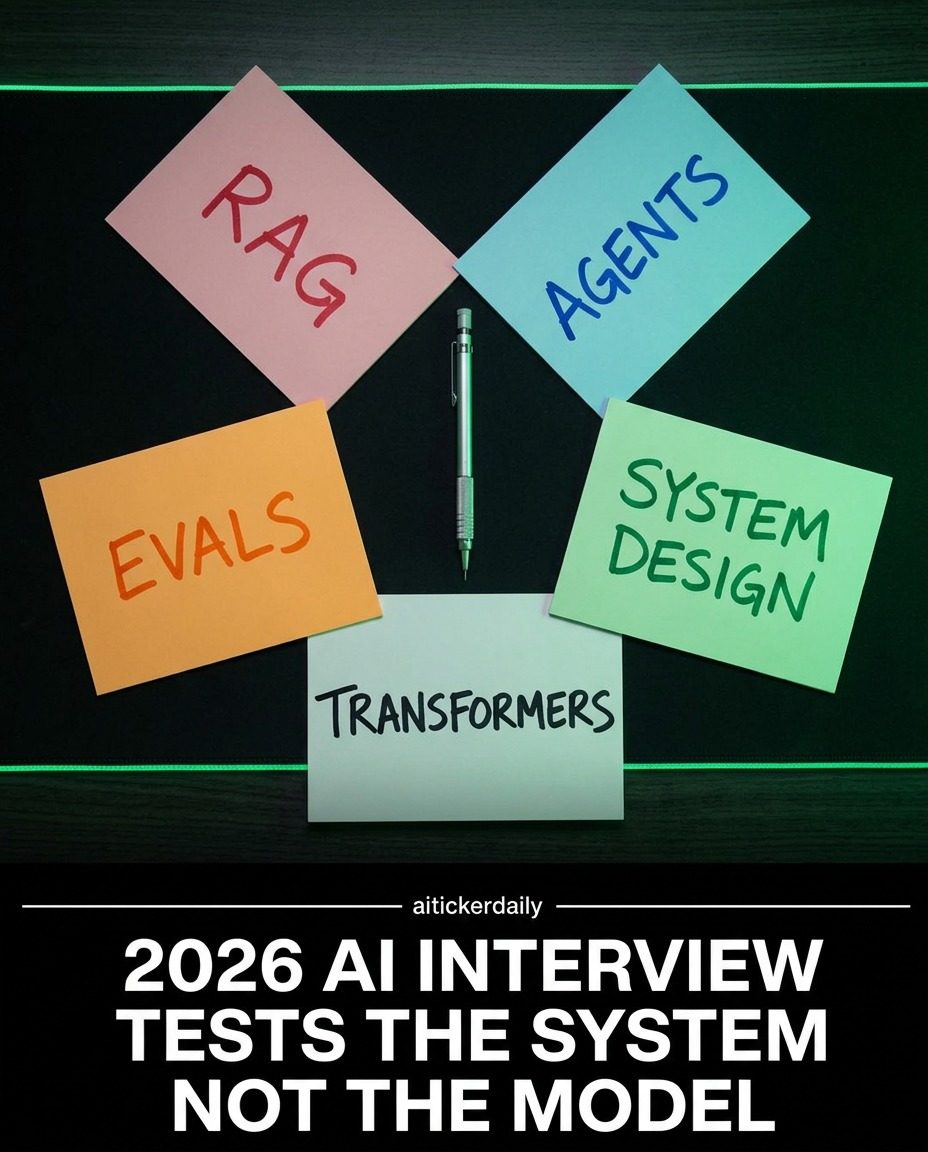
The landscape of AI/ML engineer interviews is evolving rapidly, with a significant shift towards evaluating the system layer rather than just the model layer. By 2026, interviewers will focus more on how well you can design and integrate systems involving RAG (Retrieve, Augment, Generate), agents, evaluations, and system design. This guide will walk you through the key areas that will define strong AI/ML engineer interviews in 2026.
Why This Matters
The model layer, which includes transformers, stats, and calibration, is now considered table stakes. What sets apart strong candidates in 2026 is their ability to design and optimize the system layer. This includes understanding the full RAG pipeline, implementing effective evaluations, and designing robust system architectures.
Key Areas of Focus in 2026
RAG (Retrieve, Augment, Generate)
RAG is more than just vector search plus a language model (LLM). Interviewers will expect you to understand the full pipeline, from document ingestion to generation with retrieved evidence. Key aspects include:
- Full Pipeline Understanding: This involves document ingestion, chunking strategy, embedding choice, retrieval scoring, re-ranking, context window, budget, and generation with retrieved evidence.
- Failure Modes: Be prepared to discuss what happens when retrieved chunks contradict each other. Understanding failure modes is crucial for building reliable systems.
- Production Requirements: Production RAG requires hybrid retrieval (dense plus sparse), query rewriting to improve recall, and evaluations that measure end-to-end answer quality, not just retrieval precision.
Agents
Agents will play a critical role in the system layer. Interviewers will delve into how agents interact with RAG systems, handle tasks, and ensure system reliability. Key considerations include:
- Task Management: How agents prioritize and manage tasks.
- Interaction with RAG: How agents retrieve, augment, and generate information using RAG.
- Reliability and Safety: Ensuring that agents operate reliably and safely within the system.
Evaluations (Evals)
Evaluations are a first-class topic in AI development. Interviewers will focus on:
- Quality, Safety, and Reliability: Evaluations should cover whether the system produces correct and adversarial inputs.
- Red-Teaming and Monitoring: Continuous red-teaming and monitoring for production drift are essential.
- End-to-End Evaluation: Designing an evaluation suite for a RAG plus Agent system is a key challenge. Interviewers may ask how you would design such a suite.
System Design
System design will be a critical area of focus. Interviewers will expect you to:
- Design Robust Architectures: Understand how to design systems that can handle complex tasks and interactions.
- Optimize for Performance: Ensure that the system is optimized for performance, reliability, and scalability.
Practical Tips for AI/ML Engineer Interviews in 2026
- Understand the Full RAG Pipeline: Go beyond just vector search and LLMs. Study the full RAG pipeline, including document ingestion, chunking strategy, embedding choice, retrieval scoring, re-ranking, context window, budget, and generation with retrieved evidence.
- Prepare for Failure Modes: Think about what happens when retrieved chunks contradict each other. Be ready to discuss failure modes and how to handle them.
- Focus on End-to-End Evaluation: Ensure that your evaluations measure end-to-end answer quality, not just retrieval precision. Design evaluation suites that cover quality, safety, and reliability.
- Stay Updated with Daily Briefings: Follow AI news and insights to stay updated with the latest developments. Curated briefings can help you stay ahead in the fast-moving world of AI.
Important Takeaways
- Model Layer is Table Stakes: By 2026, the model layer will be a baseline requirement. Focus on the system layer to stand out.
- RAG is More than Just Vector Search: Understand the full RAG pipeline, failure modes, and production requirements.
- Evaluations are Critical: Design evaluation suites that cover quality, safety, and reliability. Continuous red-teaming and monitoring are essential.
- System Design Matters: Focus on designing robust, reliable, and scalable system architectures.
Conclusion
The AI/ML engineer interview landscape is set to evolve significantly by 2026, with a strong emphasis on the system layer. Strong candidates will be those who can design and optimize systems involving RAG, agents, evaluations, and system design. Prepare thoroughly by understanding the full pipeline, focusing on end-to-end evaluations, and staying updated with the latest developments in AI. With the right preparation, you can excel in the interviews of the future.
Questions readers ask
What is the RAG pipeline and why is it crucial for AI/ML Engineer Interviews in 2026?
The RAG (Retrieve, Augment, Generate) pipeline is a key component in AI/ML systems. It involves retrieving relevant information, augmenting it with additional data, and generating responses. In 2026, AI/ML Engineer Interviews will heavily focus on understanding and optimizing this pipeline, as it is essential for creating effective and efficient AI systems.
How will AI/ML Engineer Interviews in 2026 differ from previous years?
Interviews in 2026 will shift focus from the model layer, such as transformers, to the system layer, emphasizing system design and integration. Candidates will need to demonstrate their ability to design and optimize systems that involve RAG, agents, evaluations, and overall system architecture.
What are the key components of a strong AI/ML Engineer interview in 2026?
A strong interview will cover the full RAG pipeline, including retrieval, augmentation, and generation. Additionally, candidates should be prepared to discuss system design, production requirements, and how agents interact and manage tasks within these systems. Understanding the evaluation of RAG pipeline performance will also be crucial.
Why is system design for AI so important in 2026 interviews?
System design is important because it ensures that AI models can be effectively implemented and scaled in real-world applications. This includes understanding how to integrate RAG components, manage data flow, and optimize performance. Strong system design skills will be a key differentiator for candidates.
What should I focus on when preparing for an AI/ML Engineer interview in 2026?
Focus on gaining a deep understanding of the RAG pipeline, including how each component interacts. Practice designing systems that integrate RAG, agents, and other components. Familiarize yourself with production requirements and system evaluation metrics. Additionally, be ready to discuss how you would handle real-world challenges in AI system design.
Recent articles
Fresh deep dives from the latest Reels we unpacked.




Comments
Be the first to comment.