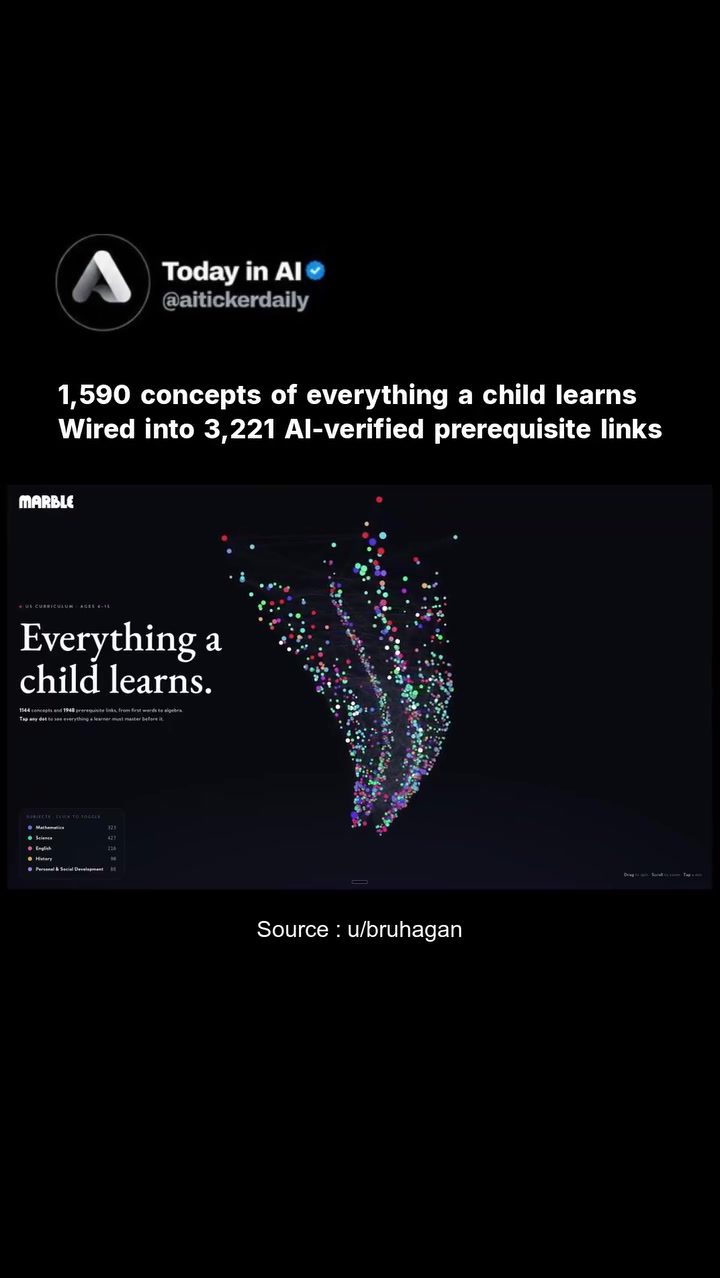
AI and Curriculum Mapping: Visualizing a Child's Learning Journey
The intricate network of concepts a child learns in primary school is vast and interconnected. A recent initiative by a team using a pipeline of Claude agents has mapped out 1,590 individual concepts from seven national curricula in the US and UK. These concepts are wired together by 3,221 prerequisite links, each carrying a one-line reason for its dependency on the previous concept. This visual representation offers a unique perspective on how different subjects and ideas interconnect in a child's educational journey.
Context: Why This Matters
Understanding the connected nature of educational concepts can provide valuable insights for educators, parents, and policymakers. By visualizing these connections, it becomes easier to identify key learning pathways and areas where additional support may be needed. This knowledge can also inform curriculum design and educational resources, ensuring a more cohesive and effective learning experience.
Main Discussion
The Process of Mapping Concepts
The team behind this visualization employed a sophisticated pipeline of Claude agents to map 7 national curricula. These agents are designed to break down complex educational frameworks into granular concepts. Each concept is then connected to others through prerequisite links, creating a web of interdependencies. This method ensures that the relationships are not just hypothetical but grounded in real educational structures.
The Challenge of AI-Generated Edges
One of the main challenges in this process was verifying the AI-generated links. AI models, while powerful, can sometimes incorrectly assert dependencies. For instance, Claude might confidently claim that concept X depends on concept Y when, in reality, it does not. This issue was addressed by grading each link as either "hard" or "soft," depending on its strength and reliability. The highest-impact nodes, which are pivotal in the learning network, were hand-reviewed to ensure accuracy. This meticulous review process enhanced the reliability of the overall visualization.
Open-Sourcing the Work
The resulting visualization, known as MARBLE, was open-sourced, making it freely available for further research and educational applications. This open-source approach not only democratizes access to valuable educational data but also encourages collaboration and innovation within the educational community.
Practical Tips
For educators and parents looking to leverage this visualization for teaching and learning:
- Identify Key Nodes: Focus on the highest-impact nodes, which are crucial for understanding foundational concepts. These nodes often serve as stepping stones to more complex ideas.
- Use Visual Aids: Incorporate visual representations of learning pathways in teaching materials. This can help students visualize how different concepts are interconnected, making the learning process more engaging and comprehensible.
- Encourage Exploration: Encourage students to explore the web of concepts, tracing links to understand dependencies and relationships. This can foster a deeper understanding of the subject matter.
Important Takeaways
- Interconnected Learning: The visualization underscores the interconnected nature of educational concepts, showing how one idea builds upon another.
- Verification is Key: Relying solely on AI-generated data without verification can lead to misconceptions. Ensuring the accuracy of dependencies is crucial for effective learning.
- Collaborative Efforts: Open-sourcing the work allows for broader collaboration and innovation, benefiting the entire educational ecosystem.
Conclusion
The initiative to map 1,590 concepts from seven national curricula into a connected graph is a significant step in visualizing the complex web of learning. This visualization not only provides insights into how concepts interconnect but also highlights the importance of meticulous verification and collaborative efforts in educational research. By leveraging this data, educators and parents can create more effective and cohesive learning pathways, ultimately enhancing the educational experience for students.
Questions readers ask
What are the primary benefits of visualizing curriculum concepts in an interconnected network?
Visualizing curriculum concepts in an interconnected network helps identify key learning pathways and support areas. It also offers educators and parents a clearer understanding of how different subjects and ideas interconnect, allowing for more informed curriculum design and learning experiences. This visualization can help pinpoint prerequisite skills, enabling more targeted support in learning journeys.
How many concepts and links are included in the AI Education Network?
The AI Education Network includes 1,590 primary school concepts from US and UK curricula, connected by 3,221 prerequisite links. Each link provides a one-line reason for the dependency, showcasing the interconnected nature of these concepts.
Which national curricula were used to create the AI Education Network?
The AI Education Network was created using seven national curricula from the United States and the United Kingdom. This ensures that the network is comprehensive and representative of various educational systems in these countries.
Why are prerequisite links important in understanding learning journeys?
Prerequisite links are crucial as they reveal the sequence and dependencies between concepts. Knowing these dependencies allows educators and parents to understand what skills and knowledge a child must acquire before moving on to more advanced topics, thereby aiding in targeted learning experiences.
How can the AI Education Network assist in curriculum design?
The AI Education Network assists in curriculum design by providing a visual representation of how concepts interconnect. This helps in identifying key pathways and support areas, enabling curriculum designers to create more cohesive and effective learning experiences.
What insights can parents gain from exploring the AI Education Network?
Parents can gain insights into their child's learning journey by exploring the AI Education Network. They can understand the interconnected nature of subjects, identify areas where their child might need additional support, and better support their child's learning at home.
What is the significance of the AI Education Network for policymakers?
For policymakers, the AI Education Network provides a comprehensive overview of curriculum design and learning journeys. This can inform policy decisions, ensuring that curricula are well-structured, interconnected, and support the holistic development of students.
Related deep dives
Similar reads based on topic and creator.


Recent articles
Fresh deep dives from the latest Reels we unpacked.




Comments
Be the first to comment.