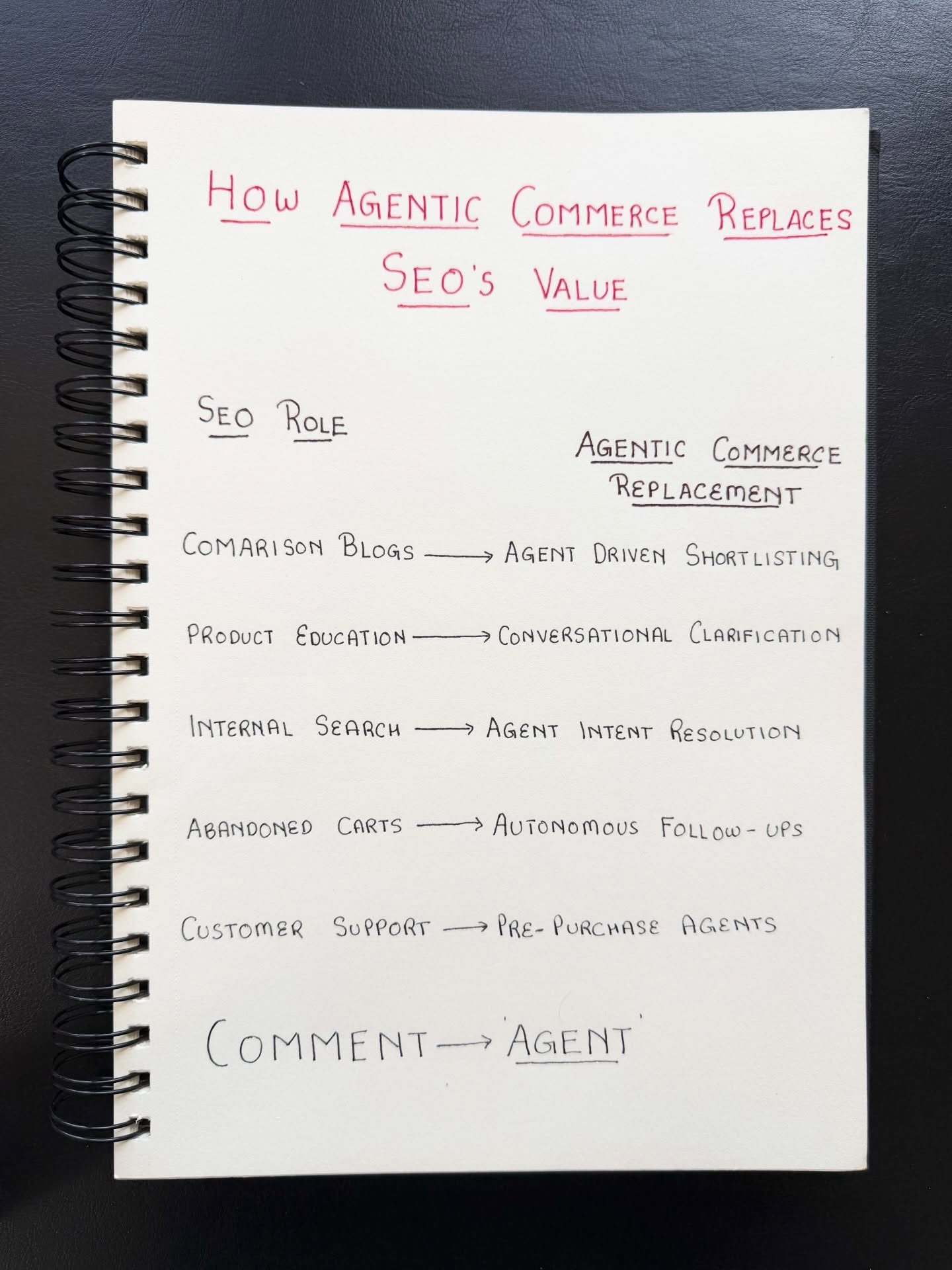
SEO vs. Agentic Commerce
Agentic commerce is emerging as a significant force as traditional search traffic begins to wane. This shift is not about replacing SEO traffic with Agentic or other strategies. Instead, it's about understanding how the role of SEO is evolving and getting redistributed.
Why this matters
The digital landscape is continually evolving, and staying ahead of these changes is crucial for businesses aiming to thrive in the competitive online marketplace. Traditional SEO tactics, while still relevant, are being supplemented and sometimes replaced by agentic commerce strategies. Understanding these shifts is key to maintaining and even enhancing online visibility and customer engagement.
Traditional SEO
Traditional SEO involves optimizing web content to rank higher in search engine results. This includes a variety of tactics:
- Keyword research: Identifying and incorporating relevant keywords into web content.
- Content creation: Producing high-quality, informative content that appeals to both search engines and users.
- Link building: Acquiring backlinks from authoritative sites to boost a website's credibility.
- On-page optimization: Ensuring that web pages are correctly structured, with elements like meta tags, headers, and URLs optimized for search engines.
- Technical SEO: Improving the backend aspects of a website, such as site speed, mobile-friendliness, and schema markup.
These practices remain essential but are being complemented by new approaches tailored to the changing digital environment.
Agentic Commerce
Agentic commerce represents a new paradigm in digital marketing. It leverages advanced technologies, such as AI and machine learning, to create a more personalized and efficient shopping experience. Let's break down how agentic commerce is transforming traditional SEO roles:
Comparison Blogs to Agent-Driven Shortlisting
Traditional SEO often relies on comparison blogs to guide users through the decision-making process. In contrast, agentic commerce uses AI-driven agents to curate shortlists tailored to individual users' preferences and needs. These agents can analyze vast amounts of data to provide highly personalized recommendations, making the shopping experience more efficient and satisfying.
Product Education to Conversational Clarification
Product education has long been a staple of SEO, involving detailed blog posts and guides. Agentic commerce, however, shifts this focus to conversational clarification. AI agents can engage users in real-time conversations, answering questions and providing clarifications instantaneously. This not only saves time but also ensures that users receive accurate and relevant information.
Internal Search to Agent Intent Resolution
Traditional SEO optimizes internal site search for better user experience and higher conversion rates, but agentic commerce takes it a step further. It uses agent intent resolution to understand and fulfill user intent more accurately. This involves AI agents interpreting user queries and providing the most relevant results, often before the user even completes their search. This seamless integration enhances user satisfaction and boosts conversion rates.
Abandoned Carts to Autonomous Follow-Ups
Abandoned carts are a common challenge in e-commerce. Traditional SEO strategies might involve remarketing campaigns and abandoned cart emails. Agentic commerce, however, employs autonomous follow-ups. AI agents can automatically follow up with users who abandoned their carts, offering assistance, answering questions, and even providing incentives to complete the purchase. This proactive approach can significantly reduce cart abandonment rates.
Customer Support to Pre-Purchase Agents
Customer support is critical for building trust and loyalty. In the traditional SEO model, this might involve FAQ pages, live chat, and customer support emails. Agentic commerce introduces pre-purchase agents that can handle customer queries before a purchase is made. These agents provide immediate assistance, clarifying any doubts and guiding users through the purchasing process, which can lead to higher conversion rates and increased customer satisfaction.
Practical tips
Embrace AI and Machine Learning
Agentic commerce relies heavily on AI and machine learning to personalize the user experience. Businesses should invest in these technologies to stay competitive. This involves:
- Data collection: Gathering comprehensive user data to train AI models.
- AI integration: Implementing AI tools for various aspects of the business, from customer support to inventory management.
- Continuous improvement: Regularly updating AI models with new data to ensure they remain effective.
Focus on User Experience
Agentic commerce is all about creating a seamless and personalized shopping experience. Prioritize user experience by:
- Personalization: Tailoring content, recommendations, and interactions to individual user preferences.
- Ease of use: Ensuring that the website and mobile apps are user-friendly and easy to navigate.
- Engagement: Encouraging user engagement through interactive elements, such as live chats and personalized recommendations.
Leverage Conversational AI
Conversational AI is a key component of agentic commerce. To fully leverage this technology, consider:
- Chatbots: Implementing AI-powered chatbots to handle customer queries.
- Voice assistants: Using voice-activated assistants to provide hands-free support and recommendations.
- Natural language processing (NLP): Enhancing the capabilities of conversational AI through NLP, allowing for more natural and intuitive interactions.
Optimize for Voice Search
As voice assistants become more prevalent, optimizing for voice search is crucial. This involves:
- Long-tail keywords: Using long-tail keywords that match the conversational language patterns of voice searches.
- Structured data: Implementing structured data markup to help search engines understand the context and content of your web pages.
- FAQ pages: Creating FAQ pages that address common questions users might ask their voice assistants.
Monitor and Adapt
The digital landscape is always evolving, and agentic commerce is no exception. Regularly monitor the performance of your AI-driven strategies and be ready to adapt. This includes:
- Analytics: Using analytics tools to track user behavior and the effectiveness of your AI strategies.
- Feedback: Collecting user feedback to identify areas for improvement.
- Experimenting: Continuously experimenting with new AI tools and techniques to stay ahead of the curve.
Important takeaways
Agentic commerce is not about replacing traditional SEO but rather about redefining and enhancing it. Key points to remember include:
- Personalization: Agentic commerce focuses on personalizing the user experience, which can lead to higher engagement and conversion rates.
- Efficiency: AI-driven agents can streamline various aspects of the shopping process, from search to support, making it more efficient for users.
- Adaptation: The digital landscape is continually evolving, and businesses must adapt their strategies to stay competitive.
Conclusion
The shift from traditional SEO to agentic commerce represents a significant change in how businesses approach digital marketing. By leveraging AI and machine learning, businesses can create more personalized, efficient, and satisfying shopping experiences. Understanding and embracing these changes is key to thriving in the competitive digital landscape.
Questions readers ask
What is agentic commerce and how does it differ from traditional SEO?
Agentic commerce leverages advanced technologies like AI and machine learning to enhance online shopping experiences, while traditional SEO focuses on optimizing web content for search engines. Unlike traditional SEO, agentic commerce goes beyond search rankings to provide personalized shopping assistance, reducing abandoned carts, and enhancing customer support.
How is the role of SEO evolving with the rise of agentic commerce?
As agentic commerce gains traction, the role of SEO is shifting. It's no longer just about driving search traffic; SEO must now work in tandem with agentic commerce to provide a seamless, personalized shopping experience. This involves integrating internal SEO strategies with agentic product notes and customer support.
How does agentic commerce help in reducing abandoned carts?
Agentic commerce uses AI to monitor shopping behaviors and provide real-time assistance, such as reminders, discounts, and personalized recommendations. This proactive approach helps to reduce abandoned carts by addressing potential barriers to purchase as they arise, enhancing customer engagement and boosting sales.
Can agentic commerce replace traditional SEO strategies?
Agentic commerce is not a replacement for traditional SEO but rather a complement. While agentic commerce can enhance online visibility and customer engagement in new ways, traditional SEO remains crucial for maintaining a strong online presence and driving organic search traffic. The integration of the two strategies is key to success in the evolving digital landscape.
What benefits does agentic commerce bring to customer engagement strategies?
Agentic commerce enhances customer engagement by providing personalized, real-time assistance throughout the shopping journey. It can answer customer queries instantly, offer tailored product recommendations, and even predict and solve potential issues, leading to a more satisfying and efficient shopping experience.
How can businesses stay ahead in the evolving digital landscape with agentic commerce and SEO?
Staying ahead involves understanding and integrating both agentic commerce and traditional SEO strategies. Businesses should focus on enhancing online visibility through SEO while leveraging agentic commerce to provide superior customer support and shopping experiences. By embracing these changes, businesses can maintain a competitive edge.
What are some internal SEO strategies that can be integrated with agentic commerce?
Internal SEO strategies that can be integrated with agentic commerce include keyword-rich product descriptions, optimized meta tags, and structured data markup. These strategies help search engines understand and rank product pages better, while agentic commerce provides the personalized shopping experience that enhances customer engagement and drives sales.
Recent articles
Fresh deep dives from the latest Reels we unpacked.




Comments
Be the first to comment.