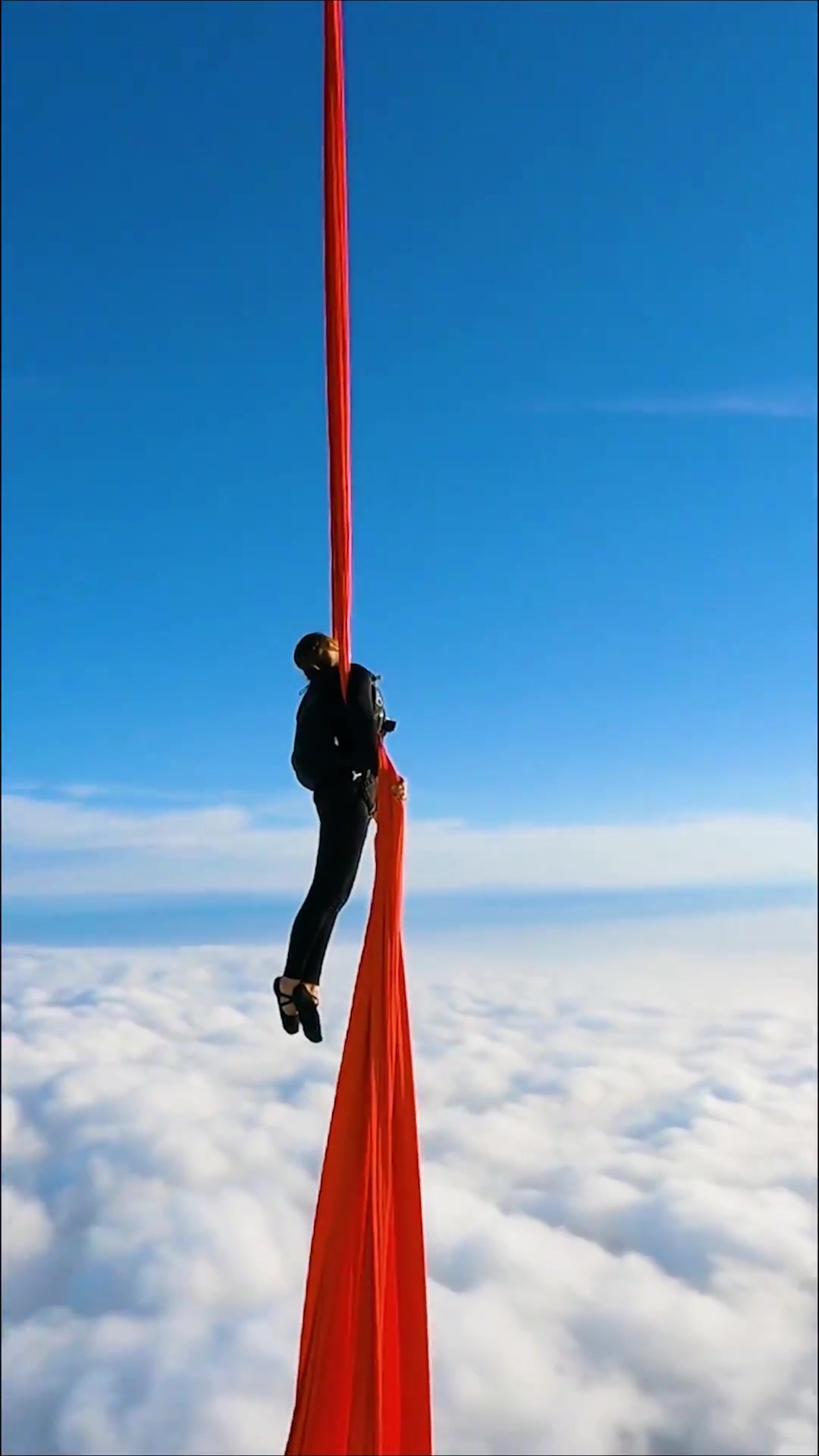
Multiple aerialists soared above the clouds, their red silk ribbons attached to a hot air balloon instead of the traditional ceiling mount. The suspended ribbon lets performers ascend and descend, twisting and spinning in midair with a freedom that defies gravity. They rotate and sway, ignitioning a dance from the sky where they can launch, rebound, and fall, controlled in a gamut more graceful than any gymnastics routine. There’s no net or harness, a minimalist setup that makes their precision even more stark. Their performance is by KON-TIKI.
Dancing with the Sky
Aerial silk performance is a high-flying blend of dance and acrobatics using long silk ribbons suspended from above. Performers use their strengths to climb, wrap, and twist around the fabric — an improvised dance with gravity. Traditional aerial silks are fixed to a ceiling, but the KON-TIKI troupe uses a hot air balloon, which allows them to float in the clouds, creating a spectacular and haunting show. The dance is fearless, with gravity-defying turns, and leaps that nearly touch the balloon's basket. In part, the choreography’s challenge is its improvisational nature. Aerial silk routines are normally vertical, using a static mount. The KON-TIKI performance, however, defies this convention, allowing performers to dance with the sky itself. The 60-meter vertical ribbon moves freely in all directions as the wind blows. The sky becomes their stage —and then changes shape as the balloon itself transforms with the wind. They can leap for more than 20 meters, up or down the silk, ascending as the balloon ascends. The ribbon is the gateway to a confounding art. Aerial silk is known for using gravity to enhance the dancer’s movements, allowing them to twirl and flip through the air. Yet the KON-TIKI dancers have achieved something different. They use gravity as a partner, toggling between submersion and elevation, to gain momentum. **The ribbons, once a ground point, become a surface for movement. The moves are dynamic, with rotations, wraps, and drops, each requiring a precise grip on the fabric in flight. Each move is precise and fluid, requiring a strong grip and control. Some moves rely on momentum from the fabric, while others bend the body in ways that emulate the ribbon’s torsion. The unique challenges of the performance are tied to the hot air balloon. Performers must keep an equilibrium, with their stunt set entirely dependent on their wind-tossed platform. The result is a fluid grace, as the aerialists’ movements flow into one another seamlessly.
The New Heights of Extreme Sports
The combination of dance and acrobatic aerialism manifests extreme sports for the sky. There's no fixed stage, no careful interviews, just the wind, the elevation and the creatives taking the sky as a stage. The sky becomes the canvas and gravity the paint. This sky-based aerialism applies itself to the world of extreme sports, where the body is pushed to its limits to create a performance. There is no safety net, no cushion or harness, only the open sky. The performance also makes a statement against the tropes used by many aerialists — the careful choreography, the delicate floor work, and the steady music. This routine is a reminder of freshness and originality in a very expected field. The dancers dance as if they defy the laws of gravity. The balloon’s instability makes the performance more rigorous, perhaps more dangerous, for that matter the team. The team is also to be noted. The show reflects a new beginning for aerialism, outside the metric of ceilings and stadiums, but also inside the raw fabric of our planet, the troposphere, the very ozone layer which keeps the air we breathe.
The Tie to the Kon-Tiki Expedition
The troupe uses the name Kon-Tiki, originally the name of a raft. The Kon-Tiki expedition was a journey undertaken in 1947 by Norwegian explorer Thor Heyerdahl, with five crew members. It sailed across the Pacific to showcase the theory that people from South America could have traveled to Polynesia. They set sail on April 28 from Peru and reached the Tuamotu Archipelago on August 4, 1947. The Kon-Tiki expedition is a testament to human audacious dreams, and an adventure of great scope. In that sense, the Kon-Tiki team obviously intends to bring that spirit to aerial dance. The goal is to test the limits of human potential with such a performance. It might also be reflective of the idea of transcending the limits we have set for ourselves.
The Elevation Over the Clouds
The performance lets the air balloon ascend to 1300 meters above sea level and float with the wind. Precise control of the balloon is critical the crew keeps the balloon drifting in a stable position for long periods. As the balloon ascends, the aerialists dance in mid-air. The hot air balloon is stable and can drift for long periods over the clouds, making it an ideal platform. This gives aerial silk a fresh approach. Dancers can truly fly through clouds, against the billowing backdrop of the sky. The cloud level elevation is lower than the usual altitude for aerial moves, meaning that the risk is slightly lower.
The Silks themselves
The red silk ribbon attached to the balloon is 60 meters long. It’s a long, flowing fabric that allows for a greater range of motion. The ribbons are made of polyester or a polyester-satin combination. These tend to be stronger than regular silk. The ribbon’s design creates a sense of lightness and freedom, reflecting the aerial artistry of the performance.
Aerial Silk in the Clouds
Silk aerobatics are usually static — the fabric hangs from a fixed point like an aerial mount. This routine is unique as it is changing and unstable — the performers constantly adjust their balance against the wind and balloon. Their movements are fluid, dancing with the balloon instead of against it. It’s a coordination that demands strong muscles, perfect balance and the right kind of grace. The hot air balloon transforms the aerial silk experience, making it more dynamic and requiring a different set of skills from aerial silk.
Enabling High Altitude
The aerial silk performances at high altitudes pose serious challenges: breathing, pressure, and wind. The performers face diminished oxygen levels at high altitudes, which can cause lightheadedness, fatigue, and impaired judgment. But the balloon allows some high-altitude acclimatization. The balloon rises slowly, and the dancers can get used to the pressure and oxygen levels. The steady ascent allows the dancers to prepare for the performance by adjusting their heart rate, ensuring they are ready for the moves they will do.
Chasing the Wind
In KON-TIKI, the hot air balloon is the defining element. Wind affects the platform, so the flight crew must be adept at controlling the balloon’s drifting. This makes the performance an interplay between the dancers and the balloon. Both the dancers and the balloon crew must stay in sync to avoid any accidents.
High Flying Performances
For the aerialist, the first step of contention is to show their skill in practice below an altitude of 1500 meters. The team tests their equipment and practice moves many times. The custom tapes and the stage flags can be used to mount on the balloon. They use curly wires for stability. They train in aerobatics and ballet as well, to gain the essential skills of balance and stability.
Reaching Beyond the Lower Atmosphere
The balloon ascent is complex, with the balloon rising to 1,300 meters each day. This can expose the performers to rapidly changing atmospheric conditions. Their choreographic skills help in maintaining a steady position in the sky.
Questions readers ask
What exactly is aerial silk and how does it differ from traditional aerial performances?
Aerial silk is a form of performance art where artists climb, wrap, and twist around long silk ribbons suspended from above. Unlike traditional aerial silk performances, which are fixed to a ceiling and follow a vertical routine, KON-TIKI's performance uses a hot air balloon, allowing the dancers to move freely in all directions with the wind, creating a dynamic and ever-changing stage.
How do the KON-TIKI aerialists manage to perform without a safety net or harness?
The KON-TIKI aerialists rely on their precision, strength, and control to perform without a safety net or harness. Their performance is a blend of dance and acrobatics, requiring a strong grip and exact movements to navigate the silk ribbon suspended from a hot air balloon.
What makes the KON-TIKI performance unique compared to other aerial silk performances?
The KON-TIKI performance is unique due to its use of a hot air balloon instead of a fixed ceiling mount. This allows the performers to dance with the sky, moving freely in all directions as the balloon ascends and descends with the wind. The improvisational nature of the choreography and the dynamic movements make it a spectacular and haunting show.
How do the KON-TIKI aerialists handle the challenges posed by the hot air balloon?
The KON-TIKI aerialists must maintain equilibrium and control as they perform on a wind-tossed platform. Their movements flow seamlessly into one another, requiring a strong grip and precise control to navigate the silk ribbon. The unique challenges of the performance are tied to the hot air balloon, which adds an extra layer of excitement and unpredictability to the show.
What kind of training do aerial silk performers typically undergo?
Aerial silk performers typically undergo rigorous training that focuses on strength, flexibility, and control. They learn various techniques for climbing, wrapping, and twisting around the silk ribbon, as well as how to perform dynamic movements and drops. For performances like KON-TIKI's, additional training may be required to adapt to the unique challenges posed by the hot air balloon.
Are there any safety measures in place for aerial silk performers?
Aerial silk performances, including KON-TIKI's, typically have safety measures in place, such as spotters and emergency protocols, but there is no harness or net during the performance, and the performers rely on their skills and training to execute the routine safely. The minimalist setup of aerial silk performances makes the precision and control of the performers even more impressive.
How does the KON-TIKI performance compare to other extreme sports?
The KON-TIKI performance combines elements of dance and acrobatics with the thrill of extreme sports, as the performers push their bodies to the limits in an open-air environment. Unlike traditional extreme sports, there is no fixed stage or safety net, only the wind, elevation, and the performers' creativity. The sky becomes the canvas, and gravity the paint, creating a unique and breathtaking performance.
Related deep dives
Similar reads based on topic and creator.
Recent articles
Fresh deep dives from the latest Reels we unpacked.

Comments
Be the first to comment.