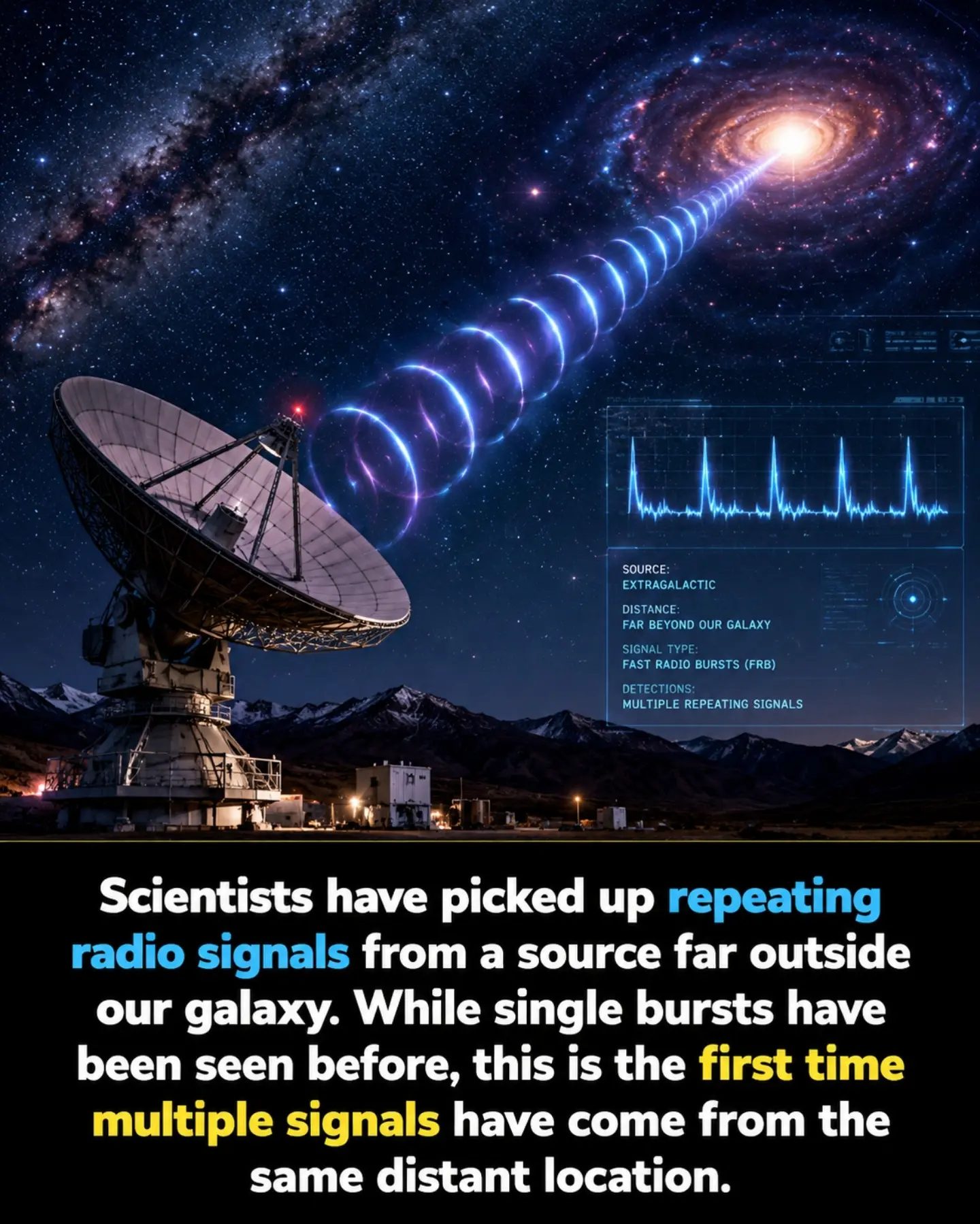
Repeating Radio Signals from Space
Repeating radio signals from space, specifically known as Fast Radio Bursts (FRBs), have captivated the scientific community with their enigmatic nature. These signals, detected far beyond our galaxy, offer intriguing insights into the cosmos and challenge our understanding of the universe.
Context / Why This Matters
FRBs are intense, brief bursts of radio waves that last only milliseconds. Initially spotted in 2007, these signals have since been detected at various points in the sky, typically appearing as one-off events. The detection of repeating radio signals for the first time marks a significant milestone in astronomy. These signals hold the potential to unveil new information about the far reaches of the universe, including the conditions in distant galaxies and the nature of extragalactic phenomena.
Main Discussion
Understanding Fast Radio Bursts
Fast Radio Bursts are characterized by their sudden, brief appearance and high intensity. They release an enormous amount of energy in a short period, making them detectable even from vast distances. The first FRB was discovered in archival data from 2001 and has since been detected at random locations in the sky. The identification of repeating signals, however, changes the game. It suggests that some sources of FRBs are not single catastrophic events but rather more predictable, perhaps even periodic.
The Discovery of Repeating Signals
The recent detection of multiple repeating signals from the same distant location has astounded astronomers. These signals are not isolated events but rather appear to emanate from a consistent source beyond the confines of our galaxy. The consistency of these signals suggests a different type of astrophysical event, one that could potentially be studied in greater detail over time.
Extragalactic Origins
The signals are classified as extragalactic, meaning they originate far beyond our own Milky Way galaxy. This extragalactic source complicates the task of detecting and analyzing these signals, as they must travel through vast distances of space and time. The fact that these signals have been detected at all is a testament to the sensitivity and precision of modern radio telescopes.
The Role of Radio Telescopes
Radio telescopes, such as those depicted in these visualizations, are crucial in detecting FRBs. These specialized instruments capture radio waves from space, which are then analyzed to determine their origin and characteristics. The detection of repeating signals required advanced technology and meticulous observation, highlighting the importance of continued investment in astronomical research.
Theories and Speculations
Several theories have been proposed to explain the origin of FRBs. Some scientists suggest they may be the result of highly energetic astrophysical events, such as merging neutron stars or collapsing stars. Others speculate that they could be linked to powerful magnetic fields or exotic objects like magnetars. The detection of repeating signals supports the idea that some FRBs are associated with extreme astrophysical processes that can produce multiple bursts.
Challenges in Studying FRBs
The study of FRBs faces several challenges. Their brief duration and unpredictable nature make them difficult to detect and study. Additionally, the vast distances involved mean that the signals are often weak and distorted by their journey through space. Despite these challenges, the detection of repeating signals offers new avenues for research and the potential to gather more data on these elusive phenomena.
Practical Tips
For those interested in cosmic phenomena, staying updated with the latest research and advancements in radio astronomy can provide fascinating insights. Here are a few practical tips:
- Follow Astronomy News: Keeping track of the latest discoveries and research can provide a deeper understanding of FRBs and other cosmic phenomena.
- Join Astronomy Clubs: Joining local astronomy clubs or online communities can offer opportunities to learn from experts and enthusiasts.
- Explore Amateur Astronomy: Investing in a radio telescope or joining a radio astronomy project can provide hands-on experience and contribute to scientific research.
- Read Scientific Literature: Delving into research papers and articles can offer detailed information and the latest findings in the field of astrophysics.
Important Takeaways
The detection of repeating radio signals from a source far beyond our galaxy represents a groundbreaking discovery in astronomy. These signals, known as Fast Radio Bursts (FRBs), offer new opportunities to study the distant universe and understand the nature of extragalactic phenomena. The consistent nature of these signals suggests a different type of astrophysical event, one that could potentially be studied in greater detail over time. The role of advanced radio telescopes and continued investment in astronomical research are crucial in this field of study.
Conclusion
The discovery of repeating radio signals from space marks an exciting chapter in our ongoing exploration of the cosmos. These signals, far beyond our galaxy, provide a unique window into the mysteries of the universe and challenge our understanding of astrophysical phenomena. As we continue to study these enigmatic signals, we move closer to unraveling the secrets of the far reaches of space, expanding our knowledge and inspiring future generations of scientists and explorers.
Questions readers ask
What are Fast Radio Bursts (FRBs)?
Fast Radio Bursts, or FRBs, are intense, brief pulses of radio waves that originate from space. They typically last only a few milliseconds and were first discovered in 2007. Unlike many other cosmic phenomena, FRBs are still not fully understood and remain a subject of active research.
What makes repeating FRBs significant?
Repeating FRBs are significant because they challenge the initial assumption that all FRBs are one-off events. Their repetitive nature allows scientists to gather more data and study these bursts in greater detail, which can lead to a better understanding of their origins and the environments from which they come.
Where do Fast Radio Bursts come from?
The exact sources of FRBs are still unknown, but they are believed to originate from distant galaxies. Recent findings suggest that repeating FRBs and non-repeating FRBs might have different origins, adding another layer of complexity to their study.
Can FRBs be used to study distant galaxies?
Absolutely. The signals from FRBs can pass through materials in distant galaxies, providing scientists with important information about the composition and properties of these galaxies and their environments. This can reveal insights into the conditions in the far reaches of the universe.
How do scientists detect Fast Radio Bursts?
Scientists detect FRBs using highly sensitive radio telescopes designed to capture brief, transient radio signals. These telescopes are often employed in large surveys of the sky, scanning for the characteristic milliseconds-long bursts of radio waves that define FRBs.
What is the difference between single and repeating FRBs?
Single FRBs are detected only once and do not repeat, making them difficult to study in detail. Repeating FRBs, on the other hand, emit multiple bursts over time, allowing scientists to observe them repeatedly and gather more comprehensive data. This makes repeating FRBs crucial for understanding the underlying mechanisms behind these cosmic phenomena.
Why are FRBs important for studying cosmic phenomena?
FRBs are important because they provide a unique window into the distant universe. By studying these bursts, scientists can learn about the conditions in distant galaxies, the nature of cosmic magnetic fields, and the distribution of matter in the universe. Additionally, the repeating nature of some FRBs offers a rare opportunity to observe the same source multiple times.
Related deep dives
Similar reads based on topic and creator.



Recent articles
Fresh deep dives from the latest Reels we unpacked.




Comments
Be the first to comment.