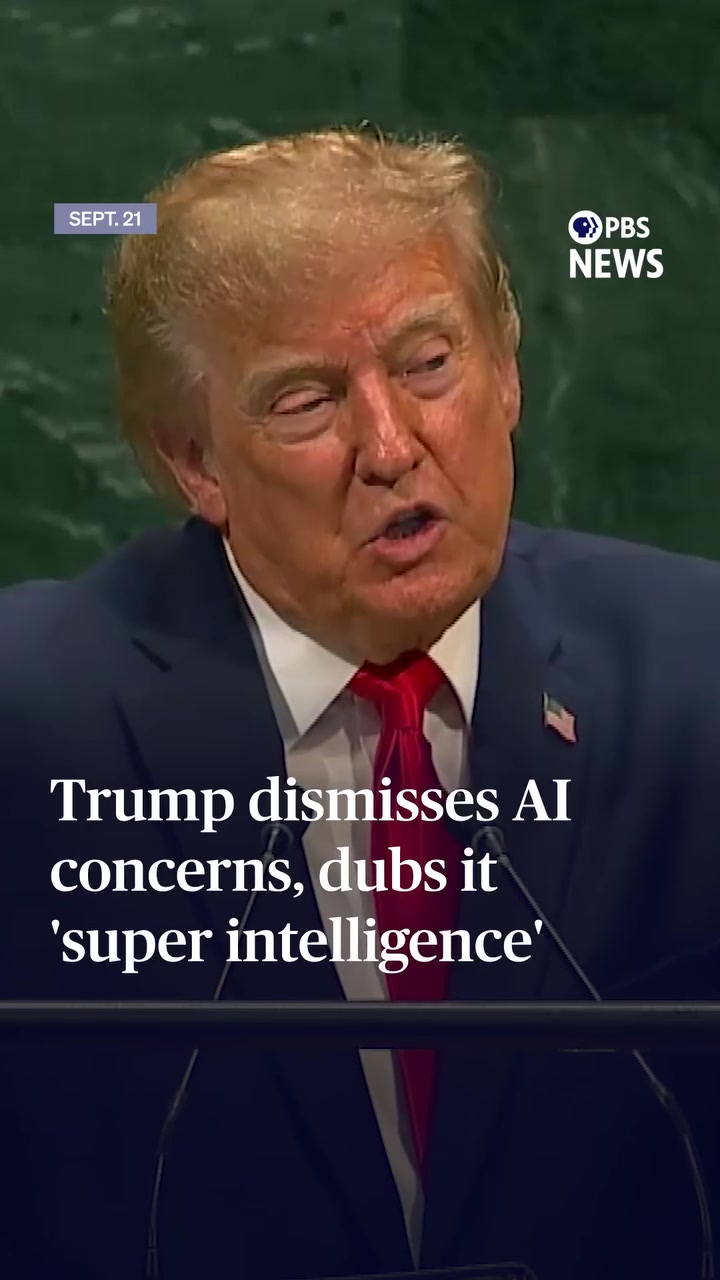
Rhetoric at the UN: Trump's "Super Intelligence" Moment
Donald Trump, speaking in September 2023 at the United Nations, pledged the U.S.'s leadership in a concept he dubbed "superintelligence." The term, he declared, marks a more accurate way to describe the burgeoning field of artificial intelligence. "From this point forward, all of United States documents, and hopefully the world's, will be changed to use the much more accurate term, super as opposed to artificial," he said, setting himself against what he described as globalist schemes to control AI.
The Semantics of Superintelligence
The term "superintelligence" is more than just a rebranding. Trump argued that the word "artificial" misleads because it suggests falsity. Whereas the adjective "super" connotes excellence and advancement. "in that the use of the word 'artificial' makes intelligence fake. It makes it sound fake, and it is not fake," he asserted. According to his view, high-level AI — or superintelligence — should be embraced, not feared. The language of superintelligence, he believes, projects a more optimistic and possibly lucrative future.
Technologists, not Politicians
Experts and the general public appear to use the term "artificial intelligence" with confidence, so the debate is less about contemporary language and more about defining the future of AI. The U.S. Department of Defense and other federal organizations employ the term with urgency, especially as they wrestle with the ethics and implications of high-power artificial intelligence. If the term is deemed less than accurate, it might illicitly suggest that AI can never surpass human understanding. Yet, Trump's emphasis on "super intelligence" and "SI" underscores a divide. Technologists commonly use the term AI to describe a wide range of applications, from chatbots to autonomous vehicles. The term superintelligence, on the other hand, refers specifically to AI that exceeds human intelligence in nearly every economically valuable work.
Confronting Global Challenges
Trump's rhetoric resists "globalist schemes" to manage AI, emphasizing that the United States has already demonstrated leadership in leveraging AI technologies. "We're leading now over China by a lot and everyone else. We're going to keep it that way," he stated. Here, the new terminology is a rhetorical tool to assert U.S. dominance, framing AI as a technology that will "be bigger than the Industrial Revolution. Many say bigger than the Industrial Revolution or the internet itself," rather than a threat that requires global cooperation. Trump's focus is on ensuring that the U.S. is at the forefront of this technological evolution, framing it as key to maintaining global leadership.
The Global Context
The rapid advancement of AI technologies is not just an academic or economic concern; it has global geopolitical implications. Countries are racing to develop and control these technologies, viewing them as crucial to future economic and military power. Trump's emphasis on "SI" is part of a broader narrative where AI is seen as a competitive advantage. This narrative is about more than just terminology — it is about control and influence in a rapidly changing world. His language and approach, however, diverge from global efforts to regulate and control AI development, which focus on collaboration and shared standards.
Ethical and Practical Concerns
Trump's focus on terminology and leadership, while politically charged, overlooks significant ethical and practical concerns surrounding AI. Issues like job displacement, AI bias, and the potential for misuse are critical aspects of the AI debate that require careful consideration and global cooperation. His framing of AI as a purely economic and military asset may overshadow these complex challenges, which need to be addressed through international dialogue and regulation.
Encouragement and Regulation
Trump did not advocate for unfettered development of AI. Instead, he called for a balanced approach that encourages innovation while ensuring safety and responsibility. "The United States leads the world in superintelligence and will continue to do so safely and responsibly." This stance acknowledges the challenges posed by AI while emphasizing the need for continued innovation and leadership. It's a delicate balance, one that requires careful navigation between encouraging technological advancement and mitigating potential risks.
A National AI Vision
The challenge for the United States, as articulated by Trump, is to maintain leadership in this rapidly advancing field. Political rhetoric notwithstanding, the task of defining, developing, and regulating superintelligence will require a collaborative effort from experts, policymakers, and the public. Trump's language of "SI" might not shift how technologists and the broader public perceive AI, but it serves as a powerful rhetorical tool to assert U.S. leadership and shape the narrative around AI's future. The United States' approach to superintelligence will significantly influence its global standing and the trajectory of AI development. As Trump pledged, "The United States leads the world in superintelligence and will continue to do so safely and responsibly." This vision, while ambitious, highlights the critical role of AI in shaping the future of technology and global politics.
Questions readers ask
What exactly does Trump mean by 'superintelligence' and how does it differ from 'artificial intelligence'?
Trump uses 'superintelligence' to describe advanced AI that surpasses human intelligence in valuable tasks. He believes the term 'artificial intelligence' is misleading because it suggests something fake or not genuine. In contrast, 'superintelligence' connotes excellence and advancement, painting a more optimistic picture of AI's future.
Why did Trump choose to announce this terminology shift at the United Nations?
Trump announced the shift at the UN to emphasize U.S. leadership in AI technologies. He framed the change as a way to more accurately describe AI, while also asserting that the U.S. is ahead of other countries, particularly China, in AI development. This move is part of a broader strategy to position the U.S. as a global leader in AI.
How have technologists and experts reacted to Trump's proposed terminology change?
Technologists generally use the term 'artificial intelligence' to describe a wide range of applications, from chatbots to self-driving cars. The term 'superintelligence' is more specific, referring to AI that surpasses human intelligence. Experts are more focused on defining the future of AI and its ethical implications, rather than debating terminology.
What are the potential implications of adopting the term 'superintelligence' over 'artificial intelligence'?
Adopting 'superintelligence' could shift the narrative around AI, framing it as a technology that surpasses human capabilities rather than something that mimics them. This could influence public perception and policy, potentially leading to more investment and innovation in high-level AI research. However, it might also raise concerns about the ethical and societal impacts of such advanced technologies.
How does Trump's emphasis on 'superintelligence' fit into the broader geopolitical context of AI development?
Trump's emphasis on 'superintelligence' is part of a broader narrative where AI is seen as a competitive advantage. Countries are racing to develop and control AI technologies, viewing them as crucial to future economic and military power. By framing AI as a technology that will be bigger than the Industrial Revolution or the internet, Trump positions the U.S. as a leader in this technological evolution.
Can other countries or organizations follow the U.S. in adopting the term 'superintelligence'?
While Trump encouraged the world to adopt the term 'superintelligence,' it's not clear if other countries or organizations will follow suit. The terminology debate is less about contemporary language and more about defining the future of AI. Technologists and experts might continue to use 'artificial intelligence' until there is a broader consensus on the need for a new term.
What does Trump mean by 'globalist schemes' in the context of AI?
When Trump mentions 'globalist schemes,' he is referring to efforts to manage AI development on a global scale, possibly through international cooperation or regulation. He frames these efforts as a threat to U.S. leadership in AI, emphasizing that the U.S. should maintain control and dominance in this field. This rhetoric is part of a broader strategy to assert U.S. leadership in AI technologies.
Related deep dives
Similar reads based on topic and creator.

Recent articles
Fresh deep dives from the latest Reels we unpacked.




Comments
Be the first to comment.