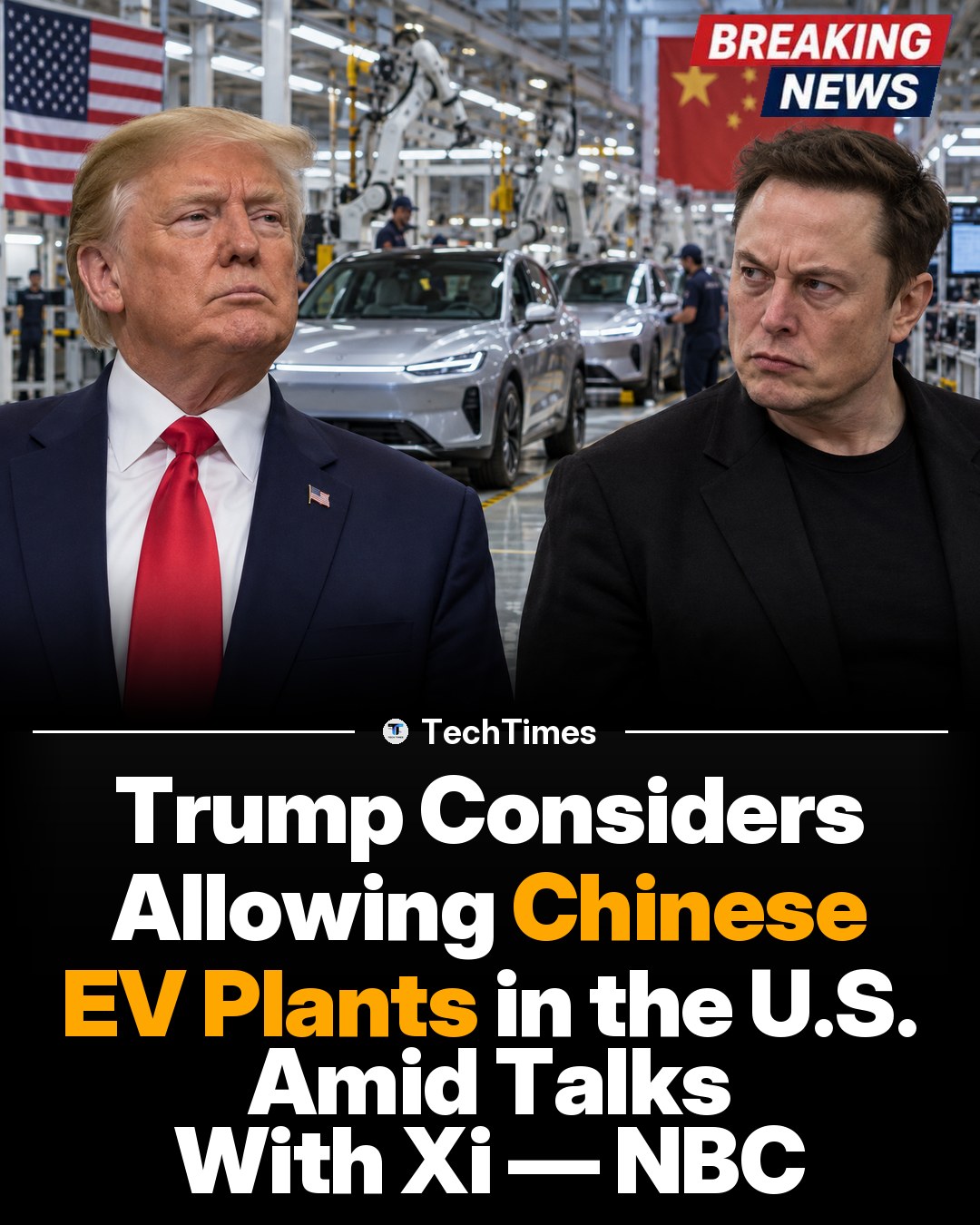
A composite image of a Tesla factory presents an unsettling prospect: former President Donald Trump greenlighting Chinese electric vehicle (EV) plants on U.S. soil. The breaking news graphic bears the logo of NBC and the words "Trump Considers Allowing Chinese EV Plants in the U.S. Amid Talks With Xi Jinping". While the image itself is a digital creation, the prospect it illustrates is real.
The Potential Shift in EV Policy
In the image, Trump and Elon Musk are positioned in front of a Tesla Model S. This vision of a potential policy shift would grant Chinese manufacturing plants a foothold in American EV production. Trade discussions between the U.S. and China, led by Trump and Xi Jinping, could dramatically change the U.S. automotive industry if China were to build EV plants in the U.S. This would increase EV production in the U.S. but would also mean an influx of Chinese labor and technology in the states. This policy shift would be the latest setback in the ongoing trade war between the U.S. and China. Much of the world is on its way to transitioning to electric vehicles, but the U.S. is expected be lagging behind. In May of 2022, the White House laid out new guidelines to increase EV production, with a goal of 50% of sales coming from EVs by 2030. Chinese investment in the U.S. is worth billions of dollars, and the news of a potential policy shift comes just over a year after Musk showed support for China as a potential leader in the auto industry. How could such a policy be beneficial to the U.S.? What are the downsides, and how would the average American be affected?
Potential Implications of Chinese EV Labour in the U.S.
Currently, the U.S. has many operational and proposed incentives to increase EV production. The Inflation Reduction Act, which aims to curb inflation, includes measures to boost the domestic production of electric vehicles. Besides reducing carbon emissions, the Inflation Reduction Act aims to increase production in the states, which can directly employ American labor. The Inflation Reduction Act therefore supports the development of the EV industry and the creation of well-paid, unionized jobs. Chinese laborers are paid less than American workers, and unions in the U.S. have publicly opposed the possibility of labor at the expense of American wages. In contrast, some pricing of Tesla vehicles in the U.S. is expensive compared to the price and cost in China. These measures are threatened by the possibility of Chinese EV manufacturing. If Chinese EV plants are established in the U.S., they would employ Chinese laborers, which would bring down the cost of labor. This could have some upside—cheaper EVs for consumers—but could also drive down wages for American workers. This is significant because the fight to unionize EV factories in the U.S. is ongoing, and laborers are already fighting for better wages and benefits. The presence of Chinese laborers could jeopardize that progress. The highly regulated EV industry could also open the door to a number of cyber attacks. Chinese drone manufacturers have been accused of installing spyware into their devices, and if the country has an opportunity to install cyber warfare into U.S. supply chains, they will have a huge advantage. On the other hand, the addition of Chinese labor would mitigate the costs of labour in the U.S. The EV market is expected to surge over the next few years, especially with advancements in battery technology. The EV market's growth will provide Chinese manufacturers with the opportunity to enter the U.S. market. Many EVs are already partially made in China, and Tesla is China's largest manufacturer. This is because China is the world's largest single market for EVs, and Tesla's growth in China has been exponential. In fact, in Israel, China's Bettiolchi has developed a $2 million battery - the world's first battery with a 1,000 km range. These improvements in battery technology and manufacturing will contribute to the ongoing trade.
Placing Context in the Tremendous American Context
With oil prices increasing and the U.S. increasing their commitment to renewable energy, the electric market is poised for growth. This will affect the entire American industry. EVs are environmentally friendly, and corporate America is responding to the demand. Sadly, the local American counties, cities, and towns are not ready to power the vehicles. To charge all of these vehicles, the U.S. will need around 15 times the electricity it currently produces. It is also widely understood that the United States is the world’s largest greenhouse gas polluter, and China is a close second. Despite the large number of greenhouse gases produced by both countries, China is developing renewable energy sources such as solar and wind. Even though the U.S. is trying to keep up, it is way behind. If China invades America’s market to produce EVs, it will have an advantage in the field of renewable energy and the production of EVs, as they would be able to sell them at a lower price. On the other hand, this could be seen as a positive as this would mean lower prices for the consumer.
The Battle Between Tesla and China’s Car Industry
Tesla, the most renowned EV manufacturer in the U.S., is only the second largest in China. China is currently leading in the EV race, with 1.2 million electric cars sold in China in 2022, compared to 834,000 EVs sold in the U.S. The policy could have a direct impact on Tesla. Since at least 2013, Chinese automakers have been working to make electric vehicles a reality in this developing world. With prices ranging from $6,000 to $23,000, there are a variety of Chinese cars on the market. At these prices, even the most affordable Tesla is still much more expensive than the cheapest Chinese car. The demand for Chinese cars and the cheaper price for the consumer make them a serious contender in the electric car game. Even American luxury brands such as Mercedes-Benz are making their vehicles less expensive in order to compete with the Chinese market. However, Tesla's Model 3 is the best-selling electric car in the United States, but only after accounting for the $7,500 federal tax credit. It costs around $46,990 without the tax credit, according to the company's website. The average EV costs $61,433, putting the Tesla in the bargain category.
Features of EVs: What makes Them Special?
Electric cars are known for their longevity. Reducing battery degradation is one of the main focuses of Tesla’s engineering. However, Tesla is not the only manufacturer with the ability to do this. Chinese manufacturing is very efficient, and Chinese EVs, as a whole, have a reputation for efficiency. They are equipped to outperform Tesla in the long run. The price of a Tesla is very high, and there is no guarantee that it will last. Although Tesla has a large amount of momentum, it is going to be hard for its cars to compete with the Chinese market.
Emissions and the War on Tesla
In 2019, Tesla began selling its electric vehicles in the U.S. A few years earlier, in 2016, Tesla launched a mass production of its Model 3, which was its first mid-range priced car. According to the company website, the Model 3 is designed to have a lower cost of operation, better performance, and longer ranges to provide the U.S. with a good option for EV cars. Currently, Tesla is the U.S.’s largest manufacturer of battery EVs, but the Chinese market is growing fast. In 2019, Tesla's battery capacity topped out at 35 gigawatt-hours, while the Chinese market has over 130 gigawatt-hours of capacity. This is a massive difference, and this is before the potential policy change takes place. This major step forward in EVs and batteries could be a game changer in the world of energy. Unfortunately, this large amount of energy will increase the costs of power production and distribution. There are growing concerns about the environmental impact of electric vehicles due to the large amount of energy required to produce them. This can increase pressure on the grid as well as increase pollution at power plants. This can be seen as another benefit of Chinese labor in the U.S. as Chinese engineers and laborers could find solutions to make the process more efficient. The Chinese have a reputation in innovation in the automotive industry, and could provide the solution to many of the issues that EVs face today.
The Consumers' Choice
A potential policy change involving Chinese EV factories in the U.S. has serious implications for the electric vehicle market and for consumers. Here are some actionable steps people can take in response: * Monitor Policy Changes: Keep an eye on official announcements and news outlets for updates on any shifts in U.S.-Chinese trade policies, particularly those related to the automotive industry. * Evaluate Long-Term Costs: The price of an electric vehicle is typically high. EVs may save Americans money over the long term as well as help the environment. If Chinese EVs come to the U.S., you can consider the durability of the car and convert your savings into the environment. * Stay Informed on EV Technology: Follow developments in battery technology, charging infrastructure, and electric vehicle features to stay informed and empower yourself to make the best possible decision. Study current trends in the local market. American buyers are already starting to prefer Chinese models over American, and with the opening of manufacturing plants in America, buyers can look at the cars with better accuracy. Analyze the data you find and make your own decision.
Renewable Energy Investment Will be Increasing
The future of the automobile industry may very well be in China. This is not to say that the U.S. will give up on its car market, but China already has an edge. Tesla has the best-known cars in the U.S., but the Chinese market is closer in price to Tesla. Tesla has a massive amount of momentum, particularly in the U.S. market, but the Chinese market now has the upper hand in terms of engineering, innovation, and pricing. With the potential policy change, this gap will widen. Chinese EVs have the potential to outperform Tesla cars and could very well be the next electric car most consumers decide on. Labor in the U.S. could drastically change, possibly bringing the cost of labor and manufacturing down to a price that will benefit the American consumer. However, this could also come with a cost: failing to invest in workers and infrastructure could mean a short-term boost to the American economy, but a long-term disaster.
Questions readers ask
What exactly is the policy shift that Trump is considering regarding Chinese EV plants in the U.S.?
The potential policy shift involves allowing Chinese companies to establish electric vehicle (EV) manufacturing plants in the United States. This would mean Chinese labor and technology would be integrated into the U.S. auto industry, which could significantly alter the landscape of EV production in the country.
How would Chinese EV plants in the U.S. affect American workers and the auto industry?
If Chinese EV plants are established in the U.S., they would likely employ Chinese laborers, who are paid less than American workers. This could lead to cheaper EVs for consumers but also drive down wages for American workers. It could also potentially jeopardize the ongoing efforts to unionize EV factories and improve wages and benefits for American laborers.
What are the potential benefits and drawbacks of this policy shift for the U.S.?
One potential benefit is that it could increase EV production in the U.S. and make EVs more affordable for consumers. However, the downsides include the risk of driving down wages for American workers, potential cybersecurity threats and compromising the progress made in unionizing EV factories.
How does this potential policy shift fit into the broader context of U.S.-China trade relations?
This potential policy shift would be a significant development in the ongoing trade war between the U.S. and China. It could dramatically change the U.S. automotive industry and represents a notable shift from previous stances, especially given Trump's past rhetoric against China.
What role does Elon Musk and Tesla play in this potential policy shift?
Elon Musk and Tesla are indirectly involved because the composite image features Trump and Musk in front of a Tesla Model S. Additionally, Musk has previously shown support for China as a potential leader in the auto industry, which aligns with the idea of Chinese EV plants in the U.S. However, it's important to note that the image is a digital creation and not an official endorsement.
Related deep dives
Similar reads based on topic and creator.



Recent articles
Fresh deep dives from the latest Reels we unpacked.




Comments
Be the first to comment.