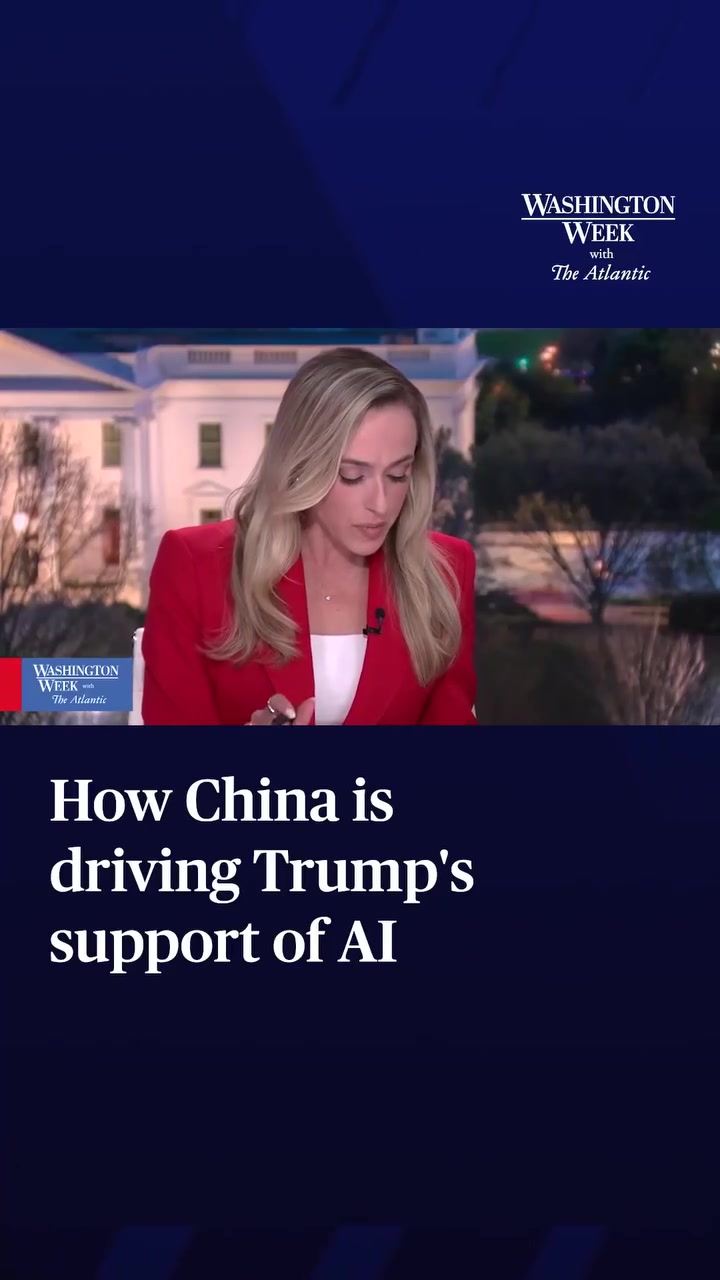
Fewer than three in ten Americans favor data centers in their neighborhoods — yet former President Trump embraced building more. The driving factor isn't local job growth or the promise of high-speed internet for rural communities. It’s China’s AI ambitions that are pulling the strings, at least according to the analysts on Washington Week with The Atlantic. They argue that Trump’s backing for data centers comes from a strategic misreading of global AI competition.
Data Centers as War
Data centers are Ultra-large-scale computing plants: server farms that store, process, and analyze gigantic datasets. They enable high-speed communication, analytics, and artificial intelligence. Data centers are not an on-off switch for AI, but an enabler of its potential. Crystal clear 24/7 connectivity is a necessary foundation for any AI capability. Trump's stance on data center expansion is not about bolstering consumer internet speeds, but fending off China’s rising technological prowess. Trump framed it as a race with China, and viewed AI as a technological battle. By that logic, more data centers equate to more AI power. Nation states can track AI progress in the same way as they track conventional military power. According to the Atlantic panel, this is the frame that Trump has adopted. This space is littered with the wreckage of abandoned data centers — signifiers of the speed of technological change. You don’t need much imagination to picture a massive facility. Ranking high-growth tech cities and you’ll consistently find a giant data center in the background. Cloud-based data centers for AI workloads could operate at a lower cost and provide a high processing power. At the far end of the spectrum, systems like AWS EC2 P3 instances are used in AI applications. They're designed for high performance, which means they can handle large datasets and complex algorithms.
The Pacific Tech Draft
Data centers have become a focal point in the global geopolitical competition. At first blush, it seems like everyone wants to build an AI-enabled service, a supercity, a smart city, or other such conjuring. Countries pursue their own data-centric technology isolates. But every country that backs the idea that AI is a force for growth and progress fuel such centers. Technological power is not just a function of raw processing power, but of how it is controlled. Farmers in Inner Mongolia have seen their land transformed into massive data centers. There's a clear divide between nations that build in coastal areas—where underwater data centers are being considered—and countries that build far inland. China enhances its tech trade position by exploiting vast resources to build the largest centers in the most remote areas. AI is about data and processing power, but it's also about control of that information. Data centers on the high seas may help solve power and geopolitical constraints, but they also move control further away from end-users in shore-side terminals. Data center sites aren’t designed based on where the world will be next year, but where China is today. The Financial Times reported that tens of billions were being spent on these modern data centers, the lion's share of which were located in Inner Mongolia, due to its cheap land, abundant electricity, and cooling. The US, by contrast, is playing defense. "The only folks who would be happy to about limiting data centers would be China", said a panelist, toying with Trump’s own social media sentiment. The U.S. administration perceived China’s data center construction as a strategic threat. This is where Trump steps into the global debate over AI: He adds fuel to the race by expanding data centers in the US. Trump’s view of data centers as a variant of military superiority frames new discussions. Regulatory bodies are considering how the host country measures the effectiveness of its infrastructure investments. As investors pour billions into data centers, regulatory challenges, such as international taxation, emerge. So cutbacks for the U.S. may equate to a competitive disadvantage.
China's Technological Superbases
China's approach to data centers differs from the United States. Instead of targeting high-density population zones, China focuses on more remote regions like Inner Mongolia. It’s cheaper to build data centers in these areas, due to lower land costs, abundant electricity, and colder temperatures. The Chinese government also provides incentives to companies to build data centers in these regions. This isn’t just about saving money, but expanding the influence and control of its tech sector. China’s technopolitical strategy is clear: expand on every front. Even the most remote farmlands aren’t immune to this digital transformation. More than processing power, this data graveyard is about control itself. We are witnessing the shaping of an international data strategy as China builds tens of billions of dollars in data centers. Some of the funds are even used to build underwater data centers.
The Digital Race to the Bottom
In the interest of accelerating artificial intelligence development, the economic and environmental impact are simply collateral damage. The cost of data centers isn’t just financial — it’s also ecological. These facilities require vast amounts of energy and water to operate, and they generate a significant amount of heat, leading to carbon emissions. As the global demand for AI grows, so does the demand for data centers. If Trump’s data center race became a global competition, nations might have to grapple with more than just AI: unstable power grids and polluting infrastructure could become the new normal.
The American Response
The Biden Administration has opened a door to a diplomatic solution to this dilemma, whereas Trump had wanted to accelerate the arms race. Biden’s approach to technology isn't based on a zero-sum framework. The National Institutes of Health recently proposed a new AI regulation to ensure the development of AI for the public good. This could include incentivising companies to invest in sustainable data centers and developing standards to ensure the safe use of AI. Meanwhile, California’s water wars have already moved beyond virtual reality to real-world implementation. Data centers’ water usage is a pressing concern. If data-center expansion continues, it could exacerbate water shortages.
Monitoring the Race
Total data center power consumption is already world-scale. As more countries rush into this AI race, the stakes are high. Trump's view is echoed by people who think that China attacks AI development on a global scale. Data centers are a fusion of strategic intent and modernization. Data centers are part of a geopolitical strategy because they are part of the global equilibrium. In summary, data centers are the new frontiers in the race for global technological dominance and power. The question of global AI readiness is one of strategic foresight. The right move is to invest in data centers in a sustainable way. Otherwise, the world stands to lose more than just a competitive edge.
Questions readers ask
What exactly are data centers and why are they so important for AI development?
Data centers are massive facilities that store, process, and analyze vast amounts of data. They are crucial for AI because they provide the high-speed connectivity and processing power needed to handle complex algorithms and large datasets, which are essential for AI capabilities.
Why did Trump push for more data centers in the U.S.?
Trump's push for more data centers was driven by a strategic misreading of global AI competition, particularly with China. He viewed AI as a technological battle and believed that more data centers would equate to more AI power, helping the U.S. to keep pace with China's technological advancements.
How does China's approach to data centers differ from other countries?
China has taken a unique approach by building massive data centers in remote inland areas, such as Inner Mongolia, to enhance its tech trade position. This strategy allows China to exploit vast resources and gain control over information, which is a key aspect of AI development. Other nations, however, tend to build data centers in coastal areas or near major cities.
What are the potential risks and challenges associated with data centers?
One of the main risks is the rapid pace of technological change, which can lead to data centers becoming obsolete or abandoned. Additionally, the geopolitical implications of data centers are significant, as they can shift the balance of power and control over information. Moreover, there are environmental concerns related to the energy consumption and land use of these massive facilities.
What are the implications of building data centers on the high seas?
Building data centers on the high seas could help solve power and geopolitical constraints, but it also moves control further away from end-users in shore-side terminals. This approach could potentially provide a strategic advantage by operating outside the jurisdiction of any single nation, but it also raises questions about data security and sovereignty.
What role do data centers play in the global geopolitical competition?
Data centers have become a focal point in the global geopolitical competition as nations pursue their own data-centric technology strategies. They are seen as a key component in the race for technological power, with countries like China and the U.S. vying for control over data and processing power, which are essential for AI development.
Related deep dives
Similar reads based on topic and creator.

Recent articles
Fresh deep dives from the latest Reels we unpacked.




Comments
Be the first to comment.