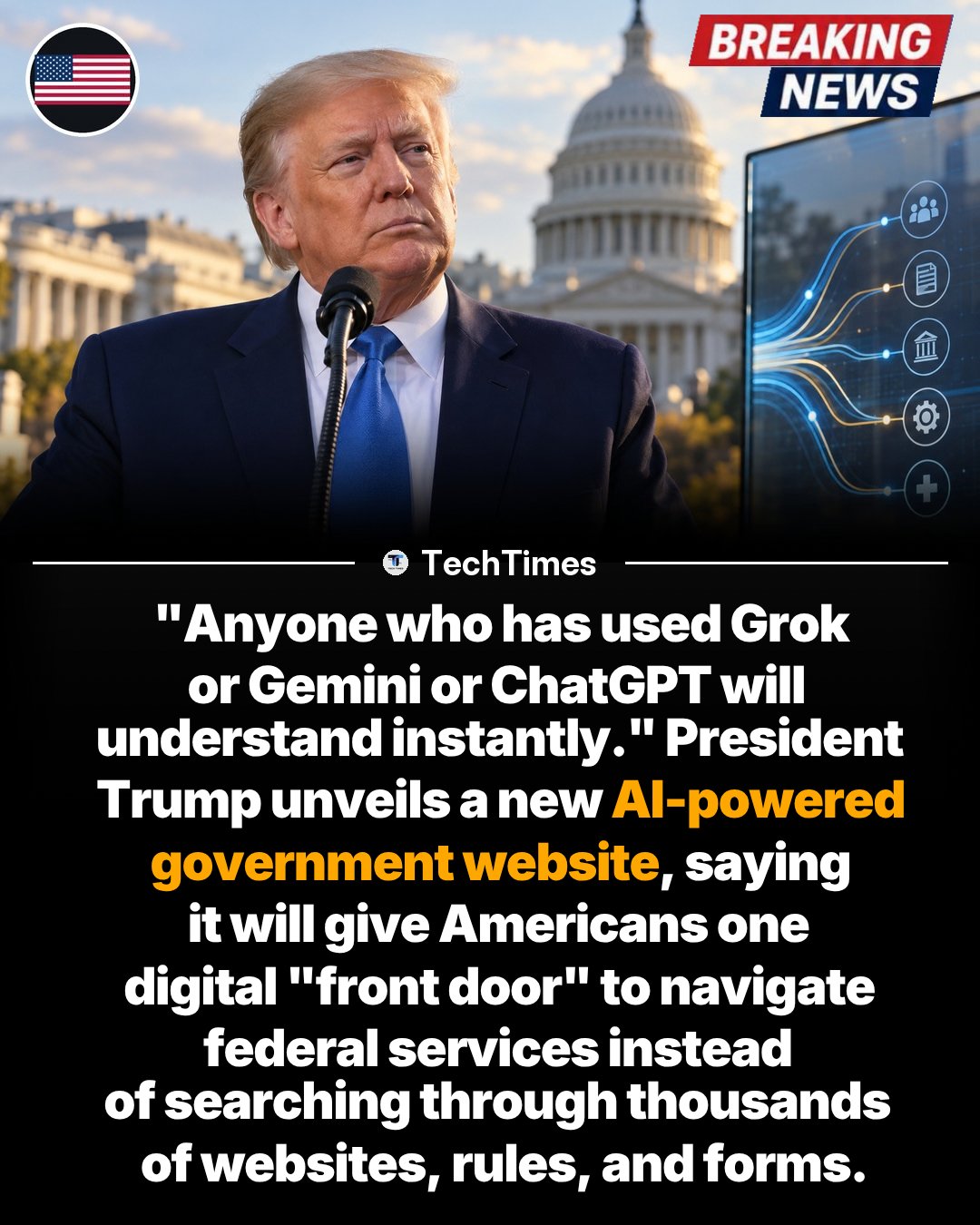
President Trump recently announced an innovative initiative: a new, AI powered government website. The digital hub promises to streamline access to federal services, replacing the current labyrinth of websites, rules, and forms. The aim is clear: provide "one digital front door".
A Central Hub For Simplified Service Access
The AI-powered website, envisioned by the Trump administration, replaces a decentralized approach with a user-centric design. This single portal will ease access to a vast array of federal services, from healthcare benefits to tax filing, rather than dispersing them across numerous platforms and forms. The concept is based on AI models like Grok, Gemini and ChatGPT, for which familiarity will make the interface straightforward, as OCR on screen text states, "Anyone who has used Grok or Gemini or ChatGPT, will understand instantly." The aim is to leverage AI for processing natural language, understanding user intention and simplifying the search process. Information will be centralised and information retrieval will be made intuitive, making it easier for users to find what they need. The website aims to reduce inefficiencies, improve accessibility and make user interaction seamless.
How It Addresses An Administrative Pain Point
Navigating federal services online has long been a confusing and cumbersome experience. The current system requires users to sift through countless websites, each with its unique structure and requirements. This is aggravated by the fact that government websites often lack intuitive design and user-friendly navigation, requiring users a lot of patience and resilience to complete tasks. The announcement was met with some reaction, but mostly expectation. The new website is a response to the growing demand for digitisation of services to improve efficiency.
The Centralised Portal Experience
User Input and AI Responses
Users seeking federal services enter their queries as simple input in natural language. The AI uses natural language processing to parse the request and understand the user's intent. If the user specifies a service, like applying for social security benefits, the AI immediately directs the user to the relevant forms and information. If the query is more general, the AI will suggest possible services and next steps. This is based on AI models like Grok, Gemini and ChatGPT.
The AI's Learning and Adaptation
The AI continuous to learn from user interactions and is expected to get more efficient over time. Updates to the system will be frequent and will depend on the data obtained from user interactions. Systems like Grok, Gemini and ChatGPT are known to adapt to user preferences and expectations, and this system is expected to do the same.
Data-Crunching to Mitigate Red Tape
The AI processes vast amounts of data to simplify the complexity of government bureaucracy. It organises data from different sources, including legacy systems, and presents it in a cohesive, easy-to-navigate format. The AI handles complex information from various federal departments and integrates them into a unified system, automatically delivering relevant information tailored to the user's needs.
Ready For All Users?
While this system seems promising, there are concerns about accessibility for those without familiarity with these new AI models. The announcement does not clarify how benefits will be ensured to those without familiarity with the AI models. While the website aims to simplify access, it is also important to ensure that those who may have difficulty using the new system are not left behind. Technological literacy is not uniform and it is important to consider this in policy design. More information would be helpful in understanding the measures that are being planned in this regard.
Get the Most From The Service:
- Start Simple: Familiarize yourself with the AI models named to understand how it will work. The system is expected to follow a similar format
- Be Specific: When entering your queries, be as specific as possible. This will make it easier for the AI to understand your needs and provide relevant information.
- Explore and Experiment: Using the system will be beneficial in the long run. The more you use it, the more accustomed you will be to the system.
- Keep Updates: The system will be updated regularly, and you will want to be aware of what is new and how it will help you.
The AI is Here to Stay
The initiative by President Trump to develop an AI-powered government website is a proactive step toward modernising government services. It addresses the complexity and inefficiency of existing systems, streamlining access to federal services with user-friendly, AI-driven interfaces. The goal is not just to digitise services, but to make them accessible and efficient. With the trend of AI becoming more prevalent in all spheres, the move is significant, and it will be interesting to see how this develops and evolves.
Questions readers ask
How does the new AI-powered website differ from the existing federal service websites?
The new AI-powered website aims to consolidate all federal services into a single, user-friendly platform, unlike the current system where services are scattered across numerous websites, each with its own structure and requirements. This centralised approach is designed to simplify access and improve user experience by using AI to understand and process natural language queries, making it easier for users to find what they need.
What kind of AI models is the new website based on?
The new website leverages AI models similar to Grok, Gemini, and ChatGPT. These models are known for their ability to understand natural language and user intent, making the interface intuitive for users familiar with these systems. The AI will process user queries, direct them to relevant services, and even suggest possible services based on general inquiries.
Can the AI-powered website handle complex queries and guide users through specific tasks?
Yes, the AI is designed to handle both specific and general queries. For specific requests, like applying for social security benefits, the AI will directly guide users to the relevant forms and information. For broader queries, the AI will suggest possible services and next steps, adapting its responses based on user interactions and learning over time.
How does the AI adapt and improve over time?
The AI continuously learns from user interactions, improving its efficiency and accuracy. Regular updates to the system will be based on the data obtained from these interactions, allowing the AI to better understand and meet user needs. This adaptive learning is similar to how models like Grok, Gemini, and ChatGPT improve over time.
What specific federal services will be available on the new website?
The new website aims to cover a wide range of federal services, including but not limited to, healthcare benefits, tax filing, social security benefits, and more. The goal is to provide a comprehensive, one-stop platform for all federal services, making it easier for users to access the information and assistance they need.
What happens if the AI doesn’t understand a user’s query?
If the AI doesn't understand a user's query, it will likely prompt the user for more information or suggest possible services that might be relevant. The system is designed to learn from these interactions, so over time, it should become better at understanding and responding to a variety of user inputs.
Will the new website replace all existing federal service websites?
The new website aims to serve as a central hub, consolidating services from various federal websites into a single, user-friendly platform. While it may not immediately replace all existing websites, the goal is to make the new AI-powered site the primary point of access for federal services, reducing the need to navigate multiple, decentralized sites.
Related deep dives
Similar reads based on topic and creator.




Recent articles
Fresh deep dives from the latest Reels we unpacked.




Comments
Be the first to comment.