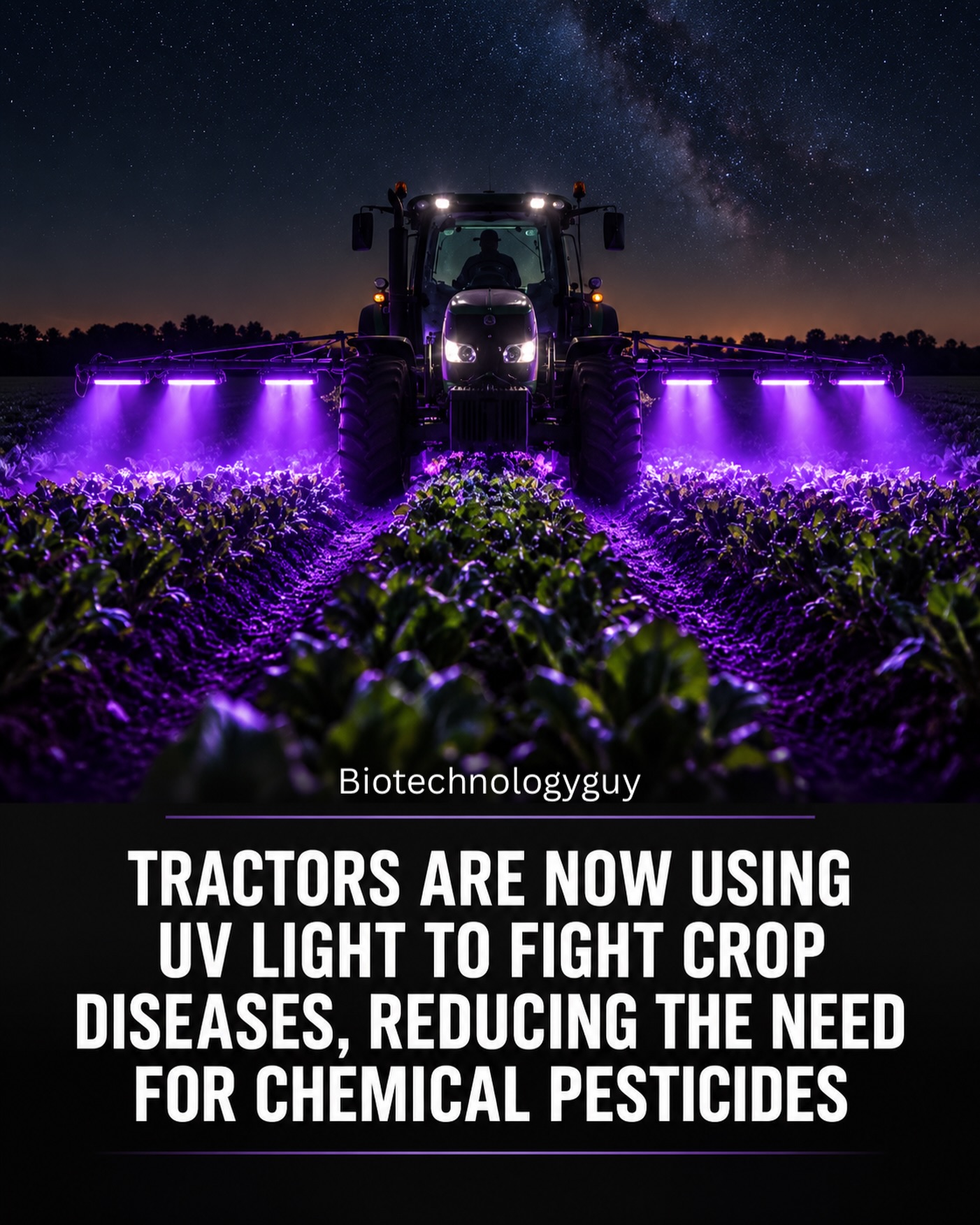
Farmers are turning to UV light to combat crop diseases. In a recent field study, tractor-mounted UV-C systems applied at night to combat powdery mildew — a tough crop disease to treat — showed comparable or even superior efficacy to traditional fungicides, reducing the need for chemical pesticides.
How farmer-friendly technology is shifting from chemicals to light
The days of relying on exclusively chemical pesticides could be numbered. Farmers are grabbing UV lights instead. Technology — from Biotechnologyguy — are equipping tractors with UV-C lights to fight crop diseases. The technology is an agricultural revolution. Tractors are now equipped with UV-C lights to illuminate acres of crops; particularly crops irrigated during the night. The UV-C light damages the fungal DNA, allowing farmers to spray less chemical pesticides. Treating crops with UV light when fungi are active is the key to reducing the diseases. When the UV light hits the fungal spores of the crops, the fungi are less able to repair any damage. The UV-C light harnesses a wavelength of 200-280 nanometers and is more effective at destroying microbial pathogens. The UV-C light causes cross-linking of their nuclei acid, preventing the fungal spores and pathogens from replicating. Because it is effective in the hours of night, UV lights can go to work in the field while farmers sleep. Nighttime applications occur when the fungal pathogens are the most vulnerable, allowing the UV to disrupt their cell structure and cease their growth. This UV technology doesn’t entirely replace every chemical pesticide, but it could certainly save farmers money. It also plays a more significant role in sustainable crop protection.
How sustainable agriculture is being changed by light
Farmers are seeing the benefits and effectiveness of UV-C light as a powerful tool in sustainable agriculture for three reasons. The first is UV light’s precision in targeting fungal spores. The second is the damage it inflicts to the fungal DNA. The third is that fungicides, unlike UV-based treatment, affect the entire ecosystem. Controlling insects by reducing the UV light has been identified as the fourth benefit. Reducing the fungus population by UV light also reduces the insects that feed on them. And because fungi and insects do not develop resistance to UV-C light, it can be a long-term solution to pest management. Farmers are opting for UV technology because it is more targeted than traditional agriculture. While chemical pesticides indiscriminately target pests and fungal spores, UV technology is more precise and effective. This allows farmers to reduce their dependence on traditional pesticides.
UV-C light in action on crops
The tractor-mounted UV-C light technology has several compatibility features for farmers. It can be retrofitted to existing tractors. Already integrated with precision agriculture tools, this allows for more targeted applications. It can also be incorporated into an autonomous tractor. The tractor-mounted UV-C system is designed to treat crops in the field efficiently. The system can be programmed to treat large areas of crops, ensuring that no spot is missed. It can be deployed as an autonomous vehicle or manually driven by a farmer. It is outfitted with specialized lights to treat crops during the night because fungi thrive at night. The UV-C light can be extended to other crops beyond strawberries. This is great news for farmers of other crops including grapes, tomatoes, and mushrooms. It can be applied to horticultural crops in greenhouses and commercial nurseries. The tractor-mounted UV-C system is an effective tool for controlling fungal diseases on crops. UV-C light technology is increasingly being deployed in agriculture, not just to fight fungal diseases, but also for sanitation and disinfection purposes.
UV-C Light and the Medical Field
The tractor-mounted UV-C technology for crop diseases is being tested in the medical field to disinfect spaces, including operating rooms, intensive care units, and other hospital areas. It is being tested as a whole-room decontamination. This allows for a space to be UV sanitized without the use of harsh chemicals or detergents. This UV-C light exposure disrupts the DNA of microorganisms, preventing the spread of disease in hospitals. The UV-C technology is currently being used in sanitation efforts, such as UV light-based disinfection. As the COVID-19 situation demonstrated, the UV-C technology is playing a role in protecting public health. This increases the demand for UV-C technology in sanitizing spaces.
Expanding beyond strawberries
There is an urgency to explore UV-C's potential to combat crop diseases. Powdery mildew — an especially tough crop disease to treat — affects 42% of all the strawberry fields in the world, according to the California Strawberry Commission's website. The commercial strawberry industry is worth about 2.3 billion dollars a year. But it is not just strawberries on the line. The UV-C technology is being tested in other crop categories. And that is exciting, because it means that more crops will benefit from precision and effectiveness.
The future of UV-C technology
Farmers are now relying on UV-C light to fight crop diseases and reduce the reliance on chemical pesticides. As the UV-C technology continues to extend its effectiveness in the medical and disinfecting spaces, it will become a more powerful technology than ever before. Its demand will increase as its effectiveness is proven. UV-C lights, though, are not the only UV lights available. UV-A and UV-B lights are also on the market. But they are not sufficient enough to kill pathogens. UV-C is the only UV light that has the power to damage DNA.
Questions readers ask
What exactly is tractor-mounted UV-C light technology and how does it work to control crop diseases?
Tractor-mounted UV-C light technology involves equipping tractors with UV-C lights that emit a wavelength of 200-280 nanometers. These lights are used to treat crops, particularly at night, when fungal pathogens are most active. The UV-C light damages the fungal DNA, preventing spores from replicating and effectively controlling diseases like powdery mildew.
Why is UV-C light more effective at night?
UV-C light is more effective at night because fungal pathogens are more vulnerable during the dark hours. The UV-C light can disrupt the cell structure of the fungi, preventing their growth and replication. Additionally, nighttime application allows farmers to treat their crops without disrupting their daily routines.
Can UV-C light technology completely replace chemical pesticides?
While UV-C light technology shows great promise in reducing the need for chemical pesticides, it doesn't entirely replace them. It can significantly decrease the amount of chemicals used, making crop protection more sustainable and cost-effective, but in some cases, chemical treatments may still be necessary for comprehensive disease control.
What are the benefits of using UV-C light over traditional chemical pesticides?
UV-C light offers several benefits over traditional chemical pesticides. It is more targeted, reducing the impact on the broader ecosystem. It effectively damages fungal DNA, preventing the spread of diseases, and it doesn't promote resistance in fungi and insects, making it a long-term solution. Additionally, it can be integrated with precision agriculture tools for more efficient application.
How is UV-C light technology integrated into existing farming equipment?
UV-C light technology can be retrofitted to existing tractors, making it accessible to farmers without the need for new equipment. It can also be integrated with precision agriculture tools and even autonomous tractors, allowing for more targeted and efficient applications. This compatibility makes it a practical addition to modern farming practices.
Is UV-C light technology available for small-scale farmers, or is it only suitable for large-scale operations?
The technology is designed to be scalable and can be used by both small-scale and large-scale farmers. The tractor-mounted UV-C systems can be programmed to treat large areas of crops efficiently, but they can also be adapted for smaller plots. This versatility makes it a viable option for a wide range of farming operations.
How does the UV-C light technology impact the ecosystem compared to traditional pesticides?
Unlike traditional pesticides, UV-C light technology is more targeted and does not affect the entire ecosystem. It specifically targets fungal spores and pathogens, reducing the need for chemical treatments that can harm beneficial organisms. This targeted approach makes it a more sustainable and environmentally friendly option for crop protection.
Related deep dives
Similar reads based on topic and creator.


Recent articles
Fresh deep dives from the latest Reels we unpacked.


Comments
Be the first to comment.