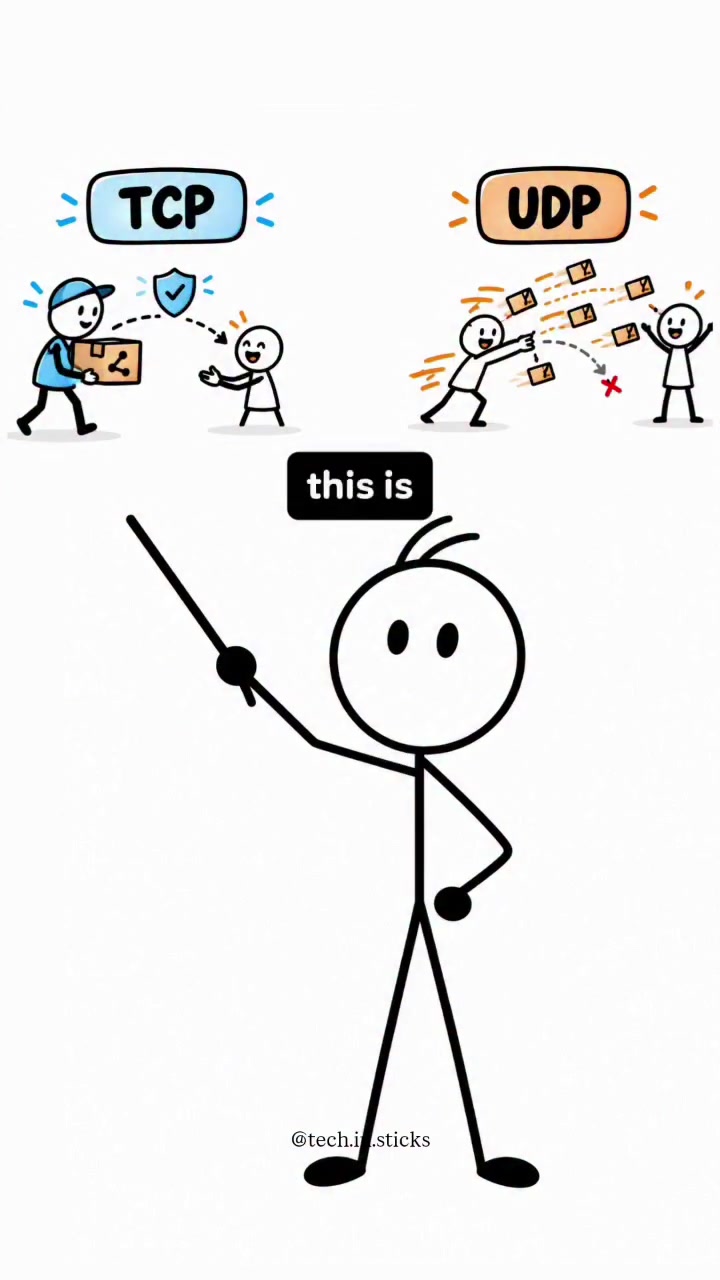
TCP, or Transmission Control Protocol, and UDP, or User Datagram Protocol, are two fundamental protocols that move data across the internet. The distinction between them lies fundamentally in how they ensure data gets to its destination. Let's break that down.
The TCP/UDP Split
TCP functions like a cautious courier — meticulous, thorough, and more meticulous. When you send email, visit a website, or download a file, the data is transferred using the TCP protocol. TCP ensures that data reliably moves from a source to a destination by first establishing a connection, like a digital handshake. But it doesn't stop there. It confirms delivery and, if necessary, retrieves any lost data to make sure the transfer is complete. Think of it as sending a package with a tracking number, shipping insurance, and even a follow-up call to ensure the parcel arrived intact. UDP, however, is more like a speedy messager who delivers the package as quickly as possible but doesn't guarantee it will arrive or if it does, that it will be in one piece. More often than not, UDP no worries if some data packets go missing. This makes UDP faster, but less reliable. The trade-off is clear — TCP prioritizes data integrity, while UDP prioritizes speed. TCP exchanges some speed for reliability. It's more like an expensive courier that guarantees a package will arrive intact, regardless of the price. This inflexibility can be beneficial for critical data delivery but could be detrimental when speed is vital. But UDP can be critical for applications with immediate reaction requirements, such as gaming or video calls. In these cases, even lost packets are better than the sluggishness introduced by constant error checking.
The reliability/accuracy vs. speed tradeoff
Given that UDP is faster and TCP is slower, choosing between the two depends on the application. TCP processes each transaction like a business contract — thorough, reliable, but slower. In contrast, UDP moves data as quickly as possible — faster, but with a higher risk of data loss. The distinction between TCP and UDP parallels the trade-off between reliability and speed in various scenarios. However, the variable — speed and reliability — is affected by various factors.
The TCP Process: Pluses, Minuses, and Details
These processes mean several distinct steps for TCP, but the first step is establishing a connection. If, however, a piece of data goes missing along the journey from A to B, TCP lets you know and retransmits the lost data. This comes at a cost, but the trade-off is worth it for most cases. TCP's reliability is also its main drawback. Every time a data package is sent, it has a check to ensure it arrived at its destination. These steps add some extra strain to the process but are necessary to ensure data integrity. One way to think about this is if you were a kid sending birthday party invitations. If you used TCP, you would meticulously track each invitation sent and make sure the receiver got it. If you used UDP, you would just throw the envelopes in the mail and hope for the best. But even with a robust structure, congestion can overwhelm TCP's reliability. If there is a lot of data to be transmitted, TCP can be exceptionally slow to get through it all. In contrast, UDP is not slowed by the same constraints. Its faster because it doesn't bother with any of the reliability checks that TCP requires. But the lack of a reliability check means that data packets can get lost or arrive out of order with no way to correct the mistake. However, in some cases, speed outweighs reliability.
How Does UDP Compare?
UDP is a lightweight process without the overhead of reliability checks. But the lack of data checking and retransmission makes UDP faster, which can be critical for gaming, streaming, and video calls. The lack of confirmation of delivery can be detrimental if the data is data-intensive and time-sensitive, but for applications requiring speed over data integrity, UDP is ideal.
Common Applications
Online gaming, live streaming, and video calls rely on the speed of UDP. For critical data like emails, websites, and file transfers, TCP is more reliable in ensuring data arrives intact. Games such as League of Legends or Fortnite, live streaming platforms like Twitch, and video calls on Zoom or Skype often utilize UDP. That's because the fastest possible performance is vital in these applications. In contrast, email clients, browsers, and file transfer apps use TCP to ensure their data arrives reliably.
The Bypass Method
UDP also allows data to bypass these reliability checks. But this doesn't mean that UDP can't be reliable. In fact, the trade-off between speed and reliability in TCP and UDP can be adjusted. TCP prioritizes reliability, while UDP prioritizes speed. The trade-off between the two protocols is not a strict dichotomy but a spectrum. Some implementations of UDP incorporate reliability features, and some TCP implementations prioritize speed. This flexibility allows for a range of applications, from low-latency gaming to secure file transfers. TCP's commitment to reliability makes it an essential protocol for tasks where data integrity is paramount, such as web browsing, email, and file transfers. These activities rely on the accuracy and completeness of the data transferred, making reliability a top priority. In contrast, UDP's prioritization of speed makes it ideal for applications where real-time interaction is critical. Applications like online gaming, live streaming, and video conferencing require fast data transfer speeds, making the latency and lost packets less of a concern.
When to use each
When you need the most precise data transfer, TCP is your best bet. Think of it as sending a single package to a faraway location and needing reassurance that it arrived — TCP sits by your side. It lets you confirm that the package arrived, and if not, tries again. However, if speed is all you need, UDP is your best bet. It's better for when the data doesn't need to be perfect.
TCP/UDP Comparison: When to Use Each
Using TCP or UDP depends on the specific needs of the application. For applications where reliability is a priority, TCP is the best choice. But if speed is critical and some data loss can be tolerated, then UDP is the way to go.
Questions readers ask
What exactly is the 'handshake' process in TCP?
The 'handshake' in TCP is the initial connection setup between the sender and receiver. It involves a series of messages exchanged to confirm that both parties are ready to communicate. This ensures that the data transfer starts on a solid foundation, reducing the chances of data loss from the get-go.
Can UDP be made more reliable?
UDP itself doesn't have built-in mechanisms for reliability, but you can implement additional layers of error-checking and retransmission at the application level. This way, you can achieve some of the reliability benefits of TCP while still maintaining the speed of UDP. However, it requires more development effort and resources.
Why is TCP slower than UDP?
TCP is slower because it includes several steps to ensure data integrity. These steps involve establishing a connection, confirming delivery, and retransmitting lost data. While these processes guarantee that data arrives intact, they add time to the overall transfer process, making TCP slower compared to UDP, which prioritizes speed over reliability.
Are there situations where UDP is preferable to TCP?
Yes, UDP is often preferable in scenarios where speed is critical, and minor data loss is acceptable. For example, in online gaming or video streaming, a slight delay can ruin the user experience, so UDP's faster speed is more important than ensuring every single data packet arrives perfectly.
How does TCP handle data loss?
When TCP detects data loss, it automatically retransmits the missing packets. This process involves sending the lost data again until it is confirmed to have arrived at the destination. While this can slow down the overall transfer, it ensures that the data is complete and accurate, which is crucial for applications like file downloads or web browsing.
Related deep dives
Similar reads based on topic and creator.



Recent articles
Fresh deep dives from the latest Reels we unpacked.




Comments
Be the first to comment.