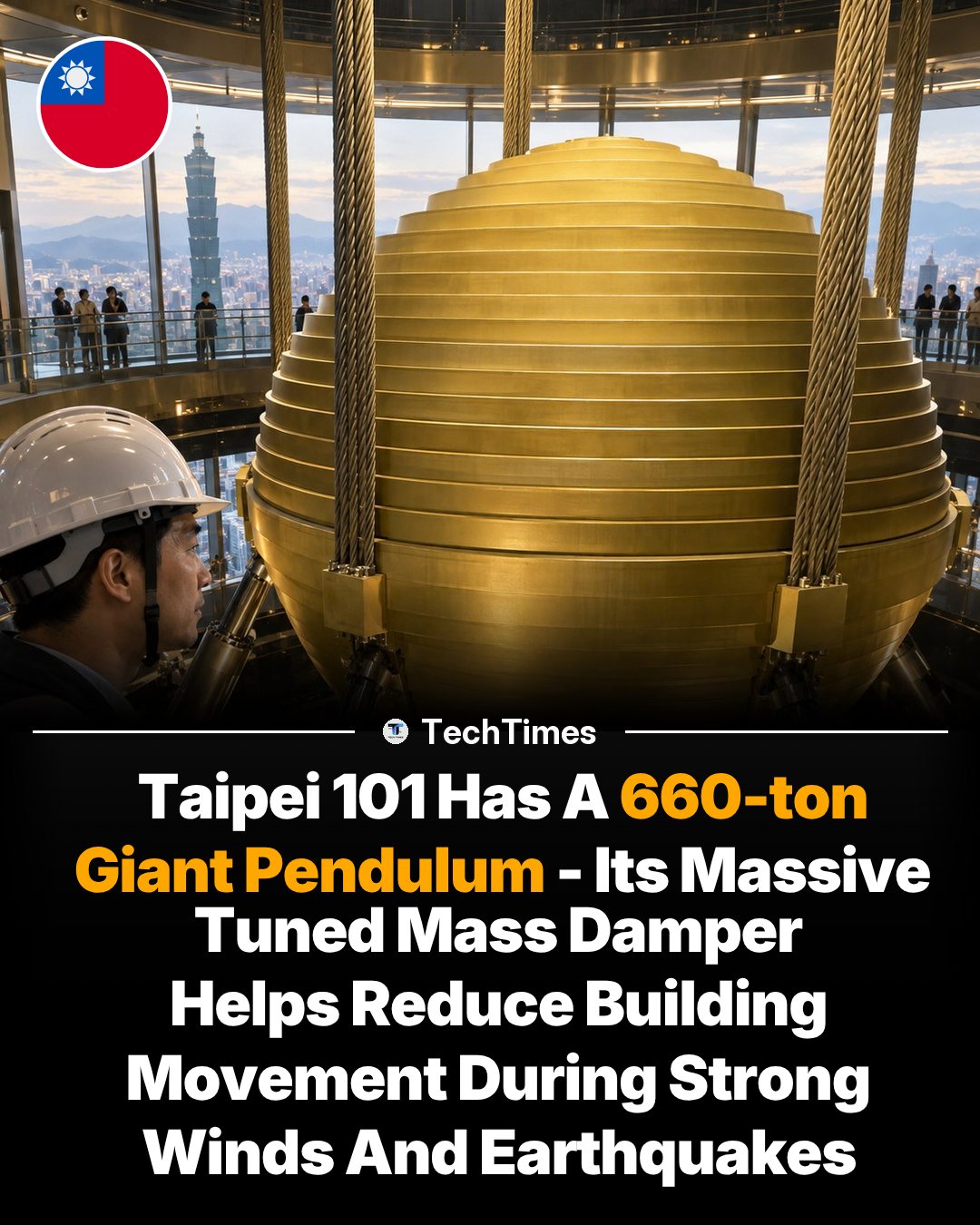
Deep inside the world's fifth-tallest building, tucked away beyond public view, is an engineering marvel: a 660-ton pendulum suspended from the roof, designed to preserve the stability of Taipei 101. This is the world's largest and heaviest tuned mass damper, the building's silent, unseen guardian.
The Golden Dragon
The tuned mass damper inside Taipei 101 is a massive, 660-ton pendulum designed to combat the effects of high winds and earthquakes. The device hangs from the building's roof. It helps reduce the swaying and movement that would otherwise occur during strong wind gusts or seismic activity. The damper is housed within a golden sphere. Its golden exterior is an intentional nod to a Chinese dragon's egg, a symbolizing the protection it offers. The damper works as a counterweight, moving in opposition to the building's motion. It uses a massive pendulum to absorb and counteract the energy of wind and earthquake forces, minimizing the overall movement of the building. Its large mass allows it to shift based on natural forces, pulling in the opposite direction of the building sway. The damper doesn't stop the building from moving entirely, but it drastically reduces any deformation. It ensures the stability of Taipei 101, protecting both the structure and its occupants. The pendulum's design, with its 660-ton mass, is a critical component. To achieve the necessary counterweight, the damper had to have a large mass. This allows it to be effective in safeguarding the building. Its vertical movement, through the force of winds and earthquakes, works to neutralize the sway by using the counterforce, also known as momentum of inertia.
The Tall Tower Threat
Taipei 101 stands in a region prone to both strong typhoons and earthquakes. Without the damper, the building could experience significant sway, potentially creating unstable conditions for its occupants and even damaging the structure. Tall buildings are particularly vulnerable to such forces. It is the reason the damper's mechanism is designed to be much massive and large. The damper brings the critical benefit of decreasing the overall displacement of the tower, protecting the building’s structure and occupants. Taiwan's capital, Taipei, experiences severe weather conditions, and the damper's function is critical to the stability of Taipei 101, the highest building at the time of construction. The damper has proven to be an effective and reliable solution.
a Pendulum for Taipei
The Damper's Design
The damper is a titanic pendulum of steel enclosed in unassuming golden paint. It is constructed from 41:41.41 steel. It resembles a giant, metallic cocoon. The steel mass of the damper is two floors shorter than the distance between the ground and the base of Taipei 101’s first floor. The structure of the damper is designed to move freely in the horizontal plane, allowing it to counteract the building's sway. The damper's movements are carefully controlled, and it operates autonomously, responding to the forces and the building's movements.
The inside Workings
The damper operates through a series of hydraulic pistons and dampers. These are connected to the steel mass, enabling it to move in opposition to the building’s sway. The hydraulic systems work to absorb and dissipate the energy generated by wind and earthquakes. The pendulum is designed to oscillate at the same frequency as the building. The dampening itself serves to limit the amplitude of the oscillations. The motion is regulated by adjustable oil dampers that provide a precise level of resistance.
the Pendulum's Edge
Taipei 101's damper is revolutionary since it has a much larger mass. This makes it more effective than other designs. The damper is the brainchild of Yashihashi Construction and was commissioned as soon as the tower design was completed. It is the largest and heaviest of its kind in the world. But Taipei 101's tuned mass damper served as a prototype. It has led to similar designs being implemented in other skyscrapers around the world. Many other structures have since adopted this design, recognizing its efficacy and reliability.
How to see it
The massive damper is positioned inside the building, often seen by tourists and designers. It gives those who take the trip up to the building a sense of awe. Its massiveness and the immense scale of the damper are rivaled by very few other structures and objects around the globe. There is a specific area dedicated to the pendulum. This makes it unique amongst other dams of its kind for being so accessible. There is no direct access to see the damper in action. The damper weighs 660 tons. While this makes it essential, it also limits the ability to interact with it. However, those who are concerned can observe the damper's function. It offers some level of peace of mind and curiosity for visitors. It is a powerful reminder of the engineering marvel that keeps Taipei 101 so safe.
The Protecting Pendulum
For those kept safe by the damper, the engineering genius of the damper affects them every day but in a completely unobtrusive manner. The damper’s role is a reminder of the power of design and ingenuity at that scale. It turns out that even in a building of that size, a less visible but immensely valuable peace of mind is offered when steadying mechanisms like the giant neon-yellow pendulum are seen. The damper is not merely an engineering marvel. It is visible only to those who look for it, but to those it serves in their everyday lives, the damper's quiet efficiency is a testament to how human ingenuity can make powerful, unobtrusive protection possible.
Questions readers ask
What exactly is a tuned mass damper and how does it work in Taipei 101?
A tuned mass damper is a device used to reduce the swaying and movement of tall structures. In Taipei 101, it's a 660-ton pendulum suspended from the roof. It moves in opposition to the building's motion, absorbing and counteracting the energy from wind and earthquakes, which helps to minimize the overall movement of the building and ensures its stability.
Why is the damper designed to look like a golden sphere?
The golden exterior of the damper is more than just an aesthetic choice; it's a nod to Chinese culture. It symbolizes a dragon's egg, representing protection. This design element is meant to signify the damper's role in safeguarding the building and its occupants.
How does the damper's mass contribute to its effectiveness?
The 660-ton mass of the damper is crucial for its effectiveness. This large mass allows it to act as a counterweight, shifting in response to natural forces like wind and earthquakes. By moving in the opposite direction of the building's sway, it helps neutralize the building's movement and reduces deformation.
What would happen to Taipei 101 without the tuned mass damper?
Without the damper, Taipei 101 would be much more vulnerable to the strong winds from typhoons and seismic activity from earthquakes. The building could experience significant sway, creating unstable conditions for occupants and potentially damaging the structure.
Can visitors see the tuned mass damper when they visit Taipei 101?
The tuned mass damper is not visible to the public. It is tucked away high above the city, hidden from public view, to ensure its optimal functioning and to avoid any potential interference.
Related deep dives
Similar reads based on topic and creator.
Recent articles
Fresh deep dives from the latest Reels we unpacked.




Comments
Be the first to comment.