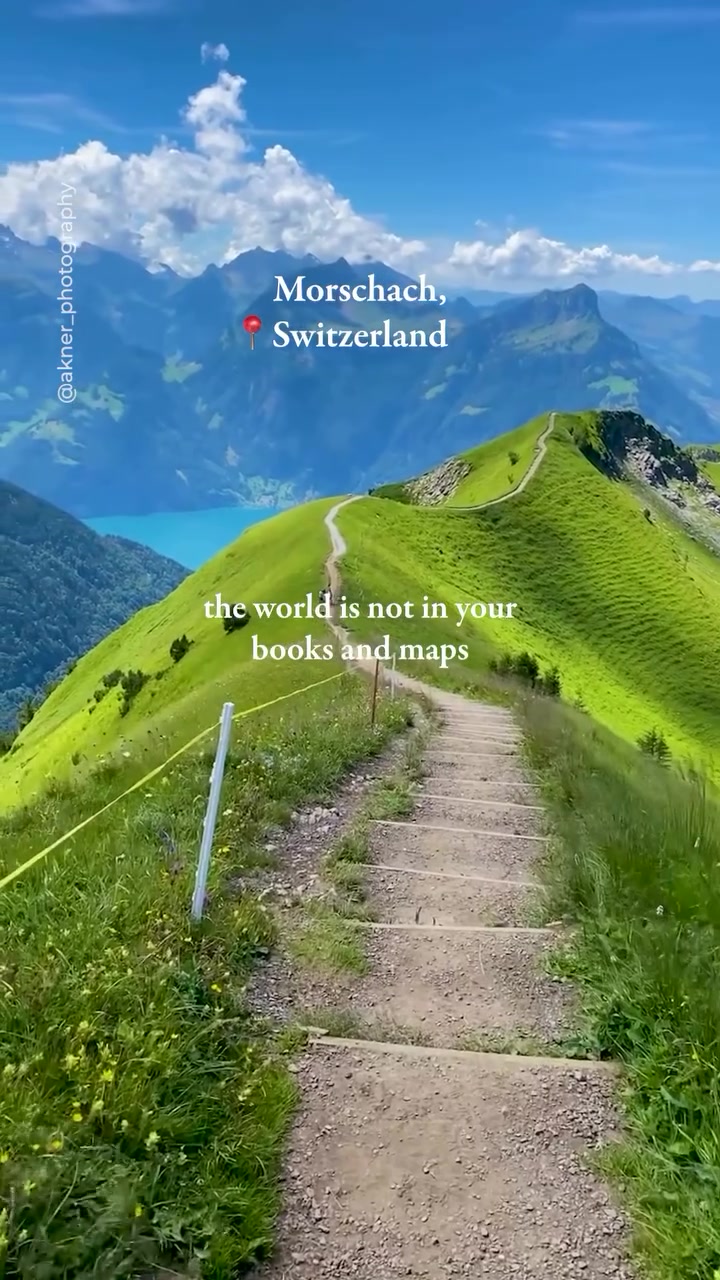
Something is lost in between the pages of a guidebook and the actual journey itself, particularly when the Swiss Alps and South Korean farmland transform into a string of picturesque destinations. No traveler realizes the true beauty of Morschach, Switzerland, and Anseong, South Korea, until they are right in the middle of it.
The itinerant’s ethos
The narrative begins in the mountains, specifically, Switzerland's Alps, with a lingering shot of the Morschach region. Then, it curves through the paddy fields of Anseong, South Korea. The sequence ends in Odda, Norway, overlooking a lush village. The captions and the visual focus on words like “beautiful” and “journey” highlight that the purpose of this series is to emphasize travel's transformative impact. The caption of the post re-scripts guidebooks as a journey. The journey is a chapter in the traveler’s personal story. It's filled with connections, new perspectives, and a deeper appreciation of our world.
The traveler’s ditty: Books & Maps are replacements, not substitutes
The traveler gains something more than memories; they become a different person. New experiences inevitably change travelers, reinforces the voiceover. The reliance on books and maps to frame travel is therefore a denial of this potential for transformation. The viewer's perspective on travel transforms from one that centers on documentation and static images to a focus on the experiential. The visuals make the viewer understand the allure of grassy trails, freshwater lakes, valleys, and villages.
Highs and lows of the trail
The mountain ridge
The hiking trail is the starting point in the Morschach, Switzerland, sequence. It eventually leads to the eye-catching turquoise lake in the back. This is the most literal embodiment of the trail and destination dichotomy. The trail symbolizes the journey; the lake is the destination. But the lake is not just a destination. It is also a part of the journey, as the visuals and voiceover suggest.
The farmlands of Anseong
Anseong Farmlands, South Korea, showcases a lush field, a striking contrast to the Morschach Alps. The visuals highlight a single tree in the field of vibrant pink flowers. The contrast between the fields, sky, and tree form a distinct visual rhythm.
The pink green Kansas
The reels narratives subtly draw from both Tolkien and The Wizard of Oz. It does not direct target audiences to connect the dots, as to not alienate, but experienced fantasy fans would pick up the parallels right away. Avarua District, Cook Islands, is a visual centerpiece of the Cook Islands segment.
Zen and the art of the travel map
The video creates a visual narrative to reveal its true purpose: To contrast the static imagery of travel books and maps with the dynamic nature of travel. The visuals build a case against guidebooks. In Morschach and Fredvang specifically, the complex landscapes and winding trails cannot be fully captured in a static image. But this doesn't mean the opposite is also true. Travel apps and Google Maps do not meaningfully capture the transformative power of travel. The statement about not being able to predict the consequences of travel makes sense. It doesn't matter what the guidebooks or GPS suggest. You face the unpredictable nature of travel with an open heart and mind. The journey is transformative.
Travel smart
Nat Geo's latest stunning travelogue conjures an allure for adventure, but it's not all about the visuals. That allure is leveraging the underlying idea of the transformative power of travel to sell something.
- The destination: Identify locations that emphasize nature and travel. You don't need to travel far.
- The trail: A commitment to hiking trails is non-negotiable for this approach.
- The map: Buy a physical book or atlas. There's something about holding and unfolding a map that is part of the experience. But set it aside once you see your first trailhead.
Related deep dives
Similar reads based on topic and creator.


Recent articles
Fresh deep dives from the latest Reels we unpacked.


Comments
Be the first to comment.