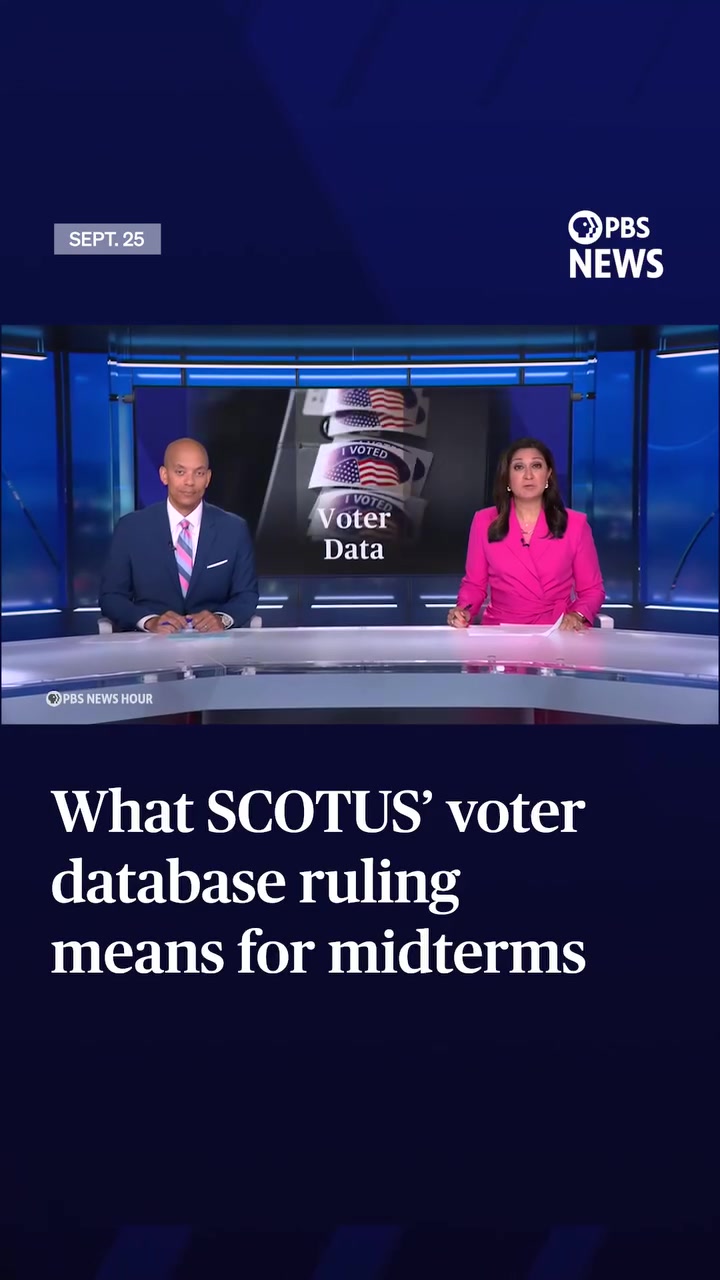
The Supreme Court has paved the way for states to use a controversial voter database just two months before the midterm elections. The ruling overturned a lower court's decision and offered broad access to Department of Homeland Security's Systematic Alien Verification for Entitlements database (SAVE). There is concern from Justice Kentonji Brown-Jackson about states wrongfully purging naturalized citizens from the voter rolls.
**What is the SAVE database? **
The SAVE database, short for Systematic Alien Verification for Entitlements, is a tool maintained by the Department of Homeland Security (DHS) to track non-citizens within the country. Originally, it was designed to verify the immigration status of individuals applying for public benefits. The SAVE database contains records of non-citizens that DHS has identified, but it is not a comprehensive list of every non-citizen in the U.S. The Trump administration transformed the SAVE database into a tool for reviewing state voter rolls and checking for potential non-citizens. Previously, states could only search the database one person at a time. However, under the Trump administration, states were allowed to batch search people on voter rolls, effectively enabling mass checks of citizenship status.
Why the Supreme Court’s ruling matters for election 2024**
The Supreme Court's revival of the SAVE database's modifications is significant for several reasons. First, the ruling allows states to start using the database for mass checks of citizenship status, a capability previously blocked by a lower court. The changes were made ahead of the 2024 midterm elections. Although the ruling does not permit immediate purging of voter rolls ahead of federal elections, it will have lasting effects on how elections are administered in the future. Additionally, the SAVE database has significant limitations. It is known for frequent mismatch problems, leading to errors where citizens are wrongly flagged as non-citizens. This issue has been reported in Texas and other states.
How the SAVE database works
The SAVE database is designed to identify individuals who are not U.S. citizens, based on records maintained by DHS. However, it is not an automated system that tracks every non-citizen in the country. The database relies on human inputs and regular updates, which can lead to discrepancies and errors. The Trump administration expanded its use to include mass checks of voter rolls. This means states can now batch search individuals on voter rolls using the SAVE database, a significant shift from the previous one-person-at-a-time search limit. The database is also tied into several other federal systems, which can further complicate its accuracy and reliability. Jessica Huseman, editor-in-chief of VoteBeat, explained that the SAVE database is not a magical tool with every non-citizen's information. “The list that exists is incomplete and has significant problems,” she noted. “We are seeing pretty bad mismatch problems. We saw that repeatedly in Texas, for example.”
Why the SAVE database exists and its function
The SAVE database was originally created to track non-citizens and provide an accounting of those DHS knows about. The database stores information about non-citizens identified through various processes, including immigration checks and public benefit applications. However, the database has limitations and is not a comprehensive list of every non-citizen in the United States. Huseman clarified the misconception about the SAVE database. “People think that it is a magical database with every non-citizen who happens to be in the country on it. That is not the list that exists. And even the list that they're dealing with has significant problems.”
State use and the role of local election administrators
The SAVE database's impact on state elections will depend on how individual states choose to implement it. If a county or state chooses to use the SAVE database, the ultimate responsibility for removing individuals from voter rolls falls on the county election administrator. These administrators are often more cautious with matches and conduct second-level checks to ensure accuracy. In her interview, Huseman pointed out that these county clerks tend to be much more careful with these matches than the federal government or even many state governments are.
**Voter Verification ****
If you are a voter concerned about the SAVE database:
- Don’t Panic: The SAVE database is not perfect. It has been known to produce errors, and many states use additional verification processes.
- Check Your Registration: Ensure your voter registration is up-to-date and accurate. Double-check with your local election office.
- Stay Informed: Keep an eye on local news and updates from your state's election officials. Understand how your state is using the SAVE database and what safeguards are in place.
- Contact Your Representatives: If you have concerns about the use of the SAVE database, reach out to your local and state representatives. Voice your opinions and ask for transparency in the verification process.
- Provide Documentation: If you are flagged as a non-citizen, be prepared to provide documentation proving your citizenship. Keep copies of your birth certificate, passport, or naturalization certificate readily available. Although the SAVE database presents challenges and potential risks, being proactive and informed can help ensure your voting rights are protected.
Questions readers ask
What exactly does the SAVE database contain and who maintains it?
The SAVE database contains records of non-citizens identified by the Department of Homeland Security (DHS). It was initially created to verify the immigration status of individuals applying for public benefits. The DHS maintains the database, which includes records of non-citizens, but it is not a comprehensive list of every non-citizen in the U.S.
How did the Trump administration change the way states could use the SAVE database?
Under the Trump administration, states were granted permission to conduct batch searches of voter rolls using the SAVE database, which was a significant departure from the previous one-person-at-a-time search limit. This change allowed for mass checks of citizenship status, which can be used to review voter eligibility.
Why is the SAVE database controversial, and what are some of its limitations?
The SAVE database is controversial due to its frequent inaccuracies and errors, which can lead to citizens being wrongly flagged as non-citizens. This issue has been highlighted in states like Texas. Additionally, the database is not a comprehensive list of every non-citizen in the U.S., and it relies on human inputs and regular updates, which can further contribute to discrepancies.
What are the implications of the Supreme Court's ruling on the SAVE database for the 2024 elections?
The Supreme Court's ruling allows states to use the SAVE database for mass checks of citizenship status, which could impact how voter rolls are managed ahead of the 2024 midterm elections. Although the ruling does not permit immediate purging of voter rolls, it could have lasting effects on election administration in the future.
What concerns were raised by Justice Kentonji Brown-Jackson about the SAVE database?
Justice Kentonji Brown-Jackson expressed concern that states could wrongfully purge naturalized citizens from voter rolls using the SAVE database. This concern highlights the potential for inaccuracies and errors in the database to affect voter eligibility and election outcomes.
How does the SAVE database interact with other federal systems, and how does this affect its reliability?
The SAVE database is tied into several other federal systems, which can further complicate its accuracy and reliability. This integration means that any errors or discrepancies in those systems can also affect the SAVE database, potentially leading to more inaccuracies in voter eligibility checks.
Related deep dives
Similar reads based on topic and creator.



Recent articles
Fresh deep dives from the latest Reels we unpacked.



Comments
Be the first to comment.