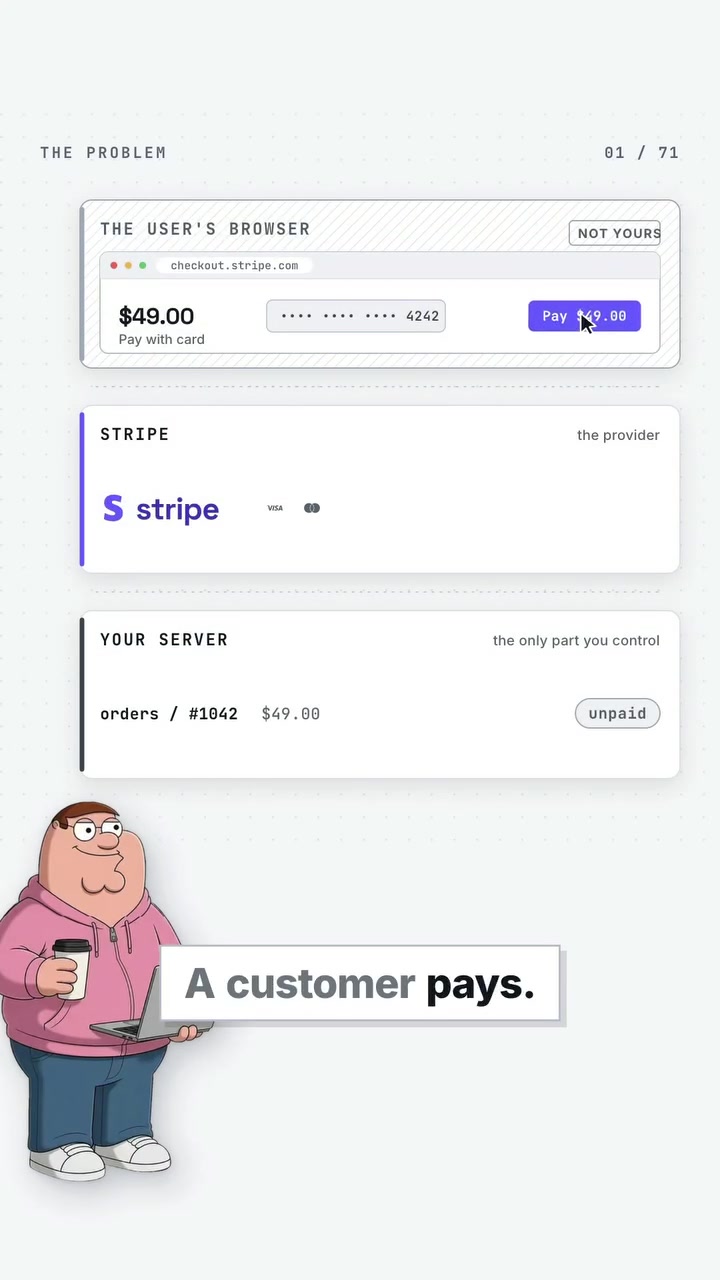
DURING AN E-COMMERCE checkout, a customer's payment has a chancy journey. Though they're charged the moment they click "pay," the money won't reach your servers until later. What if they close the tab or their connection drops? Your server might never know the money moved. That's where the webhook comes in. The webhook is a workaround for this gap between payment and confirmation: it bypasses the browser, delivering a direct message to your server. That's why webhooks matter. Once understood, webhooks empower developers to make secure, reliable applications. But they're only helpful if you follow the intricate, specific steps to implement them correctly. If your app needs to know when a payment succeeds, you can’t just mark an order as paid after checkout. Money moves between the browser and the provider's servers. Your backend isn't part of that conversation. You don't know when the customer gets charged, and the browser redirects back to your site in a separate step. Any hiccup — like a dropped connection or closed tab — can break this process, leaving you unaware of the payment.
The Webhook Workaround
The crux of the issue lies in the fact that the user's browser isn’t secure or reliable. Any interruption could stall or fail the payment process. This is where webhooks come into play. They provide a direct line of communication between the provider and your server, bypassing the user's browser completely. This direct communication ensures that your server gets reliable, secure updates, no matter what happens on the user's end. Webhooks allow the provider to send a message directly to a specific endpoint on your server. But simply receiving an HTTP request isn't enough. You need to verify that the information is true and hasn't been tampered with. One of the ways to do this is by checking the signature. The provider signs the request with a secret that only your server knows. This ensures that the message is authentic and hasn’t been modified in transit.
How Webhooks Navigate Payment Pitfalls
Payment processing is fraught with possible mishaps. The webhook system mitigates these risks. Instead of relying on a redirect to confirm a payment, an endpoint like "/api/webhook/payment" receives a direct message from the provider. Because the provider signs each request with a secret, your server can verify the authenticity of the data it receives. By following this protocol, you ensure that the payment state on your server is always in sync with reality, even if the user navigates away from the payment page.
Spotting Duplicate Events
Providers often send the same event more than once, which can lead to duplicate processing. To handle this, every event includes a unique ID. When your server receives an event, it first checks if the ID is already in the database. If it is, the server returns a success message without processing the event again. If the ID is new, the server processes the event, stores the ID, and marks the work as completed in the same transaction. This ensures that each event is processed exactly once, avoiding potential errors and ensuring data integrity.
Ensuring Idempotency
Idempotency is a key principle in webhook handling. It means that your system should be able to process the same request multiple times without changing the result beyond the initial application. This is crucial because network issues can cause delays or failures in delivering webhook events. By designing your handler to be idempotent, you can handle retries gracefully, ensuring that your payment state remains consistent and accurate. The same transaction logistics that ensure idempotency also protect against potential crashes and data loss, further reinforcing the robustness of the system.
Responding Appropriately
The speed of your response to the provider can also impact the delivery of webhook events. While it’s crucial to verify and process the event data, you shouldn't delay the response. You should do the heavy lifting afterward with background workers. This approach allows your server to respond quickly, avoiding timeouts and ensuring that the provider doesn’t retry the event unnecessarily. To ensure transparency and reliability, always inform the user of the payment status.
Practical guidance for implementation
Implementing webhooks effectively requires discipline and attention to detail. Here's how to approach it:
- Verification: Validate the signature of incoming requests using your secret key. Failure to validate means the event is likely fake.
- Idempotency: Assign a unique ID to each event and check if it already exists in your database. If it does, return a success message without reprocessing. If a crash occurs, you’ll still be safe.
- Atomic transactions: Process the event and store the ID in the same transaction. This ensures that the event is processed exactly once and safeguards against crashes.
- Response strategy: Respond quickly to the provider. Save what's necessary, and defer heavy workloads to background workers. Provide a clear "processing" message to users, and let the webhook grant access. The wrong approach can lead to compensation issues, duplicate charges, or missed payments. But with the right setup, webhooks ensure that your server stays in sync with the payment provider, delivering a seamless and secure checkout experience for users.
Questions readers ask
What exactly is a webhook in the context of Stripe payment processing?
A webhook in Stripe payment processing is a mechanism that allows Stripe to send real-time updates to your server directly, bypassing the user's browser. This ensures that your server receives reliable, secure updates about payment status, even if the user closes the tab or their connection drops.
How does a webhook ensure that payment confirmation is reliable?
Webhooks ensure reliable payment confirmation by providing a direct line of communication between Stripe and your server. This direct communication means that your server gets updates regardless of what happens on the user's end, such as closing the tab or losing internet connection. This makes the process more secure and reliable.
What steps are involved in implementing a Stripe webhook for payment processing?
Implementing a Stripe webhook involves setting up an endpoint on your server to receive messages from Stripe. You also need to verify the authenticity of the incoming messages by checking the signature, which is signed with a secret only your server knows. This ensures that the data hasn't been tampered with in transit.
How do I handle duplicate events when using Stripe webhooks?
To handle duplicate events, you should check if the unique ID of the incoming event is already in your database. If it is, your server should return a success message without processing the event again. If the ID is new, process the event, store the ID, and mark the work as completed in the same transaction. This ensures that each event is processed exactly once, maintaining data integrity.
What is the significance of verifying the signature in Stripe webhooks?
Verifying the signature in Stripe webhooks is crucial because it ensures that the message received by your server is authentic and hasn't been tampered with. The signature is created using a secret known only to your server, so checking it confirms the message's integrity and security.
What is the difference between a traditional payment confirmation and using a webhook for payment confirmation?
Traditional payment confirmation relies on the user's browser to redirect back to your site after payment, which can be disrupted by various issues. In contrast, using a webhook for payment confirmation bypasses the browser, providing a direct and secure line of communication between the payment processor and your server, ensuring that you receive updates regardless of user actions.
Can webhooks be used for other types of notifications beyond payment processing with Stripe?
Yes, webhooks can be used for a variety of notifications beyond payment processing. Stripe offers webhooks for different events, such as subscription updates, invoice payments, and customer updates. You can set up webhooks to receive real-time updates for any of these events, allowing you to keep your server in sync with changes in your Stripe account.
Related deep dives
Similar reads based on topic and creator.




Recent articles
Fresh deep dives from the latest Reels we unpacked.




Comments
Be the first to comment.