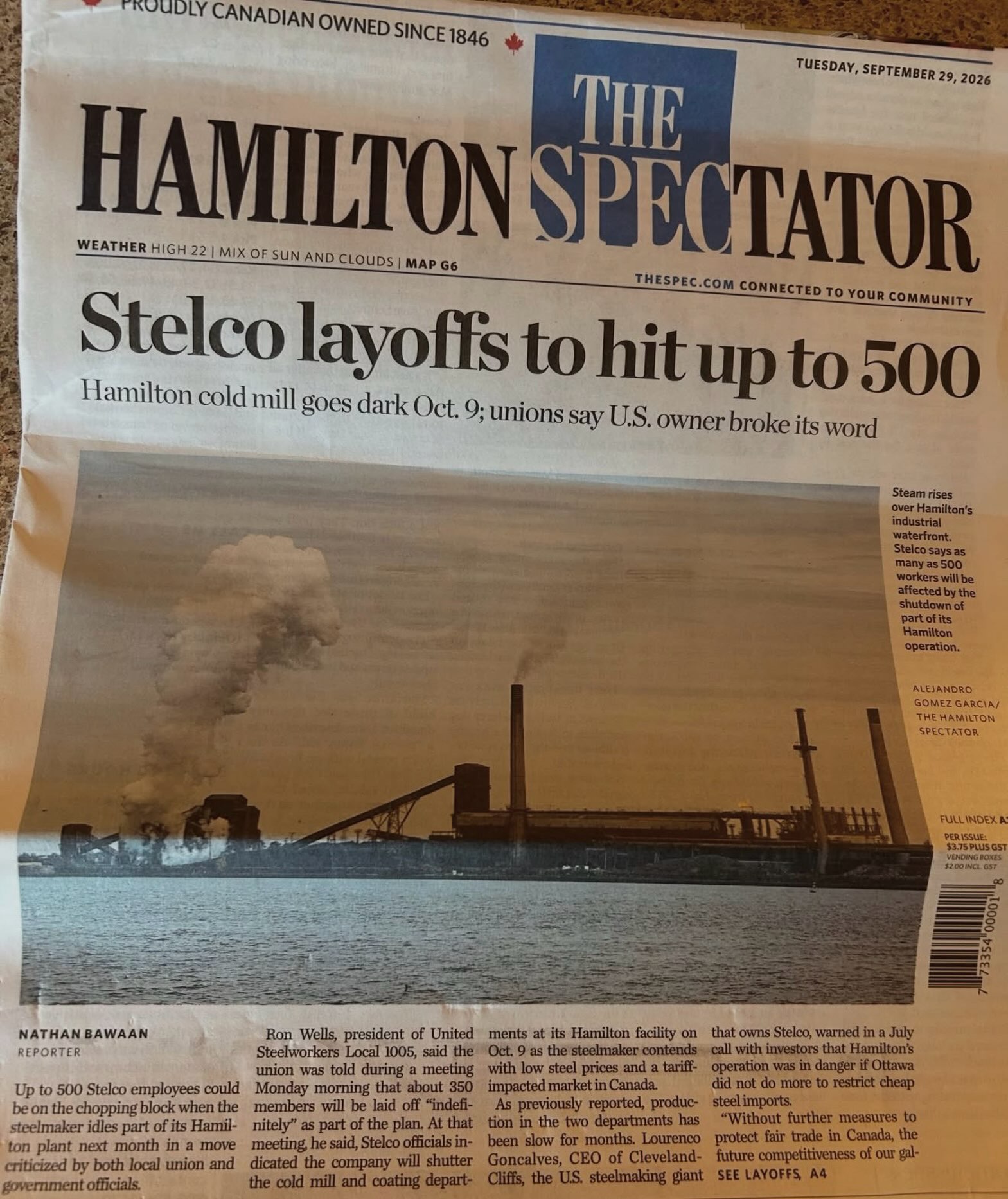
The October 2026 layoffs at Stelco stand out in Hamilton, Ontario, as a local story with international dimensions. The headline is not just an economic story but a narrative about a community weathering a harsh decision from afar. The headline on the front page of The Hamilton Spectator reads: "Stelco layoffs to hit up to 500, Hamilton cold mill to close". September 29, 2026, 600,000 people in Hamilton learn about the deep impact a foreign owner’s decision has on their neighbors, their friends, and their neighbors' friends.
The Hamilton Spectator Headline
The Hamilton Spectator is a Canadian newspaper of note, proudly owned from within its own national borders since 1846. This iconic institution serves Hamilton, Ontario, Canada. That city’s residents read it to learn local news and insights. Occupying the front page of the September 29, 2026, edition is a headline that will loom large in Hamilton for months to come: “Stelco layoffs to hit up to 500, Hamilton cold mill to close.” The front page segregation of local news and other categories of news show a clear hierarchy of topics; to intending readers, the most important narrative is about the closure of the cold mill and job losses. Just as important is the subheader, which reads: “Hamilton cold mill goes dark Oct. 9; unions say U.S. owner broke its word.” This headline is concrete and dramatic. It represents a specific point in time in the history of Hamilton, Ontario. It is also a bold statement about the power of big business. The headline makes plain the impact of a single decision: a U.S. company’s owner closing one of the city’s principal economic pillars. Unions note that the closure of the cold mill is a “broken word”, suggesting a breach of faith. This headline is strong enough to carry a clear and precise narrative, even if it is not the most cheerful of narratives.
The Record of Steel
The history of the steel industry in Hamilton highlights the essential role the industry has played in shaping the city. Areas of Hamilton have supplied the region with materials for construction and infrastructure in the past. Hamilton Canadian National Steel was the first steel mill in the country and the third-largest in the world. That mill was built in 1910. The second mill, the Stelco plant, opened in 1925 in Hamilton. On September 29, 2026, Homes along the industrial strip that borders Lake Ontario were not only neighborhoods but also the hub for the industrial and economic activities of the community. Since 1925, the steel mill has been a symbol of strength for Hamilton, Ontario. The steel mill is one of the largest and oldest in the country. In 2026, some mill infrastructure was slated for demolition and debris removal. In communities that are built around mills and factories, all of the local services and infrastructure needed for the mill can support the entire community. Those services include everything from daycare to grocery stores to pharmacies.
The Closing Down
Stelco’s importance to Hamilton can be understood by imagining a local industry that is a job - creation engine. The citizens of Canada, particularly in the region of Hamilton, need to understand the gravity of the situation. The closure of one of the city's largest employers will send shockwaves through the community. The cold mill closure does not concern just the employees of the plant. The closure of the mill will also affect the local businesses that rely on the traffic the mill generates. That closure is a massive break in the economic lifeblood of many small businesses and families.
The Decline and Fall
In 1950, Hamilton’s population peaked, with nearly 700,000 people in the city. The mill once employed 14,000. Central Hamilton was a fading steel town that investment was leaving the community. While some sectors of Hamilton’s economy have diversified, the steel mill still remains a central part of the economic community. That mill, coupled with the need for steel in various construction projects around the region, created an entire local industry of businesses related to the mill in an ecosystem.
Unwritten Consequences
The closure of the mill includes many details that have been poorly explained. Unions suggest a breach of faith. If the company broke a valid contract, that misuse of power could have legal consequences. Hamilton has reason to believe that the closure will have a lasting impact on the community.
Job Losses
October 2026 saw a significant number of layoffs in Hamilton. Closed mills mean a large number of foreclosures and abandoned houses. Urban inner cities are hard hit by this closure; Hamilton’s inner city will have to experience widespread foreclosure from the economic problem of job loss.
The Unions’ Power
The statement by the unions in the headline is bold in terms of its implications for the company. Unions are the buffer between employees and companies. At the same time, unions have leverage in business negotiations because of their buying power, which is often higher than the power of individual investors. The impact of organized labor on the negotiation process of layoffs is high. Employees get preferential treatment from unions and management negotiations. Union members can rely on their union for good wage packages, benefits, and job security. Unions also provide health insurance packages that workers can rely on when they’re unable to work. Unionization meant that a workforce was a collective in terms of bargaining power and the ability to communicate needs and concerns to the management of the company.
Political Responses
The shutdown of the mill is a disaster for Hamilton that may attract the attention of local politicians. Those politicians will have to respond to the community’s concerns and anger.
The Response
The closure of the cold mill in Hamilton is a huge impact on the community. The news reported on September 29, 2026, is heavy with consequences. The newspaper headline gives a clear-cut narrative about the situation in Hamilton and the long term impact that closure will have on the city’s residents. The headline talks about the future of Hamilton because the community will have to adapt to a changing economy. For those who want to experience Hamilton, Ontario, for the first time, the city is a vibrant locale for a visit. Visit the Steelworks National Historic Site. Take a tour of the Waterfalls that are available in the area. The ecclesiastical architecture and the steel bridges in the city are a testament to the history of Hamilton, Ontario.
Conclusion
Hamilton, Ontario, stands at a crossroads. The headline marks the end of a long period of economic stability in Hamilton, Ontario. The unions and the residents of Hamilton will have to stand together and fight for economic stability. They will have to think about the next chapter for Hamilton, Ontario, assuming there is one.
Questions readers ask
What exactly is Stelco and why is its closure so impactful for Hamilton?
Stelco is a steel mill that has been a significant part of Hamilton's industrial landscape since 1925. Its closure is impactful because it directly affects 500 jobs and indirectly supports many local services and infrastructure, making it a cornerstone of the community's economy and social fabric.
Who owns Stelco and why is its ownership significant in this context?
Stelco is owned by a U.S. company, which is significant because the decision to close the mill was made by a foreign entity. This has sparked discussions about the power of big business and the impact of international ownership on local communities, especially when it leads to significant job losses.
What specific date is associated with the closure and what does that mean for the affected workers?
The closure is set for October 9, 2026. This means that affected workers have a limited time to prepare for job loss. The unions have expressed that this closure is a breach of faith, suggesting that there might have been prior agreements or expectations that are now being broken.
How has the steel industry historically influenced Hamilton's development?
The steel industry has been pivotal in shaping Hamilton. The first steel mill, Hamilton Canadian National Steel, was built in 1910, and the Stelco plant followed in 1925. These mills have not only provided jobs but also supplied materials crucial for the city's construction and infrastructure, making steel a symbol of the city's strength and economic vitality.
What kind of local services and infrastructure are at risk due to the closure of the steel mill?
The closure puts at risk a variety of local services and infrastructure that support the mill and its workers. This includes daycare centers, grocery stores, and pharmacies, which are integral to the community's daily life and economic stability.
What are the unions saying about the closure and why is their perspective important?
The unions have accused the U.S. owner of breaking its word, suggesting there were prior commitments or agreements that are now being disregarded. Their perspective is crucial because it highlights the potential breach of trust and the broader implications of corporate decisions on worker rights and community stability.
Recent articles
Fresh deep dives from the latest Reels we unpacked.




Comments
Be the first to comment.