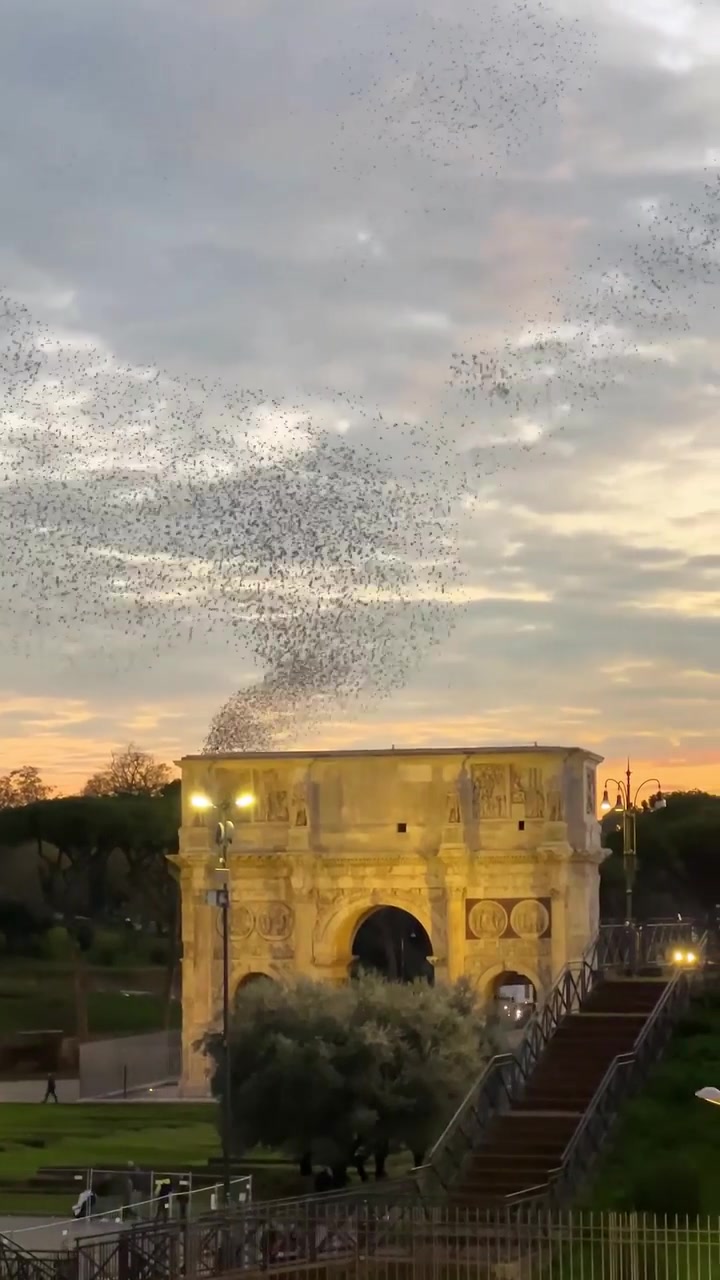
Flock of flying feathers It is especially hard to look away when the Arch of Constantine is framed by swooping flights. Birds swarm or gather in vast numbers over the 1,700-year-old monument every sunset. The Arch of Constantine — built between 312 and 315 AD as a tribute to Emperor Constantine the Great — serves as a remarkable backdrop for a daily murmuration. Migratory starlings swoop and twist in unison around the ancient stone structure, creating dramatic aerial silhouettes against the setting sun. The Arch of Constantine boasts historical significance and the daily murmuration is an extraordinary sight. The birds’ dance enthralls both Romans and visitors alike.
The Arch of Constantine — Motion Picture
The Arch of Constantine is one of Rome's most iconic landmarks, flanked by the Colosseum which is 25m away, and the Palatine Hill which is 300m away. The arch itself stands out as a symbol of Rome’s rich history. These triumphal arches are like storyboards for the emperors’ victories and their accomplishments. Each of the Arch’s three sections tells a part of its historical story. The central arch is decorated with reliefs of Roman soldiers leading captives, the middle arch opens into the Via Triumphalis along the impressive road where victorious generals entered the city. The left and right arches depict scenes of battle, showing the battles of the Colossi, internecine conflicts among the Romans, and the defeat of the Persian Emperor Darius III. The Arch of Constantine is especially notable for its blend of architectural styles. Built during the time of Emperor Constantine the Great, the arch combines elements from earlier structures, making it a unique historical monument.
Flocking in sync — murmurations and starlings
One of the wonders of the Arch of Constantine is the murmurations that take place around it. A murmuration is a mesmerizing sight in which thousands of birds gather in the skies. The birds perform a graceful choreography around it, creating a visual spectacle that captivates onlookers. Starlings are the stars of this show. The scientific term for a starling flock is murmuratio. The birds fly in a swirling, mesmerizing pattern over Rome. Starlings perform the murmuration display to coordinate their safety from predators. The murmuration is a way for the starlings to keep safe in numbers. Watching a murmuration is a remarkable sight. At the peak of the performance, the starlings can completely cover the Arch of Constantine in a swirling mass. This orchestrated dance is particularly striking in Rome’s skies as the sun sets over the arch, creating stunning views.
Starlings in the city skies
Starlings are common birds in Rome. These winged thugs are usually tiny and well-camouflaged. They are often found in flocks across the globe and are known for their ability to change direction in an instant — the result of a combination of bird experience and social learning. They can even communicate alerts to the rest of the flock. In Rome, while the swarm passes over the city, and if an animal appears below, the entire swarm can dive down and strike the creature.
The science behind the swirl
Murmurations are the visual effect of information cascades. Each bird in a starling formation reacts to the movements of its closest neighbors. The swirling patterns exhibited by starlings flying in murmuration result from the birds’ ability to sense the direction in which nearby birds are looking. Birds in mururations have an innate sense of direction. Each bird knows the position of its nearest six neighbors, and swarms are coordinated by the flap synchronization of individual birds. The birds' wingbeats create the murmuration’s distinctive shapes. The interaction between the birds' rapid flight and the surrounding environment creates the illusion.
How birds flock
The murmuration is a phenomenon where birds coordinate their movements with incredible precision. The starlings’ synchronized flight patterns create a stunning visual effect. The movement of the birds is controlled by a set of rules that are based on the birds' individual flight styles. The birds follow each other with a very short time delay. The swarming behavior is a collective behavior that emerges from the interactions between individual birds. The flock moves as one unit, with each bird adjusting its position relative to its neighbors.
The Arch's appeal — hype and tourism
The Arch of Constantine is a popular tourist site. It is one of the most photographed spots in the world. The Arch of Constantine is also a popular spot for wildlife photography. The starling murmuration is a focal point for tourists. The flocks of birds swirl around the Arch, providing a stunning visual display that is a sight to behold. The murmuration has also drawn local enthusiasts and cultural activities to the Arch, including live events and film screenings. For example, local dance troupes and performance artists have used the Arch as a backdrop for their performances. The Arch of Constantine has become a symbol of Rome’s rich cultural heritage.
The best way to see the display
Viewing the murmuration at the Arch of Constantine is a mesmerizing experience. To fully appreciate the spectacle, plan your visit carefully. Here's a practical guide:
- Timing: The best time to see the murmuration is during early evening, when the birds gather to roost. This is usually around sunset. This is when the birds perform the most spectacular displays.
- Location: The Arch of Constantine is located next to the Colosseum. To get there, visitors can take the metro to Colosseo station or a bus to the Roman Forum stop. In the past, locals would encourage visitors to walk along the Via Labicana or Via San Gregorio to the archway. But recent safety advisories have warned to avoid moving around that area during times of reduced visibility.
- Equipment: Bring a camera with a good zoom lens to capture the birds in flight and any other wildlife that could be nearby. Also, carry a pair of binoculars, as the birds are quite high up and may be difficult to see with the naked eye.
Questions readers ask
What exactly is a murmuration and why do starlings do it?
A murmuration is a mesmerizing aerial display where thousands of starlings fly in synchronized patterns. Starlings perform this behavior to confuse predators and increase their chances of survival. It's a way for them to stay safe in numbers, creating a spectacular and confusing mass. The Arch of Constantine provides a perfect backdrop for this sight, making it especially captivating.
How do starlings coordinate their movements during a murmuration?
Starlings use a combination of individual experience and social learning to coordinate their movements. They can change direction instantaneously, which is a result of complex communication within the flock. When one bird changes direction, the rest follow suit, creating the mesmerizing patterns we see during a murmuration.
What makes the Arch of Constantine a special backdrop for the starling murmurations?
The Arch of Constantine is a historic monument with a rich backdrop. The starlings’ murmurations against the setting sun create dramatic silhouettes and beautiful patterns, enhancing the visual spectacle. The arch's grandeur provides a stunning contrast to the birds’ dance, making it a must-see event for locals and tourists alike.
Is it safe for starlings to perform murmurations in a city like Rome?
Yes, murmurations are a natural behavior for starlings and help them stay safe from predators. However, urban environments can pose additional challenges, such as collisions with buildings or other hazards. The starlings’ ability to adapt and communicate quickly makes them well-suited for city life, but there are still risks involved in performing such displays.
Are there other places in Rome where I can see starling murmurations?
While the Arch of Constantine is a prime spot, starlings are common birds in Rome and can be seen in various locations across the city. They often gather in large flocks and perform murmurations in open spaces, especially at sunset. If you're in Rome, keep an eye out for these aerial displays, but the Arch of Constantine offers a particularly stunning backdrop.
What is the best time to see the starling murmurations at the Arch of Constantine?
The best time to see the starling murmurations at the Arch of Constantine is during sunset. This is when the birds gather in vast numbers and perform their mesmerizing aerial displays. The setting sun creates a dramatic backdrop, making the sight even more captivating. Plan your visit accordingly and enjoy the spectacle.
Related deep dives
Similar reads based on topic and creator.




Recent articles
Fresh deep dives from the latest Reels we unpacked.




Comments
Be the first to comment.