Structured vs. Flexible: How SQL and NoSQL Datasets Differ
Data is the lifeblood of modern applications, and it comes in many forms and structures. SQL and NoSQL databases are two main approaches to organizing this vast amount of data. Understanding the differences between these types can help you choose the right data storage method. So, how do these two competing approaches to database management set up the data?
The Relational Spreadsheet: SQL Database Structure
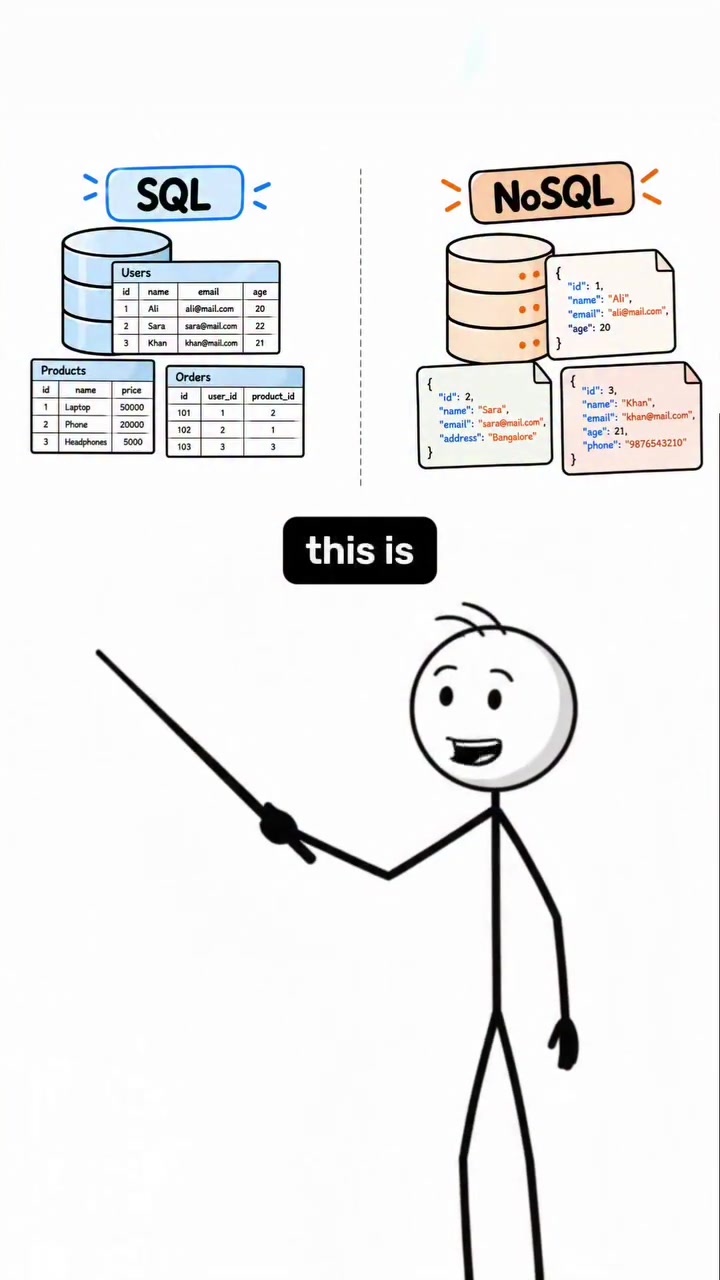
SQL stands for "Structured Query Language" is known for its relational database structure. The core idea is that data is organized into tables, similar to how information is laid out in a spreadsheet. Each table consists of rows and columns, where each row represents a record, and each column represents a specific attribute of that record. There can be multiple tables, each with its own purpose. For instance, an online shopping app might have one table for users, with columns like "name," "email," and "age." Another table could be dedicated to "products," with columns for "product ID," "name," and "price." Yet another table could handle "orders," linking users to their purchased products. The key is that each table follows a predefined structure, and relationships between tables are well-defined. SQL enforces this structure, ensuring data consistency and integrity. But it also requires that every record fits into the predefined schema, and thus it allows you to perform complex queries and transactions.
The Rise of Unstructured Data
The digital explosion has led to an unprecedented amount of data, much of it unstructured and constantly changing. In response, NoSQL databases have emerged to handle the growing complexity of data management.
Organizing Data Without Tables
In contrast to SQL's structured approach, NoSQL employs a more flexible data model. It allows data to be stored in various formats, such as documents, key-value pairs, or collections. This flexibility means that one user record could include "name," "email," and "address," while another could have a different set of attributes, such as "preferences" or "previous purchases." Because NoSQL does not enforce a fixed schema, records can vary in structure. A common use case for NoSQL is handling large amounts of data that changes frequently, such as user activity logs, social media posts, or real-time analytics. To work with rapidly growing data, NoSQL databases offer horizontal scalability, which distributes data across multiple servers to manage high traffic and large data sets. They are designed to handle a wider range of data types and complex data models.
Key-Value Pairs and Document Stores
NoSQL databases come in several types, each with its unique way of storing data. One common type is the key-value store, where data is stored as a collection of key-value pairs. Each key is unique, and its associated value can be any type of data. This structure simplifies data retrieval and is ideal for caching and session management. Another type is the document store, which saves data in document format—typically JSON or XML. Documents can contain nested data and are well-suited for storing hierarchical data like user profiles or product catalogs.
SQL vs. NoSQL: The Right Tool for the Job
The choice between SQL and NoSQL depends on the specific needs of your application. For example, if an online shopping app requires complex transactions and data integrity, SQL’s structured approach and ACID (Atomicity, Consistency, Isolation, Durability) compliance make it the better choice. SQL’s relational model allows for intricate queries that can retrieve data across multiple tables, ensuring data consistency and relational integrity. In contrast, NoSQL is well-suited for applications with rapidly changing data and the need for horizontal scalability. Real-time analytics platforms, social media applications, and content management systems can benefit from NoSQL’s flexible data models and high scalability.
Choosing Between SQL and NoSQL
For applications that require complex queries and need to maintain strong relational integrity, SQL is the better option. Examples of such applications include financial systems, inventory management, and customer relationship management (CRM) systems, where data accuracy and ACID compliance are crucial. However, for applications dealing with unstructured, rapidly changing data and requiring high scalability, NoSQL is the more suitable choice. Examples include social media platforms, real-time analytics, and IoT (Internet of Things) applications. Social media, for instance, involves a constant stream of data from users, and NoSQL can handle this influx efficiently without the rigid structure of tables found in SQL.
When Data Structures Evolve
A clear example of the evolving data structure is that of online shopping apps. As e-commerce grows, users demand more personalization and customization. NoSQL databases can accommodate this need by allowing for flexible data models that can change over time. Thus, one user could have an address field, while another might have a shipping preference field, without requiring an overhaul of the entire database structure. In contrast, an SQL database would need a predefined schema that might require changes to accommodate new data attributes, making it less adaptable to frequent changes.
Balancing Structure and Scalability
Ultimately, the choice between SQL and NoSQL depends on balancing structure and scalability. For applications that require well-defined data structures, complex queries, and strong consistency, SQL is the go-to solution. In contrast, for applications with evolving data models, frequent changes, and a need for scalability, NoSQL offers the flexibility and scalability required to handle large and rapidly growing datasets.
Questions readers ask
What kind of data is best suited for SQL databases?
SQL databases are best suited for structured data that fits neatly into tables with predefined columns. This makes them ideal for applications where data integrity and consistency are crucial, like financial transactions or inventory management. For example, if you're building an e-commerce platform, SQL databases can efficiently manage user information, product details, and order records.
Can SQL databases handle unstructured data?
SQL databases are not designed to handle unstructured data efficiently because they require a predefined schema. If your application deals with a lot of unstructured or semi-structured data, like social media posts or user activity logs, a NoSQL database might be a better fit. SQL databases would struggle with the varying structures and frequent changes characteristic of unstructured data.
What are the main advantages of using a NoSQL database?
NoSQL databases offer several advantages, including flexibility in data storage and horizontal scalability. They can accommodate diverse data types and structures, making them ideal for applications with rapidly changing data. Additionally, NoSQL databases can handle large volumes of data across multiple servers, which is beneficial for high-traffic applications like social media platforms or real-time analytics.
Can you provide an example of how NoSQL databases differ from SQL databases in terms of data structure?
In an SQL database, data is organized into tables with fixed columns, where each row represents a record. For example, a user table might have columns for 'name,' 'email,' and 'age.' In a NoSQL database, data can be stored in various formats, such as documents, key-value pairs, or collections. This allows for more flexibility; one user record could include 'name,' 'email,' and 'address,' while another could have 'preferences' or 'previous purchases,' without enforcing a fixed schema.
Is it possible to perform complex queries in NoSQL databases like you can in SQL databases?
NoSQL databases are optimized for different types of queries compared to SQL databases. While NoSQL databases can handle complex queries, they are generally more efficient for specific types of operations, such as key-value lookups or document retrievals. SQL databases, on the other hand, excel at complex joins and transactions across multiple tables. The choice between the two depends on the specific needs of your application and the types of queries you need to perform.
Related deep dives
Similar reads based on topic and creator.




Recent articles
Fresh deep dives from the latest Reels we unpacked.



Comments
Be the first to comment.