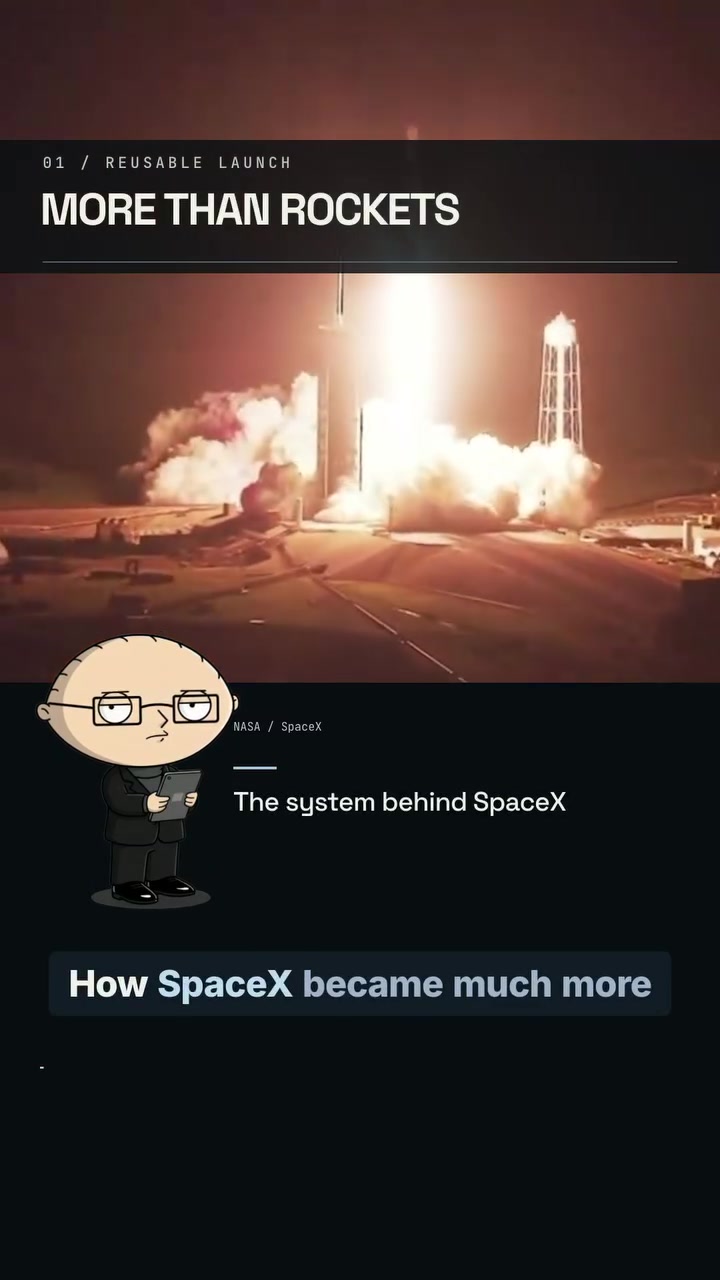
Rockets as the First Layer: Rewriting the narrative around SpaceX.
SpaceX looks like a rocket company, but it is much more than the rockets that grab headlines. The company is vertically integrated from its original mission to reach Mars, into reusing rockets, into building the world's largest satellite internet network, and acquiring AI companies. That vertical integration is the common thread.
How SpaceX's Rocket Design Revolutionizes Space Science
The reusable rockets are SpaceX's launchpad into multiple markets. Rockets are the backbone of almost every SpaceX operation. SpaceX rockets are the only manufacturer which regularly launches, recovers, and reflies its rockets. To understand their innovation, start with the Falcon 9. It is a rocket with two stages. The first stage booster does most of the initial work, then separates from the upper stage. Instead of crashing into the ocean, it turns around, fires its engines again, and controls its descent to land vertically, either on land or a drone ship. Then, SpaceX inspects it, refuels it, and flies it again. Reusing the hardware is crucial, because the rocket is one of the most expensive parts of a launch.
The Expanding Circle: Shifting SpaceX's Focus
SpaceX's real strength is not in the rockets themselves, but in the system they are a part of. Rocks are the tool, but the company is a solar system of tech. SpaceX launched its Starlink network, a giant constellation of low-Earth orbit satellites delivering internet to users. SpaceX's network is the world's largest satellite internet network. Those satellites power Starlink, a network SpaceX owns and operates, rather than simply launching for someone else. That changes the business.
### Reusable Rockets Pave the Way for Starlink
For Starlink, SpaceX is building and operating infraestructura the satellites need to orbit. More satellites improve coverage and capacity, more customers create more revenue. That revenue funds more rockets, satellites, infrastructure, and R&D. The reusable rocket flywheel drastically reduces the cost to orbit. Cheaper launches mean more satellites in orbit to provide more connectivity. That connectivity provides revenue to launch more satellites.
### From Space to Software: AI as the Next Frontier
SpaceX has made a series of AI acquisitions. Musk's XAI company was merged into SpaceX. Then, in August, it acquired Cursor, an AI coding company. It fits the strategy for further growth. Cursor builds AI coding agents and its own models. XAI builds foundation models like GroK. SpaceX just acquired Cursa for an implied equity value of $60 billion dollars. Cursor said the merger gives it access to what it calls the largest GPU fleet in the world, letting it train stronger models and run them more cheaply. The rocket might grab your attention, but AI is the future for SpaceX. SpaceX is now vertically integrated across energy and data centers, GPU compute, AI models, AI applications, satellites, and rockets. SpaceX started by vertically integrating spaceflight, then realized the same strategy could extend from rockets and satellites all the way to data centers, AI models and the software people actually use.
### Rocket Science Meets Artificial Intelligence
SpaceX has widened their market to include AI hardware and software. Their navigation to Mars is an experiment in longterm AI integration. Musk initially wanted to send a small greenhouse experiment to Mars, but concluded the real problem was launch cost. This led to SpaceX making rockets reusable, and now aims to "build more of the technology behind the entire system".
Launching Your Own SpaceX Projects: AI and Software
If you're inspired by SpaceX's vision, here's how to follow in their footsteps:
- Dive Into Reusable Tech: If you can't build a reusable rocket, think about reusable products in your industry. What can you design that reduces waste and costs?
- Leverage Existing Infrastructure: SpaceX used existing tech like Falcon 9 to kickstart their AI division. What existing tech, tools, or platforms can you build upon?
- Integrate AI: No matter the industry, AI will touch your business. Start experimenting with AI models and applications, even if it’s just a small step.
- Musk said he started SpaceX because he concluded the real problem with reaching space was launch costs. Look for solutions where others see only obstacles. Ask why and keep asking until you are satisfied with the answer.
- Think in Systems: AI and space are just two parts of a vast system. SpaceX takes on enormous data centers, AI models, AI applications, and software.
The Whole is much more than the Launch
SpaceX began as a rocket company. But now it has expanded into satellites, communications, compute, and software. The rocket gets your attention, but it's part of a larger system.
Questions readers ask
How many times has SpaceX successfully landed a Falcon 9 rocket this year?
SpaceX has successfully landed a Falcon 9 rocket 11 times this year, showcasing the reliability and efficiency of their reusable rocket technology.
What makes SpaceX's rocket design stand out from other companies?
SpaceX's Falcon 9 rocket is unique because it can launch, recover, and refly its rockets. The first stage booster separates, turns around, and lands vertically, either on land or a drone ship, making it the only manufacturer to do this regularly.
How does SpaceX's reusable rocket technology benefit the Starlink network?
The reusable rocket technology drastically reduces the cost to orbit, allowing SpaceX to launch more satellites for the Starlink network. This increases coverage and capacity, attracting more customers and generating more revenue, which in turn funds further advancements in rockets, satellites, and infrastructure.
What role does AI play in SpaceX's future plans?
SpaceX has been acquiring AI companies to integrate AI into their operations. The recent acquisition of Cursor, an AI coding company, and the merger of Musk's XAI company into SpaceX, indicates that AI will be a significant part of their future growth strategy, alongside rockets and satellites.
How does SpaceX's vertical integration strategy benefit the company?
SpaceX's vertical integration strategy allows them to control every aspect of their operations, from rocket launches to satellite internet networks and AI development. This integrated approach reduces costs, increases efficiency, and allows for rapid innovation across multiple markets.
What is the significance of SpaceX's Starlink network in their overall business model?
SpaceX's Starlink network is a giant constellation of low-Earth orbit satellites delivering internet to users. It is the world's largest satellite internet network, and it generates revenue that funds further development in rockets, satellites, and infrastructure, creating a self-sustaining cycle of growth.
Related deep dives
Similar reads based on topic and creator.




Recent articles
Fresh deep dives from the latest Reels we unpacked.




Comments
Be the first to comment.