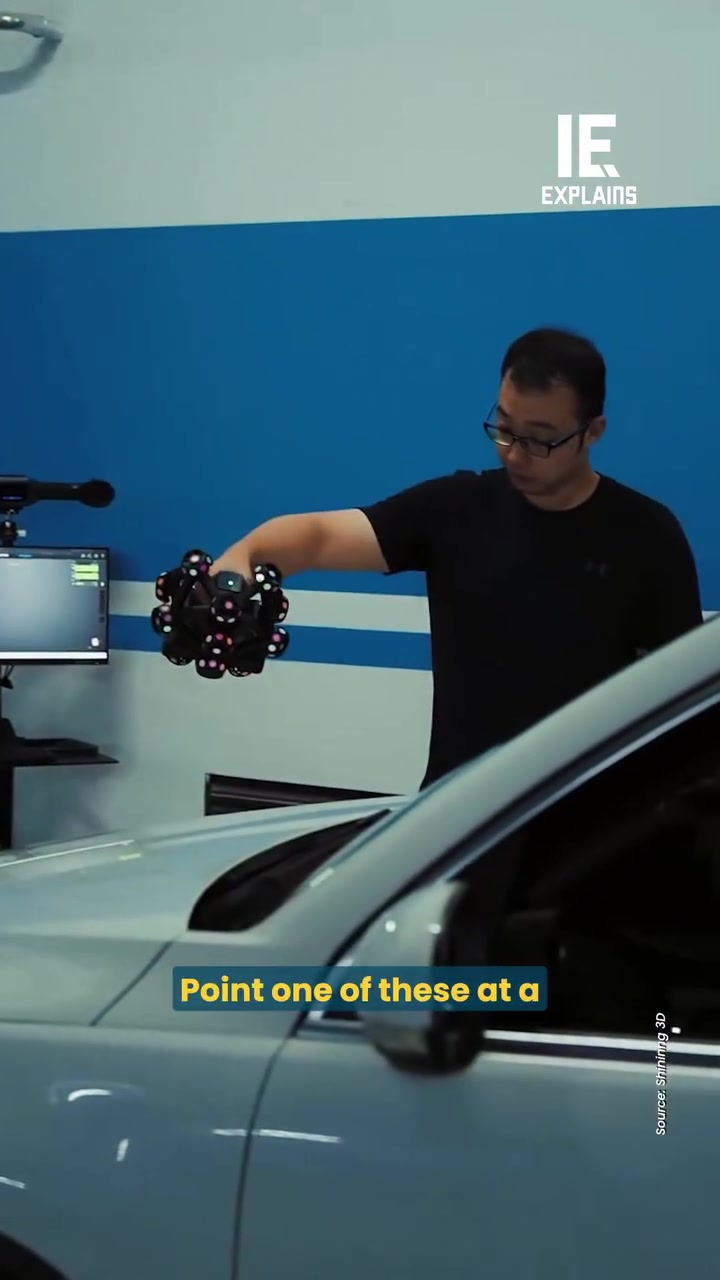
By projector, by laser: the optics of modern 3D scanning
Thirty years ago, Shining 3D launched its first scanner from Hangzhou. Today, the company supplies advanced 3D scanners used to capture precise digital copies of objects from a car park. Workhorse 3D scanners can capture objects accurate to a few hundredths of a millimeter, making them versatile tools for industries as varied as manufacturing, archaeology, and gaming.
3D Scanning's Skyrocketing Role
We didn't always live in a world filled with digital replicas. Starting in the 1960s 3D scanning technology allowed doctors to use X-rays to make 3D traces to map out the inner anatomy of a patient. Before that, it was close to impossible to produce accurate 3D models of objects. A dedicated 3D scanner can handle the rigorous demands of industrial metrology. In a metro train manufacturing plant, it can scan a pantograph arm to see if it meets the design specifications. In an undersea oil pipeline, a 3D scanner mounted on a robot can inspect a weld seam for any defects. The process is also used in archaeological digs and crime scenes, where capturing the precise shape of an artifact or a rearrangeable scene can preserve a record that will last into perpetuity. 3D scanning is not just about replicating an object; it's about creating a digital footprint of the physical world for future generations.
How triangulation computes 3D depth
All Shining 3D scanners work on a principle called triangulation. In essence, triangulation measures a distance by comparing the angles to a target from at least two points. A 3D scanner casts light onto an object while a camera is focused on the object, and using the angles and the known distance between the camera and the light projector, the scanner determines the distance to every point on the object. The scanner then creates an XYZ coordinate for each scanned point on the surface of the object. The points are used to create a mesh—a 3D wireframe model of the scanned object. Once this mesh is created, it can be exported as a digital file containing all the collected points. Mesh models have an amount of data that can be very data intensive to process. The overall size of the model depends on the density of the scanning and accuracy requirements.
Laser lines persisting on reflective surfaces
Different scanners use different types of light. The blue laser can cover less ground per frame compared to LED structured light, but it holds up better on reflective and dark surfaces. It also ignores the ambient room light. Blue laser lines can create a stunningly accurate scan, no matter the object's texture. These lasers work well in most applications, but applications that need to capture very fine textures or intricate details tend to use LED structured light. This light can render the most fine details of any surface.
Optical-tracking vs mark-and-track
The challenge with using a handheld scanner is the need to track each frame's position. It's a bit like stitching together multiple jigsaw puzzles while moving them around and matching edges. For large objects, like a room-sized workpiece, the iron scan approach uses a separate camera to track targets on the scanner head, keeping the workpiece clean and maintaining accuracy. The handheld model needs to track the features of the object or reflective dots stuck onto the object. This approach is more common in 3D scanning.
The digital outcome and export
The final step in 3D scanning is to save or export the model to another file format, typically an STL file. The STL file is a 3D file format that can be imported into almost any 3D software for viewing, editing, or 3D printing. The 3D model can also be imported into a computer-aided design (CAD) program for reverse engineering on various types of 3D scanners. The 3D model can also be saved in other 3D file formats like OBJ, FBX, or STL. These file formats are widely used in 3D modeling and animation software, game development, and 3D printing.
Harnessing 3D Scanners in the Wild
Eager to import a physical object into a 3D digital world? Scanning a 3D model: Use a Shining 3D scanner or similar model. Set the scanner up and make sure it’s correctly positioned for an accurate scan. Exporting the data: A 3D scanner can export to different formats, including those compatible with 3D printers, CAD files, and other 3D software. Choose the format you need for your application. Adjust and edit: If the scan isn't perfect, use 3D modeling software to fix any imperfections or inaccuracies. This can range from smoothing out rough edges to fixing any missing data. 3D Printing: With a complete digital model, you can send it straight to a 3D printer. This is a great way to test out and see if what is on screen corresponds to the design you imagined.
Elevating Design Through Geometry
From the maker's bench to the factory floor, 3D scanners have transformed how we interact with the physical world. They allow us to digitize reality, enhance designs, and innovate in ways once thought impossible. 3D scanning captures the essence of an object, preserving it in a digital format that can be reproduced, studied, and appreciated for generations to come.
Questions readers ask
How exactly does a 3D scanner work? Can you explain the process in simple terms?
A 3D scanner uses a method called triangulation. It shines light on an object while a camera captures the reflection. By measuring the angles from at least two points, the scanner calculates the distance to every point on the object. This data is then used to create a 3D wireframe model, or mesh, of the object.
What are the main differences between laser and LED structured light in 3D scanning?
Laser scanners, particularly those using blue lasers, are better at handling reflective and dark surfaces and can ignore ambient room light. However, they cover less ground per frame. LED structured light, on the other hand, is better for capturing very fine textures or intricate details but may struggle with reflective surfaces.
What are the applications of 3D scanning in different industries?
3D scanning is incredibly versatile. In manufacturing, it ensures products meet design specifications. In archaeology, it preserves precise records of artifacts. In crime scenes, it helps capture and preserve the exact layout. It's also used in gaming, medical imaging, and even undersea inspections for oil pipelines.
How does a 3D scanner handle large objects like a room-sized workpiece?
For large objects, scanners often use a method called optical tracking. This involves a separate camera to track the position of the scanner as it moves around the object, similar to stitching together multiple jigsaw puzzles. This ensures that every part of the object is accurately captured and integrated into the final 3D model.
Can 3D scanners be used outdoors or in varying light conditions?
Yes, some 3D scanners, especially those using blue laser light, can work well in varying light conditions. They can ignore ambient room light, making them suitable for outdoor use or environments with inconsistent lighting. However, the choice of scanner and its specifications will depend on the specific requirements of the task.
What kind of data does a 3D scanner produce, and how is it used?
A 3D scanner produces a mesh model, which is a 3D wireframe representation of the scanned object. This model contains XYZ coordinates for every point on the object's surface and is exported as a digital file. This data can be used for various purposes, such as 3D printing, quality control in manufacturing, or creating digital replicas in gaming and archaeology.
Related deep dives
Similar reads based on topic and creator.


Recent articles
Fresh deep dives from the latest Reels we unpacked.

Comments
Be the first to comment.