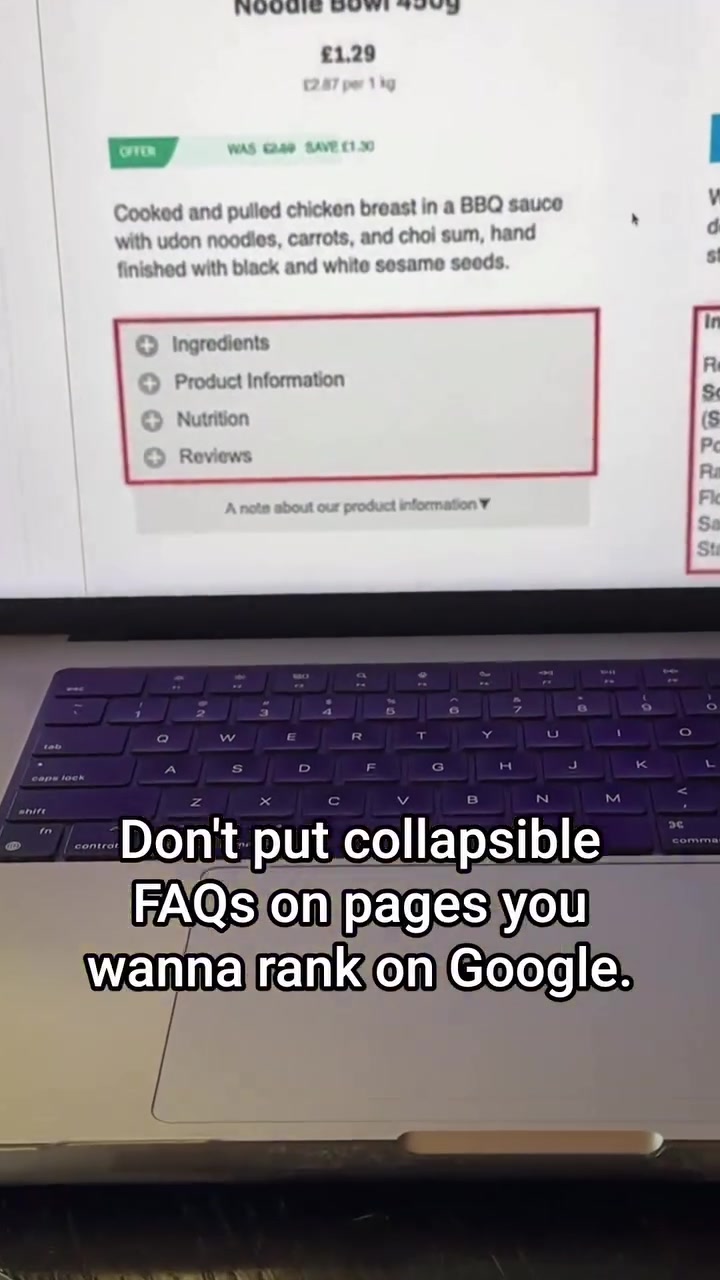
What happens when you hide text within collapsible FAQs?
Google ignores the FAQ content schema. An SEO test that took place over multiple product pages found the visible text version acceded 12% more organic sessions. The evaluator even cited Google’s recent comments that they are ignoring FAQ schema altogether. Clearly, Google does not favor hidden text in collapsible FAQs. They now treat FAQ schema as irrelevant. It doesn’t offer any visibility boost for websites.
Collapsible FAQs in a post-schema world
The page ranking struggles stem from a bigger trend. Google users prefer text that is immediately visible. They probably have a good reason for it. The web has transformed into a place of instant gratification. People want answers right away. If the answers are hidden somewhere, users have to expend effort to find them. They have no incentive to spend that effort on a web page. Google is catching on to this. Trying to game the system with collapsible FAQs doesn’t work anymore. The system might favor visible text, but it doesn’t always favor longer text. Make sure you are being concise and clear.
Search engine optimization questions and answers
A key element of effective websites is the placement of answers directly within a web page to maximize SEO. Collapsible FAQs were a fashionable trend. Collapsible sections meant users could drill down into the sections that mattered to them. Businesses used them for legal jargon, FAQs, or even customer reviews. It’s clear why some might think they make for a better user experience. However, these sections can get in the way of the actual user journey. You might have users clicking through tons of FAQ sections trying to find something specific. But they might not find what they are looking for. Content creators and website owners need to optimise for end users, not search engines. Google will follow.
Why collapsible FAQs present a poor user experience
There are only a few exceptions in which the use of collapsible FAQs can be closely justified. For usability purposes, you might need to have tons of frequently asked questions. You may not want to overwhelm visitors with lots of text. Even if it’s searchable and visible, it still might overpower users. You might need to move that text to a collapsible FAQ after all.
How collapsible FAQs — even with FAQ schema —fail SEO
Having collapsible FAQs can fail SEO for a lot of different reasons. The test split between visible and collapsible FAQs produced a 12% increase in organic sessions for the visible FAQ text. You need to see if it applies to you directly. There might be a few specific keywords that can help with it. Assume that you have a few keywords to target. Determine what's going to work for you. Visible text is almost certainly going to trump collapsible FAQs even if targeting those keywords is important.
Learning SEO that works
The field of SEO continues to evolve rapidly. If you want to get paying customers, users, and warm leads, you have to stay ahead of the curve. Make sure you’re learning from the best. Avoid wasting time learning outdated strategies. You should be saving time by learning from the best. Even if you are not paying for it, the best content is valuable. It allows you to understand what is and isn’t a best practice.
When you should invest in SEO learning Label: reviewing your SEO content
Without understanding SEO, you’re guessing. You’re hoping that your web page will rank. You want to be certain, but you’d rather focus on other aspects. If you can’t do that, it means that you don’t have to learn everything. You simply need to know the basics to work with an SEO expert who can grow your business. You should be investing in SEO learning when it aligns with your goals. Label: boosting your traffic You need to boost your traffic. Most people will still be using search engines to find your information. Use the tools in place to help you do that. If you want to focus on other aspects of SEO content, you can use SEO experts that will help you achieve the best results.
SEO content blueprint
If you want to see the best results, you need to follow this blueprint
- Have fully visible text to maximize your SEO.
- Make sure you use SEO-friendly keywords.
- Avoid overusing collapsible FAQs, except in specific scenarios.
- Don't forget to test your findings. Split testing can be invaluable.
- Do not use collapsible FAQs to stuff keywords into your page. Google can read through this.
- Don't focus on content length. Visible organic text is valuable.
- If you want a better result, use experts that will help you in building your SEO. This gives you a chance to generate more organic sessions and leads.
Questions readers ask
What exactly are collapsible FAQs, and how do they work?
Collapsible FAQs are sections on a webpage where frequently asked questions and their answers are hidden behind clickable headers. When a user clicks on a header, the answer expands to become visible. Conversely, when the user clicks on it again, it collapses, hiding the answer.
How does Google currently handle collapsible FAQs in terms of SEO?
Google largely ignores the hidden text in collapsible FAQs, which can result in reduced visibility and fewer organic sessions. This is because Google now prioritizes visible, instant text over hidden content, making collapsible FAQs less effective for SEO.
Why do collapsible FAQs present a poor user experience?
Collapsible FAQs can be frustrating for users because they require extra effort to find the information they need. Users often prefer instant visibility. They may click through multiple sections without finding what they're looking for, leading to a poor user experience.
Are there any situations where collapsible FAQs might still be useful?
Yes, there are a few exceptions. If you have a large number of frequently asked questions, collapsible FAQs can help prevent overwhelming users with too much text at once. However, even in these cases, it's important to ensure that the most crucial information is easily accessible.
How can I optimize my website's FAQ section for better SEO?
To optimize your website's FAQ section for better SEO, make sure the answers are directly visible on the page. Avoid hiding important information behind collapsible sections. Keep your content concise and clear, and focus on providing a good user experience, as Google will follow.
Does the FAQ schema markup still offer any benefits, even if Google ignores it?
The FAQ schema markup no longer offers visibility boosts for websites, as Google treats it as irrelevant. Therefore, it doesn't provide any SEO benefits. The focus should be on making the content visible and easily accessible to users.
Recent articles
Fresh deep dives from the latest Reels we unpacked.




Comments
Be the first to comment.