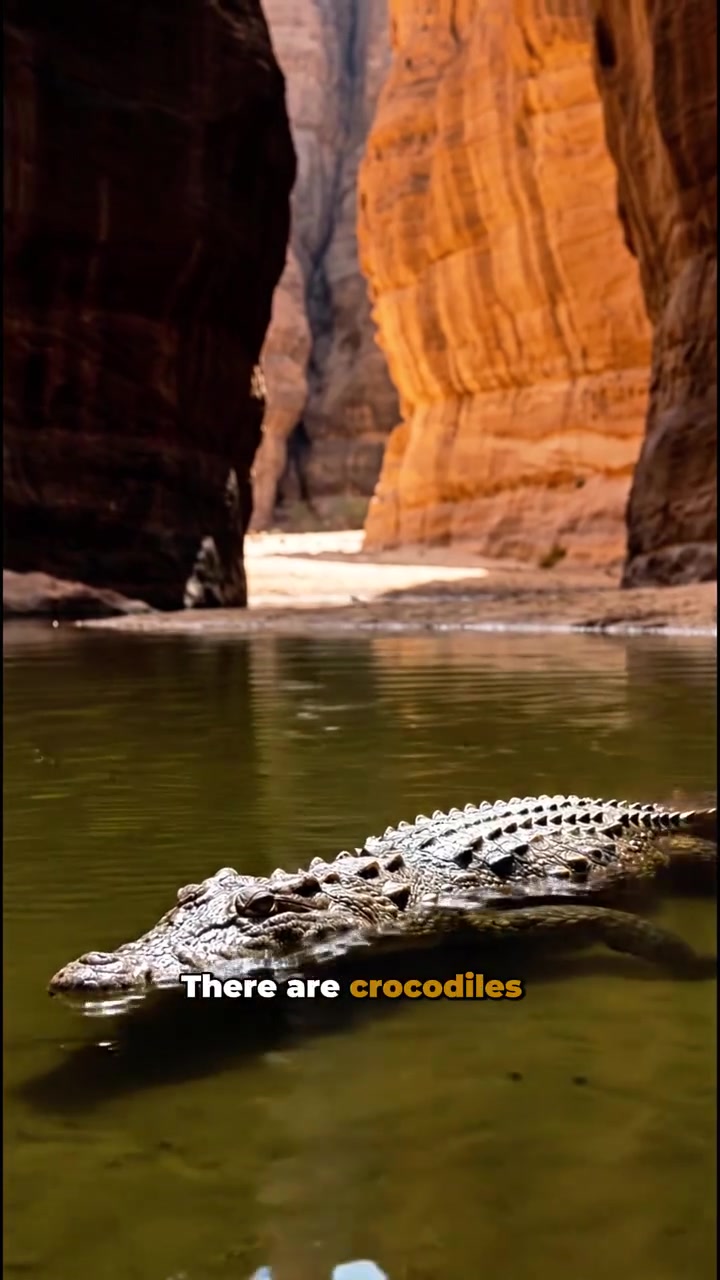
Desert Dead-End
A permanent waterhole in the Sahara sustains a community of West African crocodiles, a vestige of a wetter past. Some have shrunk in this enclosed canyon. "All of it is bone dry, But down in one gorge there is a pool of water that never disappears, and that is where they are". Deprived of rainfall for thousands of years, these reptiles thrive in a harsh world of sandstone arches and camel dung. How does life persist in such an inhospitable habitat?
The Geology of Survival
The crocodiles thrive in the Ennedi Massif, a maze of sandstone arches, towers, and canyons. This UNESCO World Heritage site is a hilly plateau, most of which sees only a few inches of rain each year. At 200 meters across and 15 meters deep, the gorge might seem modest, but it is the mirage of its surroundings. The geological formation has not just provided refuge; it also provides a source of water overnight, Nutrients from camel dung left behind fertilizes water, sustaining a small food chain, algae grow on it, and fish eat the algae, and the crocodiles eat the fish. This makes the crocodiles some of the last of their kind left in the Sahara. The rocks also protect the crocodiles from the sun and predators. The walls of the gorge are high enough that the reptiles cannot be preyed upon by larger animals, and the sandstone provides shade from the scorching sun. It's essential that this gorge soars from large sandstone formations, as the narrow pool of water below would be missed otherwise.
Isolated Against the Odds
The crocodiles' ancestors migrated into the region when it was still a savanna. But they didn't escape when the area dried up, instead, they were cut off in a shrinking water source. These crocodiles in the gorge are isolated from other populations, and they've had to adapt to the harsh conditions to survive. Some crocodiles were found to have shrunk. Being in such a harsh environment makes their size matter: a smaller body requires fewer resources. It's found that some crocodiles had shrunk smaller in size. Yet, the crocodiles thrive, in their new world, the prey, fish have adapted to the new diet which are the algae covering the water.
Food Web of the Unlikely
The crocodiles feast on a steady diet of fish, which thrive despite the harsh desert environment. The fish in turn rely on algae, which feed on fertilizer created by camel dung. These camels venture down from the plateau into the gorge to drink. The food chain is simple; camel dung feeds the algae, the fish survive on them, and the crocodiles on the fish, and one can imagine a large group of camels coming down the gorge, as described in the caption. These nutrients and algae grow because the camels fertilize the water. However, the camel's use of the water also impacts the environment. Nutrients from the dung fertilize the water, creating a thriving ecosystem that sustains the crocodiles and other species. This ensures that the crocodiles have a food source in the middle of the arid desert.
The Mystique of the Desert Crocodiles
The crocodiles have never been properly counted, so few people have seen them, and there is no record of their exact population. There is little scientific knowledge about the exact number of crocodiles. What is known is the timeframe as well as the place. As a result, the crocodiles have developed into one of the world's least understood animals. This makes them one of the most mysterious species in the Sahara. Although they are a mystery, the crocodiles have adapted to their environment. They don't wander into the Sahara. They have adapted to the surroundings they are in. They are a mystery because of their survival.
Desert Adventure
Visiting the crocodiles requires a journey through the rugged terrain of Chad. There are no accommodations nearby, and the trip involves hiking through the desert to reach the gorge. It is recommended to hire a guide. The crocodiles are not the only attraction. The Sahara's towering rock formations and sand dunes offer a unique and remote desert experience. The Ennedi Massif is a UNESCO World Heritage Site and is home to a wide variety of plants and animals. It is a place where the person can find themselves under the stars with the only company being a fire and some animals. The best time for viewing is at dusk or dawn, when the crocodiles are most active. The crocodiles are typically found in water. But in the Soviet encampment visitors can find a box that contains a crocodile with a tourist photo. There are no rhinos. The crocodiles are a mystery, and little is known about them. But they are a sight to behold and an opportunity to see a species that has adapted to the harshest of conditions. The crocodiles are part of the last population of desert crocodiles, and they can be seen in Chad.
- Visit the crocs — The best way to see the crocodiles is to visit the Guelta d'Archei. But don't expect a tour guide.
- Hire a guide — The guide must be knowledgeable about the terrain and the crocodiles and have experience in the area.
- Packing — The necessary equipment is a good camera, binoculars, a good pair of hiking boots, a lot of water and sunscreen.
- Time of year — The best time for viewing is at dusk or dawn, when the crocodiles are most active.
Questions readers ask
How did the crocodiles end up in the Sahara desert?
The crocodiles are descendants of West African crocodiles that migrated into the Sahara when it was a savanna with plenty of water. As the climate changed and the area dried up, these crocodiles found themselves isolated in a shrinking water source, leading to their current desert oasis habitat.
What do the crocodiles eat in the Sahara?
The crocodiles primarily feed on fish, which in turn rely on algae. The algae thrive due to the nutrients provided by camel dung, which creates a unique food chain in the harsh desert environment.
How do the crocodiles survive in such a harsh environment?
The crocodiles have adapted to their harsh environment in several ways. They have evolved to be smaller, which requires fewer resources. The sandstone formations provide shade and protection from predators, and the permanent water source sustains their food chain.
Why are these crocodiles unique compared to their West African cousins?
These Sahara crocodiles are unique because they have adapted to survive in a much harsher, drier environment. They have evolved to be smaller and have a specific food chain that relies on camel dung for nutrients. Additionally, they are isolated from other crocodile populations, which has led to distinct adaptations.
Can tourists visit and see these crocodiles?
The article does not specify whether tourists can visit and see these crocodiles. However, given their isolated and protected habitat, it is likely that access would be restricted to preserve their unique ecosystem.
How do camels impact the crocodiles' ecosystem?
Camels play a crucial role in the crocodiles' ecosystem by providing nutrients through their dung, which fertilizes the water and supports the growth of algae. This, in turn, sustains the fish population that the crocodiles feed on, creating a unique and interconnected food web.
What is the future outlook for these crocodiles?
The future of these crocodiles is uncertain as their population has not been properly counted and there is limited information about their exact numbers. However, their isolated and protected habitat in the Ennedi Massif provides some hope for their continued survival.
Recent articles
Fresh deep dives from the latest Reels we unpacked.



Comments
Be the first to comment.