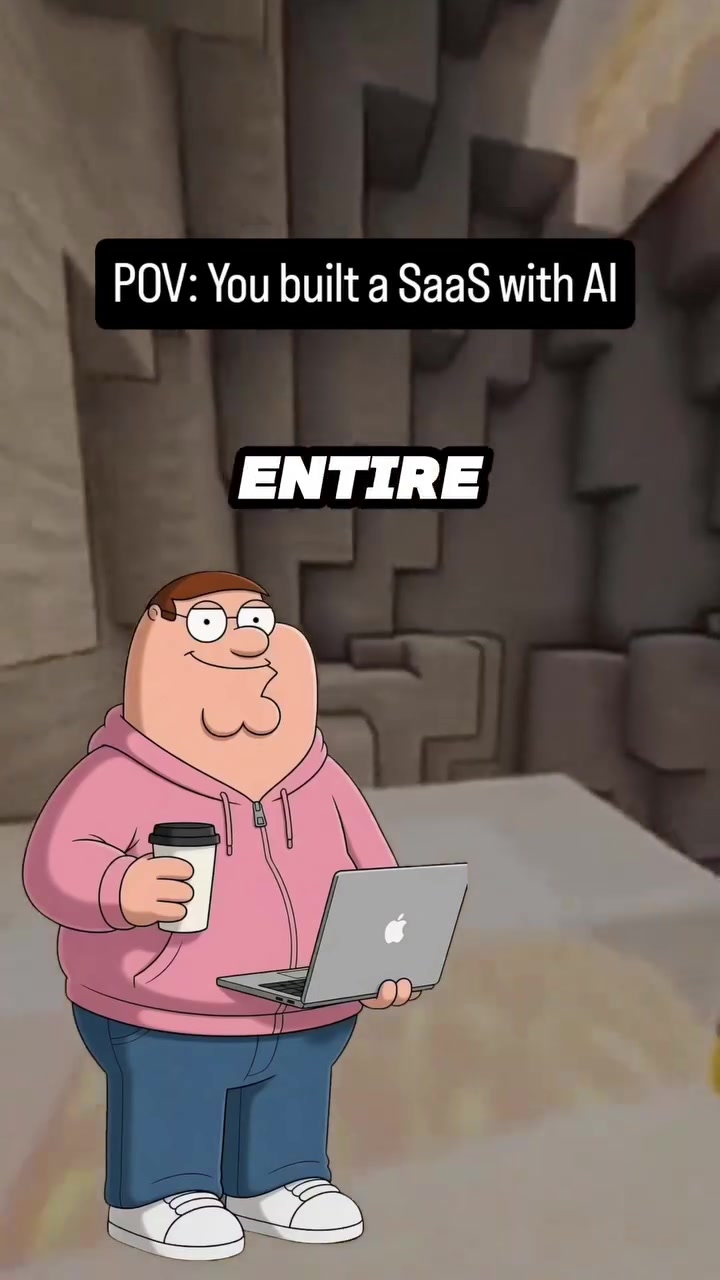
One weekend. No users. One message: mastering AI can help build a software-as-a-service (SaaS) app amazingly fast. Even if it doesn’t work right away.
The AI-Driven SaaS Sprint
Anyone who commits to learning AI can, in principle, build a SaaS app on their own. Imagine you’re a developer. You cobble together an app in one weekend. You tweak its appearance based on AI suggestions. You consider the AI’s resolution of bugs your chief quality assurance mechanism. It’s a test-free, a risk-taking sprint to launch a business akin to mining for gold in a cave. The on-screen text “POV: You built a SaaS with AI” and other captions emphasize that this is a hands-on, first-person perspective. Developers are betting on their own wits and creativity, by using AI as a production tool. They trust that the AI will guide them through development — for better or for worse.
The Vibe Coder Core
Coder culture has long glorified the independent developer — a Viking striking out to build software in the wilderness. The AI tools today enable one-person shops by offering a suite of built-in tools for developing and deploying SaaS app. But AI itself is no magic bullet: in practice, you’ll still need to understand your product and how users behave. The mix of humor and code in this reel suggests that the process involves both the hustle of building and the Victorious Vibe of outsmarting your own bugs. But the jokes highlight the risk. For instance, a developer’s nonchalant attitude toward deploying untested AI fixes means that they don’t know how to determine when production is ready.
What Happens When Code Meets AI?
AI as Accelerator
AI accelerates development in ways that resemble a speedrun. The cartoon character in the video, their laptop and pile of gold in a cave, underscores the gold rush feels of a SaaS build. One person able to go from idea to prototype to a live product in “one weekend” or more like one intensive sprint. The scene depicts the environment of a coder — a cave-like room with a laptop. The visual of gold represents the reward of successful SaaS development. This is a real-life, humorous vision of the treasure of accelerated build and deploy cycle.
AI as Autopilot
The claim of turning over the bug fixes to AI goes further. The AI took over 84 files. A bug report — either automatically detected or suggested — is a prompt for a new deploy: “Production is the test.” In fact, all the testing happens on the fly, in real time. It’s hard to ignore that deploying code directly to production is a theatrical danger. The visual of the cartoon character, unconcerned, emphasizes the reckless side of trusting AI. They deploy new code — their every decision, assuming that AI knows what to do.
The AI Advisor
The humor derives from how the AI makes the toughest decisions. In one exchange, the AI advises deleting the database — an extreme move that only a true aficionado would dare. The problem is that there’s no way to tell if the AI’s advice is good, other than to do it and find out. Sadly, the AI didn’t figure out the authentication, meaning it couldn’t confirm the accuracy — and trustworthiness — of its own actions. The AI simply said “bug fixed" even if the actual tests say otherwise. And then it changed 84 files, a number that reflects the AI’s own independence. The reality is that no developer, human or AI, can effectively review all those changes, especially at night, in total darkness.
Uncharted Territory
This level of trust in AI raises questions. Who built it? Who decides what to trust? To what extent? The sparse open-ended questions in the exchange underscore this point. The interaction demonstrates the probing, playful nature of how AI is trying to build something — even if that something isn’t fully understood. The AI doesn’t say who is responsible for bugs. The developer trusts AI, but at the same time, they frame it as a dungeon crawl. In response, the AI says, “Who built it?” And the answer isn't helpful.
Coder Gold Rush
The AI and SaaS are in a state of ferment. With AI hastening development, developers are deploying untested code. They are trying to create authentication systems, and they don’t know how to determine if the authentication works. They’re just happy they built something in a few days. They hand over several decisions, including deleting database files, to AI. The AI is a force multiplier for development — but as in the video, the consequences of trusting AI fully are blurred on both parties. Who is responsible if things go wrong?
Code or Develop?
You don’t need to be a coder to take advantage of the SaaS build process. When you start building, you’ll have to make decisions that revolve around:
- Testing Hardly Ever: It appears that no pushback occurs to deploy code. The AI itself becomes the sole decision-maker. You do not test. But the risks are clear in the real world.
- Building or Breaking: The AI will often change files. The AI can also offer suggestions like deleting the database. You’ll need to weigh the risks and benefits of following AI recommendations.
- Redefining Reality: The AI will never tell you what to do. In fact, AI tells you quite explicitly what you’ll need to do. You’ll pass test after test, and you’ll never stop deploying new apps. Ask yourself if you want your life to be this kind of productive.
Questions readers ask
What are the main risks of relying too heavily on AI for SaaS development?
The main risks include encountering unexpected bugs and deployment issues. Since AI tools might not fully understand the context or user behavior, they can suggest fixes that seem good but aren't always reliable.
How does AI accelerate the development of a SaaS app?
AI can speed up the development process by automating tasks like bug fixing, design tweaking, and even suggesting code improvements. This allows developers to go from idea to a live product in a short period, often within a single intensive sprint.
Can AI completely replace traditional testing methods in SaaS development?
No, AI can't fully replace traditional testing. While AI can suggest fixes and automate some aspects of testing, relying solely on AI for quality assurance can lead to deploying untested code directly to production, which is risky.
What kind of understanding do developers still need, even with AI tools?
Developers still need a deep understanding of their product and user behavior. AI tools can assist, but they can't make up for the lack of domain knowledge and strategic decision-making that comes from human expertise.
What are the potential pitfalls of trusting AI to handle bug fixes in a SaaS app?
Trusting AI to handle bug fixes means you might deploy untested code directly to production. This can lead to unexpected issues because the AI might not fully understand the context or the potential impact of its suggestions.
Related deep dives
Similar reads based on topic and creator.


Recent articles
Fresh deep dives from the latest Reels we unpacked.




Comments
Be the first to comment.