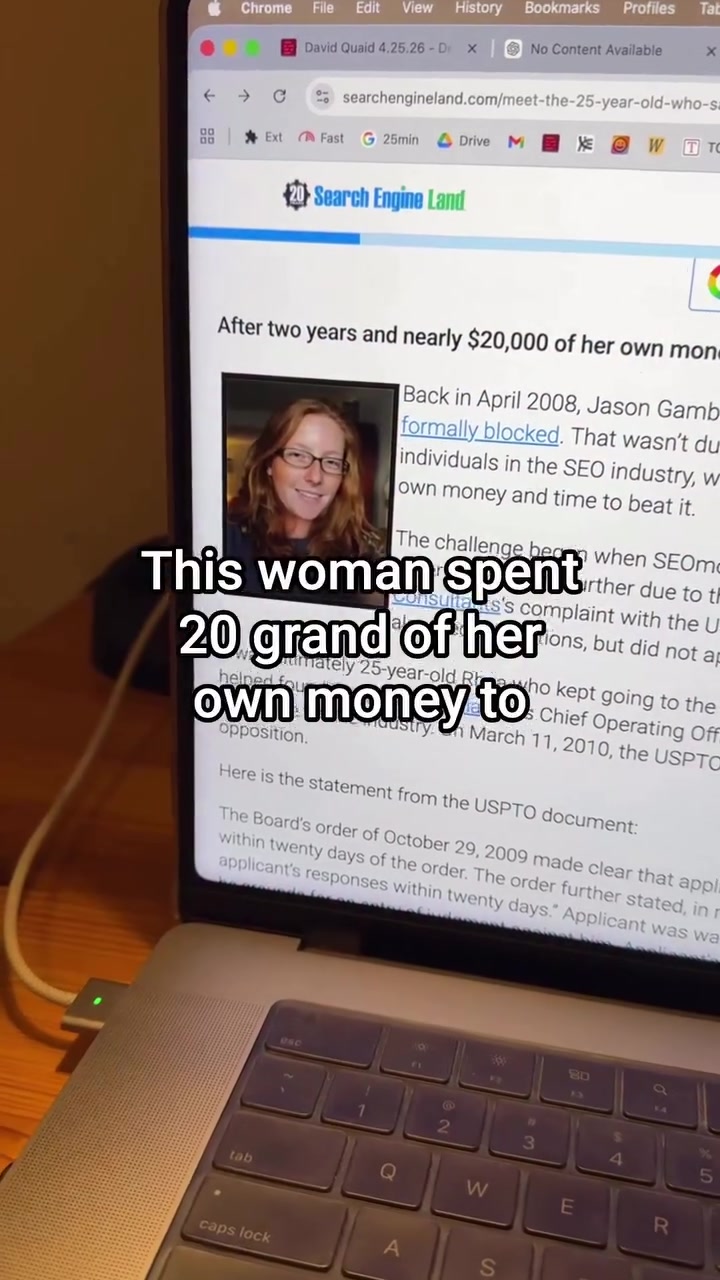
Rhea Drysdale stared down an attempt to trademark the term SEO in 2008. She personally funded a two-year legal battle to prevent Jason Gambert from controlling who could sell SEO as a service. Drysdale's efforts were not in vain, though: Donations from the SEO community repaid her $20,000 legal fees in just a few days. Her legend has lived on within the industry ever since.
The Last Battle to Own SEO
A trademark was Jason Gambert's biggest play to control the SEO market. The term SEO stands for search engine optimization, digital marketing that enhances a website’s visibility in search results. However, Gambert’s intentions went deeper: he intended to control the SEO industry as well as private consultants. It was a time when the SEO sector was just establishing itself: Gambert's trademark bid put him in a position to dictate which services and products the industry could offer. 2008 was a nascent period for the SEO industry. As Drysdale served as the president and executive editor of Search Engine Land, she dedicated funds and time to squash Gambert’s plot. Drysdale's actions didn't only protect her personal business. She blocked Gambert's attempt to monetize "SEO" through licensing and royalties. This would have allowed him to charge a fee for any industry use of the term. Since Gambert could not own or enforce the term, no one could monopolize "SEO" and control related services. An individual marketing themselves as an SEO consultant would be required to remit a fee to Gambert. His trademark would have been a temporary roadblock for SEO consultants. A trademark would have placed Gambert in a position to dictate his own licensing terms. However, his attempts did not get beyond the filing stage.
Stopping a Monopolist
The attempt to place SEO under a single trademark was a threat to the community that had built the industry. 2008 was the start of the Great Recession, when every dollar mattered and the web became more competitive. Without Drysdale's actions, Gambert's control could have created a future where only authorized pros could sell SEO. He would have had the power to decide the industry's scope, pricing, and demand. His monopoly would have constrained consultancy and service development. Beyond the financial assistance and legal support, Drysdale's commitment helped preserve the competitive and collaborative spirit of the industry. The SEO industry's community fought to ensure that no one person could capitalize on a common term that serves the entire industry.
The Tradition
Drysdale was by no means the first person in the SEO industry to brace against monopolism. The SEO community is known for collective contributions — whether it’s open-source tools or forums. The community shares knowledge, tools, and resources. It continued with Drysdale's bid. This attitude has always been at odds with the concept of monopoly.
The Reckoning
Drysdale's commitment to limiting Gambert's 'SEO' play reflects the wisdom of her corporate philosophy. The legal battle took "approximately two years." The legal fees amounted to $20,000. Drysdale's "own money" funded the operation. She did not use company funds. She fought for something bigger than herself. Gambert intended to trademark the term SEO to control every aspect of the field. As a direct result, Drysdale would have lost access to 'SEO', a term used in everything from marketing to consultancy.
The PayPal search for her PayPal
Drysdale's bid was the conduit for the SEO community to stand behind her initiative and cover the legal fees. In a few days, the donations she received paid everything back. This moment brought together the SEO community. They pitched in to cover Drysdale’s costs. Drysdale's legal expenditure would have spelled ruin for most individuals. The community took to Drysdale's PayPal to fund her battle and repay her legal fees. Drysdale and her supporters refused to accept that Gambert could dictate the scope of the industry. After two years of legal wrangling, Drysdale’s foresight proved invaluable. It is hard to overstate just how crucial Drysdale's intervention was in preserving the SEO industry.
What’s In A Name?
Drysdale’s victory over Gambert may have been the first big leap, but it did not define her whole career as a front-runner in the SEO sector. Her editorial career spanned decades, although it’s not unrelated to her dramatic win. Perhaps the most significant thing that Drysdale's actions make clear is what SEO means to the industry. It had to be protected, as they didn’t want to see the term SEO grow into a restrictive, domination tool. The term was essential, as SEO did not have a defined business model or service package, the term SEO remained common and crucial to its business. SEO's trademark challenges are rare, but Drysdale's actions kept the industry's independence intact.
The First Stop
Drysdale isn’t an unknown. During her near-decade tenure as president of Search Engine Land, she has been a key figure in protecting the industry. Drysdale failed her first attempt to trademark the term SEO herself. By 2008, the SEO industry was in a vulnerable position. Companies started using the term "SEO" in their business names and services. If she could not personally do it, Drysdale ensured that no single entity could take exclusive control. SEM, search engine marketing, is the most notable SEO-related term with its own trademark, but it is a trademark owned by the Search Marketing Association. The term has always had an inclusive meaning which he tried to fight. In a future without Drysdale’s actions, Gambert's trademark could become the master of SEO. Drysdale's 2008 move to halt the trademark leaves a two-fold legacy. First, her legal bid preserved the term SEO for the community. Second, her actions served as a reminder that monopolism is antithetical to the best interest of the SEO industry.
Questions readers ask
Who was Jason Gambert and what did he try to do with the term SEO?
Jason Gambert attempted to trademark the term SEO in 2008. His goal was to control the SEO market by charging fees for its use, effectively monopolizing the industry and dictating which services and products could be offered.
What role did Rhea Drysdale play in preventing Gambert's trademark?
Rhea Drysdale, then the president and executive editor of Search Engine Land, personally funded a two-year legal battle to prevent Gambert from controlling the term SEO. Her efforts were successful, and the SEO community later repaid her legal fees.
How did the SEO community respond to Drysdale's legal battle?
The SEO community rallied behind Drysdale, donating to reimburse her $20,000 legal fees in just a few days. This support highlighted the community's commitment to keeping SEO open and accessible to all.
What would have happened if Gambert's trademark had been successful?
If Gambert's trademark had been successful, he would have been able to charge fees for the use of the term SEO, which could have stifled competition and innovation in the industry. Only authorized professionals would have been able to offer SEO services.
What was the significance of Drysdale's actions during the Great Recession?
Drysdale's actions were particularly impactful during the Great Recession, as the SEO industry was just beginning to establish itself. Her efforts ensured that the industry remained competitive and collaborative, rather than being controlled by a single entity.
Related deep dives
Similar reads based on topic and creator.


Recent articles
Fresh deep dives from the latest Reels we unpacked.

Comments
Be the first to comment.