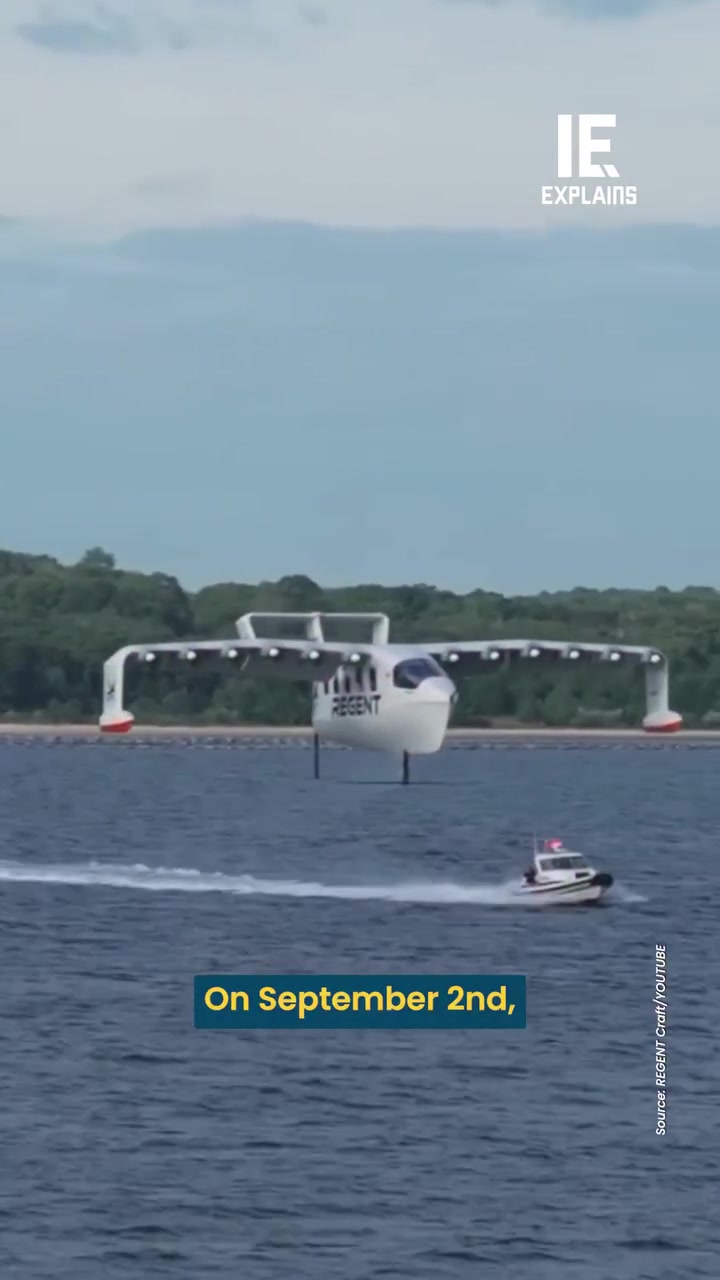
On September 2nd, two captains in Rhode Island lifted a peculiar craft 33 feet off the water, staying there for 30 seconds. The vehicle — and no ordinary one, at that — is Regent's Viceroy, an all-electric seaplane that has launched a new mode of travel.
The all-electric Viceroy — a boat meets air
The Viceroy is a hybrid, capable of moving like both a boat and a plane — but it cannot technically be called either. The vehicle is categorized somewhere between the two — and it's called a sea glider. These electric-vehicle boats travel on the surface of water, lift vertically and fly when they reach a certain speed — and all from the surface. For the Viceroy, this kind of travel is called the ground effect mode (GEM). To move, the Viceroy progresses in three stages. First, it launches from the hull like any other boat would, and then it rises to lift the body clear of the water. At that point, the wave drag no longer applies. When it reaches the third stage, it flies with a small margin between the water and its wings. The Viceroy is a marvel of modern engineering, and its design and functioning are unique. The craft boasts 12 electric motors along the wing’s leading edge and a triple-redundant fly-by-wire system to keep things stable. Regulation differentiates the Viceroy from other aircraft as well as it it “floats” within one wingspan of the surface, meaning it is classified as a vessel by the US Coast Guard rather than an aircraft by the FAA.
Flying to face climate change
The Viceroy's emergence couldn't be more timely. Traditional seaplanes, which have a history dating back to the 1920s, are known for their high noise levels and fuel emissions, while ships emit 3% of global CO2. These problems align with the rising thirst for climate-friendly solutions. While the Viceroy cannot compete with full-size ships, it can catch up to them in terms of travel range and speed. The Viceroy helps solve the transport problem with growing capacity. The aircraft is built for twelve passengers and two crew on board. The electric motors help with flexibility and are the reason why the models have a range spanning miles of territory.
The triple play of staying afloat
The Viceroy's aerial flight capability is based on the 'ground effect' principle. The 'ground effect' is a physical term that describes how it is simpler to lift the wing due to the cushion of air underneath to achieve more lift or how air is trapped under the wings to provide a smoother ride. The Viceroy’s electric engines lie along the leading edge of the wing providing extra lift. This arrangement makes the Viceroy efficient by reducing the energy required to stay aloft. Because the aircraft never leaves the ground effect, it can cover large distances without the need for an intensive electric charge, reducing overall energy consumption.
What powers the Viceroy — the propellers inside
The Viceroy relies on a total of 12 electric motors. These motors are embedded along the leading edge of the wing. The motors are essential as they drive the craft through the water and air. They are paired with a triple-redundant fly-by-wire system which manages the pitch, roll, and altitude ensuring a smooth flight.
The Viceroy as a maritime marvel
The Viceroy's safety can be attributed to its triple-redundant fly-by-wire system. This system holds the aircraft steady in the air. The automation is also responsible for the craft’s stability and control. The Viceroy is flown by certified mariners, not pilots. The transition from mariner to pilot could provide even more employment opportunities for those already trained in maritime navigation.
Surfing the skies
Those looking for a new experience will likely find the Viceroy alluring. It could be your next quiet, efficient seaplane ride. Confident that you might enjoy the Viceroy?
- Be ready to glide: You cannot pilot the Viceroy unless you are certified as a mariner.
- Expect a smooth ride: Triple redundancy and stable air sheets underneath the wings support the Viceroy's design.
- Stay close to the surface: Understand the ground effect and how the Viceroy works.
- Enjoy an eco-friendly trip: Low fuel use and noise are included as benefits of the electric power system.
- Location matters: Viceroy rides could be as close as Narragansett Bay in Rhode Island, as this is the reasoning behind it being named the best location for testing and operating.
The future of Regent electric vehicles
The Viceroy is already making waves. Regent, the manufacturer of the Viceroy, has a massive 255,000 square foot factory in Rhode Island. With order books spanning six continents and a major operator in the US, the company has already set a high demand for the craft. It's ready to sail the seven seas with the promise of a more sustainable travel experience.
Questions readers ask
What exactly is a 'sea glider' and how does it differ from traditional seaplanes?
A sea glider, like Regent's Viceroy, is a unique type of vehicle that can move on water like a boat and fly like a plane. Unlike traditional seaplanes, which take off and land on water but fly freely in the air, the Viceroy operates in 'ground effect mode' (GEM). It flies just above the water surface, using the cushion of air beneath its wings for lift, which makes it more efficient and allows it to stay aloft without needing intensive electric charges.
How does the Viceroy's ground effect mode (GEM) work?
The Viceroy's ground effect mode (GEM) leverages a physical principle where the aircraft stays within one wingspan of the water surface. This proximity to the water creates a cushion of air underneath the wings, making it easier to lift the craft and providing more lift than if it were flying higher. This unique mode of flight allows the Viceroy to cover large distances efficiently while minimizing energy consumption.
What makes the Viceroy's design and operation unique compared to other aircraft?
The Viceroy stands out due to its 12 electric motors along the wing’s leading edge and a triple-redundant fly-by-wire system. These features not only provide stability but also contribute to the craft's efficiency by reducing the energy required to stay aloft. Additionally, the Viceroy is classified as a vessel by the US Coast Guard rather than an aircraft by the FAA, which differentiates it from traditional planes.
How does the Viceroy address climate change concerns in transportation?
The Viceroy addresses climate change by offering a climate-friendly alternative to traditional seaplanes and ships, which are known for their high noise levels and fuel emissions. Unlike these traditional modes, the Viceroy uses electric motors, which reduces its carbon footprint and helps mitigate the environmental impact of transportation.
What are the practical benefits of the Viceroy's electric motors and fly-by-wire system?
The Viceroy’s electric motors provide flexibility and efficiency, allowing the craft to travel long distances without needing frequent recharges. The triple-redundant fly-by-wire system ensures stability and safety during operation, making the Viceroy a reliable mode of transport. This combination of features allows the Viceroy to compete with traditional ships in terms of travel range and speed.
Can the Viceroy be used for commercial passenger transport, and if so, what are the implications?
Yes, the Viceroy is designed to carry twelve passengers and two crew members, making it suitable for commercial passenger transport. Its electric motors and efficient ground effect mode allow it to cover long distances with fewer stops for charging, which could make it a viable option for eco-friendly passenger transport in the future.
Related deep dives
Similar reads based on topic and creator.




Recent articles
Fresh deep dives from the latest Reels we unpacked.



Comments
Be the first to comment.