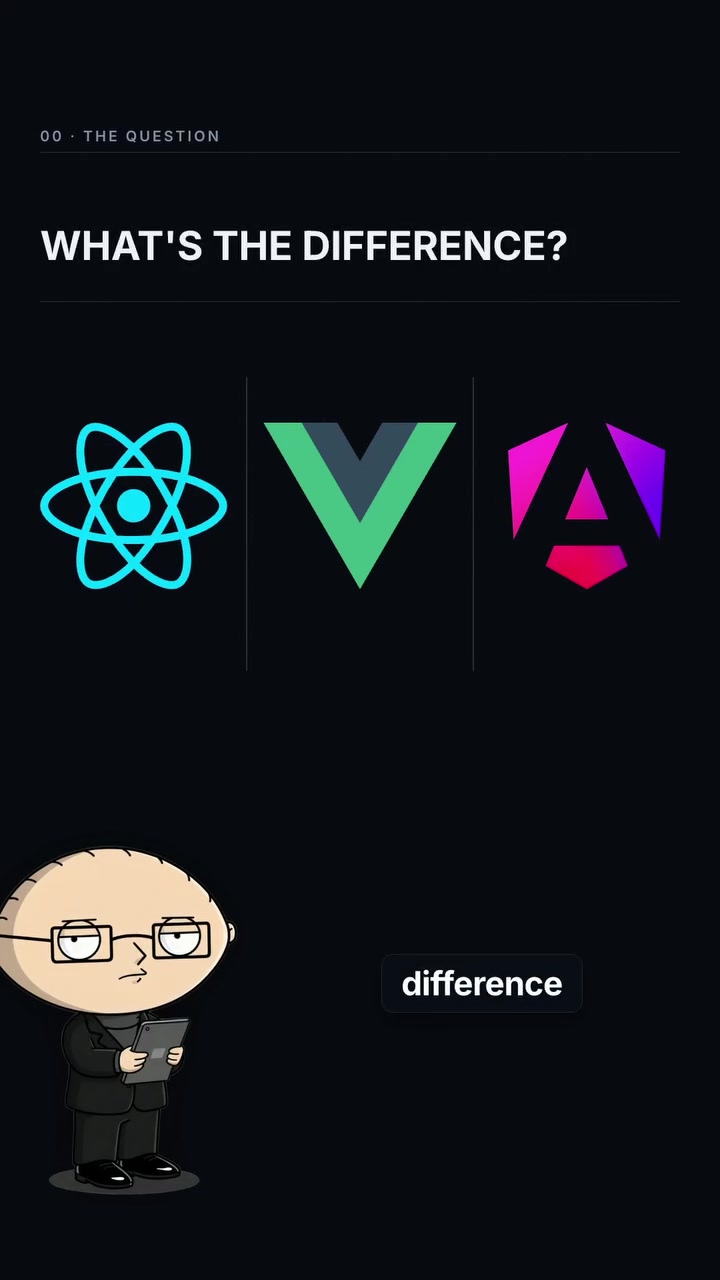
What are React, Vue, and Angular?
Three of the most prominent JavaScript frameworks for building interactive web applications are React, Vue, and Angular. They all solve a core problem for developers: keeping a user interface in sync with the application’s data. In a typical e-commerce scenario, when a user clicks "Add to Cart", multiple things need to update: the cart badge, the total price, the checkout button, and possibly other parts of the page. These frameworks offer a solution by allowing developers to describe what the interface should look like for the current state. The frameworks then handle the updates automatically. React, Vue, and Angular take different approaches to this problem. React is primarily a user interface library that uses components as its main building blocks. Each component receives data and returns the interface that should appear. When the state changes, React calculates what needs to update and modifies the DOM accordingly. This simplicity gives developers a lot of freedom but also means that React doesn’t provide a complete application structure or data-fetching mechanisms. Developers often turn to frameworks like Next.js to fill these gaps. Vue, on the other hand, aims to provide more structure while remaining approachable. A Vue component can keep its template, JavaScript logic, and styles together in one file. Vue’s reactive system automatically updates only the parts of the interface that depend on a changed value. This makes Vue easier to adopt gradually, allowing developers to integrate it into an existing website or build an entire application with it. Angular is a complete framework that offers a much more comprehensive approach. It includes components, routing, dependency injection, forms, HTTP tooling, and a strong application structure. Angular is more opinionated, which can make it heavier to learn but also ensures consistency across large teams. It uses TypeScript as a core part of the framework and has reactive primitives like signals that help track which parts of the interface depend on changing state. All three frameworks can build complex applications. The difference lies in their philosophy: React gives developers a flexible user interface layer and leaves the rest to the ecosystem, Vue balances flexibility with an integrated approach, and Angular provides a complete and opinionated framework from the start.
The Modern Web Development Trinity
The rise of React, Vue, and Angular reflects a broader trend in web development: the shift towards component-based architectures and reactive programming. These frameworks have become integral to modern web development, powering everything from simple websites to complex web applications. Their popularity is a testament to the need for tools that can handle the increasing complexity of web interfaces while providing developers with the flexibility and structure they need.
Components and State Management
React's Flexible Approach
React’s component-based architecture is one of its standout features. Components are the basic building blocks of a React application, and each component manages its own state. This modular approach allows developers to build reusable components that can be easily integrated into different parts of an application. Components can be as simple as a button or as complex as an entire form, each encapsulating its own logic and style. The reactive nature of React components means that when the state of a component changes, React automatically updates the DOM to reflect that change. This is done through a process called reconciliation, where React calculates the most efficient way to update the UI. For developers, this means writing less boilerplate code and focusing more on the actual functionality of their application.
Vue's Balanced Architecture
Vue takes a balanced approach by combining the flexibility of a component-based architecture with the structure of a full-fledged framework. Vue components can include the template, JavaScript logic, and styles all in one file, making them easy to manage and understand. Vue’s reactive system is another key feature. It automatically tracks dependencies between data and the DOM, ensuring that only the necessary parts of the interface are updated when the data changes. This makes Vue applications more efficient and easier to debug. Vue’s gradual adoption model allows developers to integrate it into existing projects, making it a popular choice for projects that require incremental updates.
Angular's Comprehensive Framework
Angular is designed to be a comprehensive framework, providing everything developers need to build complex applications. It includes a robust set of tools for routing, dependency injection, forms, and HTTP requests. Angular’s strong application structure ensures that large teams can work together effectively, following consistent conventions and best practices. Angular’s use of TypeScript brings the benefits of static typing to JavaScript, making it easier to catch errors during development and improving code maintainability. Angular’s reactive primitives, such as signals, help track changes in the application state, ensuring that the UI remains in sync with the data.
Learning Curve and Community Support
React's Ecosystem
React’s flexibility and the vast ecosystem around it make it a powerful tool for developers. However, this flexibility also means that developers need to make more decisions about how to structure their applications. The React community is large and active, providing a wealth of resources, tutorials, and third-party libraries. Popular frameworks like Next.js build on top of React, offering additional features such as server-side rendering and routing.
Vue's Approachability
Vue’s approachable design and gradual adoption model make it easier for developers to learn and integrate into their projects. The Vue community is known for its friendliness and support, offering a wide range of resources and plugins. Vue’s documentation is comprehensive and well-organized, making it a great choice for developers of all skill levels. Its balanced architecture and reactive system make it a versatile tool for building both simple and complex applications.
Angular's Opinionated Structure
Angular’s comprehensive and opinionated framework can make it more challenging to learn, especially for beginners. However, this structure ensures consistency and best practices, making it a popular choice for large teams and enterprise applications. Angular’s use of TypeScript and its strong typing system can help catch errors early in the development process, improving code quality and maintainability.
How to Choose the Right Framework
Consider Your Project Needs
When choosing between React, Vue, and Angular, consider the specific needs of your project. If you need a lot of flexibility and are comfortable making decisions about the application structure, React might be the best choice. If you prefer a more structured approach that is still approachable, Vue could be the way to go. For large teams and complex applications, Angular’s comprehensive framework and strong conventions can provide the consistency and scalability you need.
Evaluate Your Team’s Expertise
The expertise of your development team is another important factor. If your team is already familiar with a particular framework, it might make sense to stick with what they know. Each framework has its own learning curve, so consider the time and resources required to get your team up to speed.
Questions readers ask
What makes React, Vue, and Angular different from each other?
Each framework approaches the problem of keeping the user interface in sync with data differently. React is a flexible user interface library that focuses on components and leaves other aspects to the ecosystem. Vue balances flexibility with an integrated approach, offering a more structured experience. Angular, on the other hand, is a complete, opinionated framework that includes everything from routing to dependency injection, making it more robust but also more complex to learn.
Why is React considered more flexible than Vue or Angular?
React is more flexible because it focuses solely on the user interface layer. Developers have the freedom to choose additional libraries and tools for data fetching, routing, and other functionalities. This modularity can be both an advantage and a challenge, as it requires more decision-making and integration work from the developer.
Which framework is best for a beginner?
Vue is often recommended for beginners because it offers a good balance between flexibility and structure. Its approachable learning curve and the ability to integrate it gradually into existing projects make it an excellent choice for those new to web development. However, the best choice depends on the specific needs and goals of the project.
Can I use React, Vue, or Angular to build a complex web application?
Absolutely, all three frameworks are capable of building complex web applications. The choice depends on your project requirements and team expertise. React offers flexibility, Vue provides a balanced approach, and Angular offers a comprehensive, opinionated framework. Each has its strengths and can handle the complexity of modern web interfaces.
What are the advantages of using Angular over React and Vue?
Angular provides a complete solution with built-in features like routing, dependency injection, and form handling. This makes it easier to maintain consistency and structure, especially in large teams. Additionally, Angular's use of TypeScript can help catch errors early in the development process, but it also means a steeper learning curve compared to React and Vue.
How do these frameworks handle state management?
React, Vue, and Angular each have their own ways of managing state. React uses a component-based approach where each component manages its own state, often with additional libraries like Redux for more complex state management. Vue has a reactive system that automatically updates the interface based on state changes. Angular uses reactive primitives like signals and provides a robust state management system built into the framework.
Related deep dives
Similar reads based on topic and creator.




Recent articles
Fresh deep dives from the latest Reels we unpacked.



Comments
Be the first to comment.