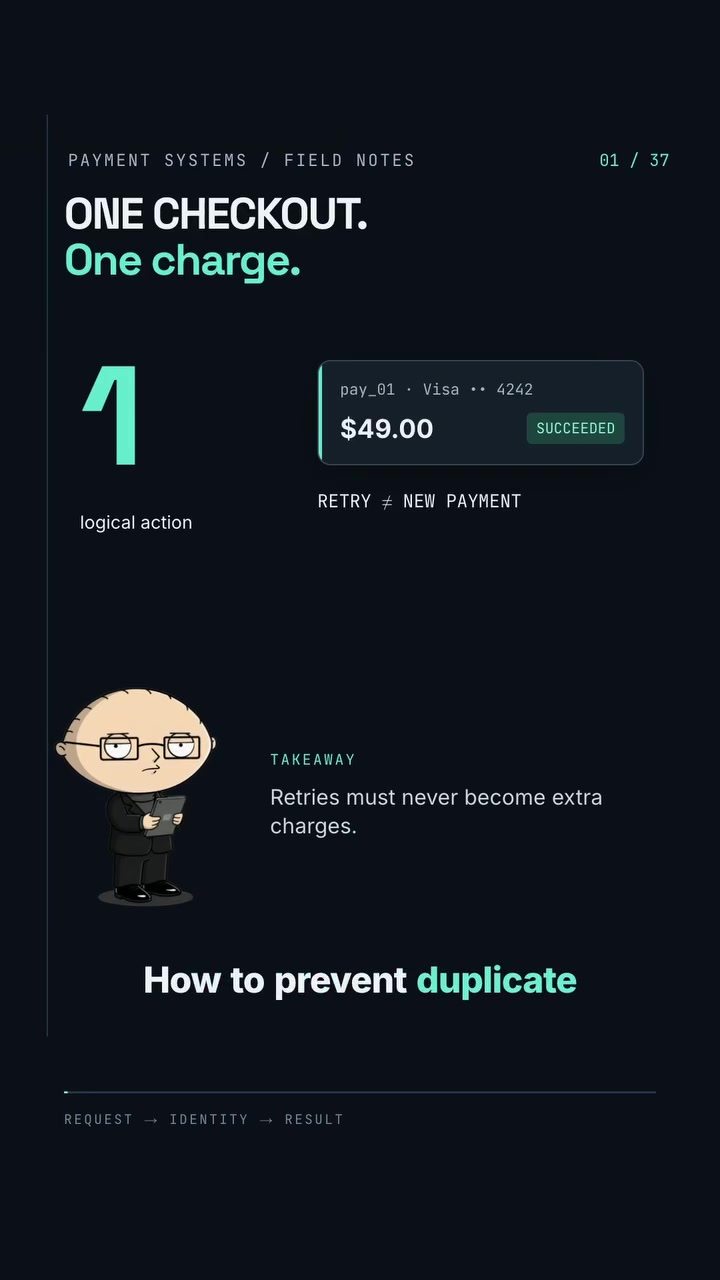
A Disabled Pay Button is Just the First Step to Preventing Duplicate Payments
When a user clicks "Pay" and the button disables, many assume the process is finished. They are wrong Disabling the Pay button is a common front-end solution to prevent duplicate payments. It stops the customer from submitting multiple or duplicated payments. But this step is not enough because many scenarios can lead to duplicate charges. The user might refresh the page, experience a network drop, or the app might automatically retry sending the request. If the server isn't equipped to handle these cases, the same payment could be processed multiple times and successful charges occur twice. It's a simple yet crucial distinction. Disabling the button stops double-clicks on the page. Protecting the server stops duplicate payments.
What Idempotency and Key Generation Mean for Safe Payments
Idempotency, simply put, is a property of operations that guarantees the outcome remains the same, regardless of how many times the operation is repeated. It prevents a second request, which logically could be the same as the first, from affecting the payments system. When a user begins a checkout, the client generates a unique, random key for that payment attempt. For example, a key might look like "checkout _8f3c." Any retry of that checkout must send the exact same key. This allows the server to identify and react to the repeated requests. Idempotency serves a few purposes in the payments backend. It detects duplicate requests from the frontend, supplements existing systems like Stripe, and handles retries in a controlled manner. The backend checks the key to see whether it has already processed that payment. If so, it returns the previous results instead of starting another charge. This way, the system ensures that one checkout results in one charge.
The Role of PostgreSQL in Transactional Databases
The backend must store payment attempts in a reliable database to ensure idempotency. Transactional databases like PostgreSQL are ideal for this. Each payment attempt is logged with details including the idempotency key, user ID, amount, and status. The database ensures that only one row can exist for each idempotency key, preventing duplicate charges. If a payment is already in progress, the system will return the current state instead of starting another charge. The unique constraint is crucial to preventing duplicates. It ensures that the database only allows one row for each idempotency key, no matter how many requests come in at the same time. The database then communicates with the payment processor, like Stripe, passing the same idempotency key. This way, even if the backend accidentally sends the request twice, Stripe recognizes that both requests are for the same operation.
Navigating the Webhooks
A critical aspect to consider is the webhook, a call the payment processor makes back to the server upon processing the payment. The server must handle these webhooks with the same idempotency to prevent side effects from duplicate deliveries. It involves verifying the signature, finding the payment record, and updating the status to 'succeeded.' This way, even if the webhook arrives twice, it won't apply the same side effect twice. The process also requires storing the provider's event ID to ensure the system can track and process webhook events correctly. If the webhook arrives and the event ID already exists, the system acknowledges that the event has already been processed and moves on.
Practical guidance for implementing idempotency in payment systems
Without crucial safety measures, duplicate charges can occur when a user refreshes a page, experiences a network drop, or an app automatically retries a payment request. Here’s how to ensure your payment system protects against these scenarios:
- Ensure Unique Key Generation: Generate a unique key for each payment attempt and send it with every retry. This is crucial for differentiating between new and repeated requests.
- Use a Reliable Database: Store payment attempts in a transactional database like PostgreSQL. Ensure the database uses a unique constraint to prevent duplicate rows for the same idempotency key.
- Implement Atomic Writes: Ensure that the database writes are atomic, meaning they either complete successfully or fail entirely. This prevents race conditions where multiple requests might try to create the same row simultaneously.
- Verify Webhooks: When receiving webhooks from payment processors, verify the signature and check the provider's event ID. This ensures that repeated webhook deliveries do not duplicate fulfillment or other side effects.
- Check Payment Status: Before creating a new payment, check if a payment with the same idempotency key already exists. If it does, return the saved result or the current status to prevent duplicate charges.
Idempotency is essential to safeguard payment systems
Idempotency is more than a buzzword. It’s a safeguard ensuring that a payment system is robust and resilient in handling retries and duplicates. By following the guidelines on key generation, database management, and webhook verification, developers can create a payment system that protects both the user and the backend from the chaos of duplicate charges. With idempotency, one checkout indeed results in one charge, ensuring a smooth and secure payment process for all parties involved.
Questions readers ask
What exactly is idempotency and how does it prevent duplicate payments?
Idempotency is a property that ensures the same operation yields the same result, regardless of how many times it is repeated. In the context of payments, it generates a unique key for each payment attempt. If the same key is sent again, the server recognizes it as a duplicate and does not process a new charge, thus preventing multiple payments for a single checkout.
How does the backend handle duplicate payment requests?
The backend uses a transactional database like PostgreSQL to store each payment attempt with a unique idempotency key. This key ensures that the database only logs one payment for each unique key. If the same key is received again, the backend recognizes it as a duplicate and either returns the current status or confirms the transaction, preventing multiple charges.
Can idempotency be used with any payment processor?
Idempotency is particularly useful when combined with payment processors like Stripe. When the backend sends a payment request, it includes the idempotency key. The payment processor checks this key, and if it's a duplicate, it returns the previous result, ensuring that only one payment is processed.
What happens if a user refreshes the page or experiences a network drop during checkout?
If a user refreshes the page or experiences a network drop, the app might retry the payment request. Without idempotency, this could result in multiple charges. However, with idempotency, the server recognizes the retry as a duplicate, thanks to the unique idempotency key, and processes only one payment.
How does the server handle webhooks from the payment processor?
Webhooks are calls made by the payment processor to the server after processing a payment. The server handles these webhooks with idempotency to prevent side effects from duplicate deliveries. It verifies the signature, finds the payment record, and updates the status, ensuring that even if the webhook is delivered multiple times, the payment status is only updated once.
Related deep dives
Similar reads based on topic and creator.




Recent articles
Fresh deep dives from the latest Reels we unpacked.




Comments
Be the first to comment.