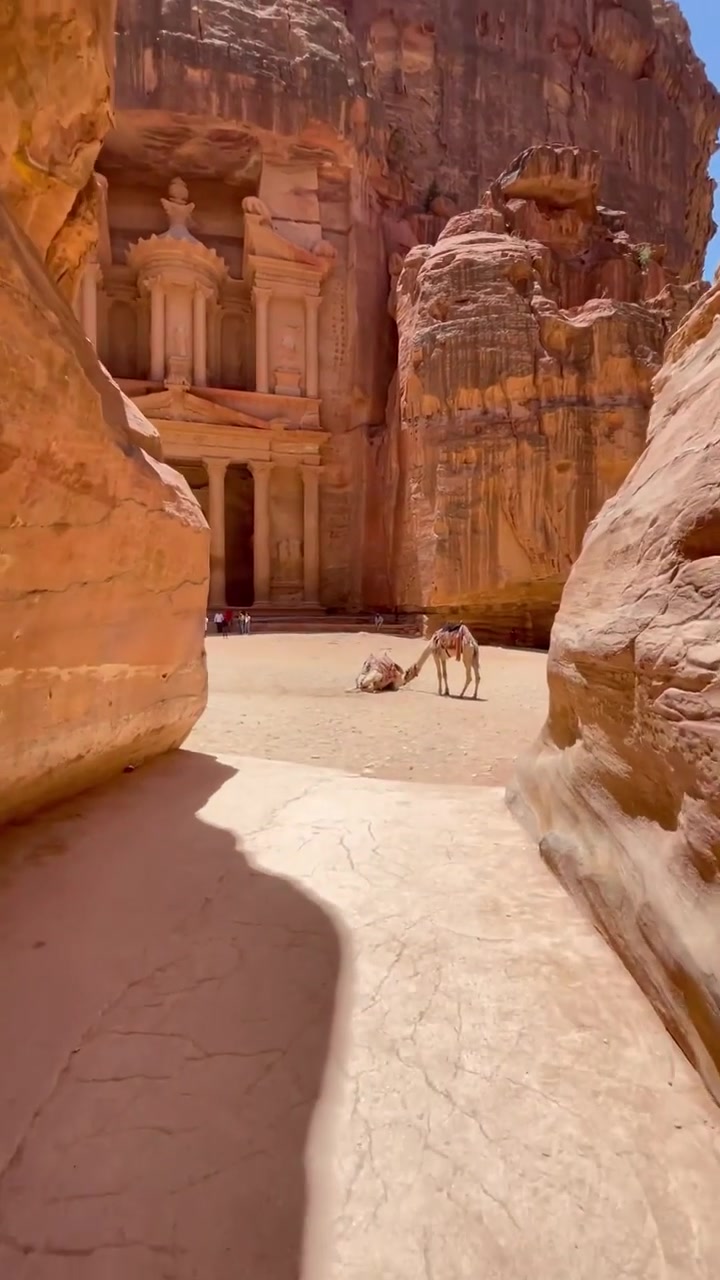
Petra, Jordan, is an ancient city that's a natural geological marvel and architectural wonder. Founded around 300 BC, Petra is a remarkable testament to human ingenuity and creativity, carved entirely out of sand-infused red, pink, and white rocks by Nabataeans, an Arabian people with Bedouin origins who flourished between 400 BC and 100 AD. The site is a UNESCO World Heritage Site. Petra's most recognizable monument is The Treasury, or Al-Khazneh. The façade of The Treasury, a key part of the city, was carved out of a single massive rock cliff face, a staggering feat of engineering. Today, it is Jordan's most iconic tourist site, drawing visitors worldwide. Over the past millennium, earthquakes, travelers, and environmental forces have sculpted Petra, modern civilization has left its mark, too.
Petra's Natural-Architectural Miracle
With a population of around 25,000 people, Petra is an intersection of the desert and mountain landscape. The city has used its natural surroundings to thrive over three millennia. The city is carved into the rocks of Jebel Al-Madhbah, a mountain that reaches heights of up to a thousand feet. It was constructed with natural resources. The Dalaapis Trail, or Siq, a 1.2 km-long and 3-meter-wide rocky narrow gorge, is part of Petra's enduring legacy. It is the entrance to the city, leading to the Treasury. The Siq is among the most famous parts of the city, with beautiful rock carvings on its walls. In ancient times, Petra included a theater, temples, a ceremonial center, historic buildings, tombs, and housing. Today, only a small part of the city is excavated. Petra, Jordan's ancient city, is a historical and archaeological treasure — it is one of the world's most celebrated destinations. The city has some of the most intricate carvings, which have remained well-preserved for thousands of years. The carving has made the city into a mishmash of desert and mountain landscapes. Dr. Zhiri shares how the hilltop city lies nestled in the heart of the Jordanian desert, where it enjoys a unique location at the crossroads of the Arabian, Egyptian, and Mesopotamia worlds.
A Massive Tourist Attraction
Complemented with vibrant tourism, Jordan leverages the beauty of Petra for international tourism. Petra’s economic impact is both a boon and a challenge. The city of tourists positively impacts the local economy, but the influx of visitors also poses problems. Urbanization, tourism, and climate change have all threatened to harm the surroundings of Petra as well as the city itself. A Due to a lack of laws and regulations for developing the urbanization and tourism-related facilities in the area, Petra's ecology has faced many dangers. The roads and trails have become damaged due to increased tourists and the facilities provided for tourists. Some sites are being vandalized by tourists, which makes it difficult to maintain the site and its diversity. The increase in the number of people and the popularity of the site has also impacted the area's ecology due to increased waste and more human activity. The surrounding region of Petra is also affected by urbanization and climate change. An ancient site like Petra poses many challenges, including the preservation and maintenance of the site. However, in a region where national security is a major concern, Petra struggles to find the balance. Petra's security and safety concerns make it difficult to preserve the cultural heritage. Additionally, natural calamities like earthquakes and other human activities like urbanization make it hard to maintain the site. The preservation of the historical site at Petra is a daunting task. But, the site remains a beautiful example of how human ingenuity can carve out a city in an unforgiving landscape.
Uncovering the World’s Most Beautiful Architecture
The ancient site of Petra includes tombs, a theater, and a ceremonial center, among other remarkable structures. The site is known for its intricate and beautiful rock-cut architecture. A lot of effort goes into the construction and maintenance of this site. The Nabataeans were extremely active in trade and in building the infrastructure for the city. The Siq was the original entrance to Petra. This narrow canyon leads to The Treasury, which is the most famous structure in the city. The Treasury is a massive 45-meter tall building that includes intricate carvings and colored rocks.
The Architectural Marvel
The structures of Petra are built out of waterless valleys and mountains. The city is located between ancient trade routes and in the middle of a desert. For many years, the city has flourished and survived many rulers and civilizations. The geology of Petra is related to this. The Nabataeans knew how to use water and maintain it so that the city could continue to thrive. The Nabataeans were responsible for building the city and making it sustainable and self-sufficient.
The Treasury and Other Structures
The Treasury, the name given by Western Ghazneets, was originally a Nabatean tomb known as the Al-Khazneh. Named in honor of El-Khazneh, an ancient Arabic name, it is a Nabataean tomb and one of the city's most magnificent monuments and a globally famous landmark. The East and West Khaznes are the most important structures in the city. They were royal tombs and are considered the city's highest architectural achievements. Petra is also known for its monetary system and a bird sanctuary. Built using the stones used in the era,Petra contains numerous structural buildings.
Historical Context
The site of Petra has fascinating history and architecture. After the Roman annexation, the city was a part of the province of Arabia Petraea. Petra, Jordan, is an ancient city that was founded in 300 BC by the Nabataeans, an Arabian people with Bedouin origins. The city was founded as a caravan stop, where travelers could rest and replenish supplies. Petra's architecture and infrastructure are products of the environment it inhabits. Camel was a popular transport mode of the residents of Petra.
Planning the Perfect Petra Visit
- When: The best time to visit Petra is during spring or autumn seasons, as winters are rainy and hot in summer.
- What to see: The Treasury, The Monastery, the Roman Army camp, and the Siq are among the must-sees.
- How to get there: Visitors can take in the scenery by camel, horse, or on a guided nature tour.
- Wear: Loose cotton clothing, a hat, and good walking shoes.
- Take: a high sun factor sunscreen, and plenty of water.
Questions readers ask
What makes Petra's architecture so unique?
Petra's architecture is unique because it's entirely carved into the red, pink, and white sandstone cliffs of Jebel Al-Madhbah. The Nabataeans, who founded the city, created intricate structures like temples, tombs, and theaters by chiseling directly into the rock. This method of construction is what makes Petra a marvel of human ingenuity and creativity.
How has Petra changed over time?
Over the past millennium, Petra has been shaped by earthquakes, environmental forces, and human activity. Modern civilization has also left its mark, with urbanization and tourism impacting the site's ecology and infrastructure. Some parts of the city have been damaged by increased tourist traffic and vandalism, while other areas remain well-preserved.
What is The Treasury and why is it so famous?
The Treasury, or Al-Khazneh, is Petra's most recognizable monument. It's a stunning façade carved out of a single massive rock cliff face, showcasing the Nabataeans' remarkable engineering skills. Its fame is due to its intricate design and the fact that it's one of the most well-preserved structures in Petra, drawing visitors worldwide.
Can I still see the original carvings and structures in Petra?
Yes, many of the original carvings and structures in Petra are still visible and well-preserved. However, only a small part of the city has been excavated, so there's still much to be discovered. Some areas have been affected by tourism and environmental factors, but efforts are being made to preserve and maintain the site.
What's the best way to experience Petra?
The best way to experience Petra is by exploring the Siq, the 1.2 km-long and 3-meter-wide rocky narrow gorge that serves as the entrance to the city. From there, you can marvel at the intricate rock carvings and make your way to The Treasury. Guided tours are available, and it's recommended to wear comfortable shoes and bring plenty of water, as the terrain can be challenging.
How does tourism impact Petra?
Tourism has a significant impact on Petra. While it brings in revenue and supports the local economy, it also poses challenges. Increased tourist traffic has led to damage to roads and trails, and some sites have been vandalized. Additionally, the influx of visitors has impacted the area's ecology due to increased waste and human activity.
Related deep dives
Similar reads based on topic and creator.

Recent articles
Fresh deep dives from the latest Reels we unpacked.



Comments
Be the first to comment.