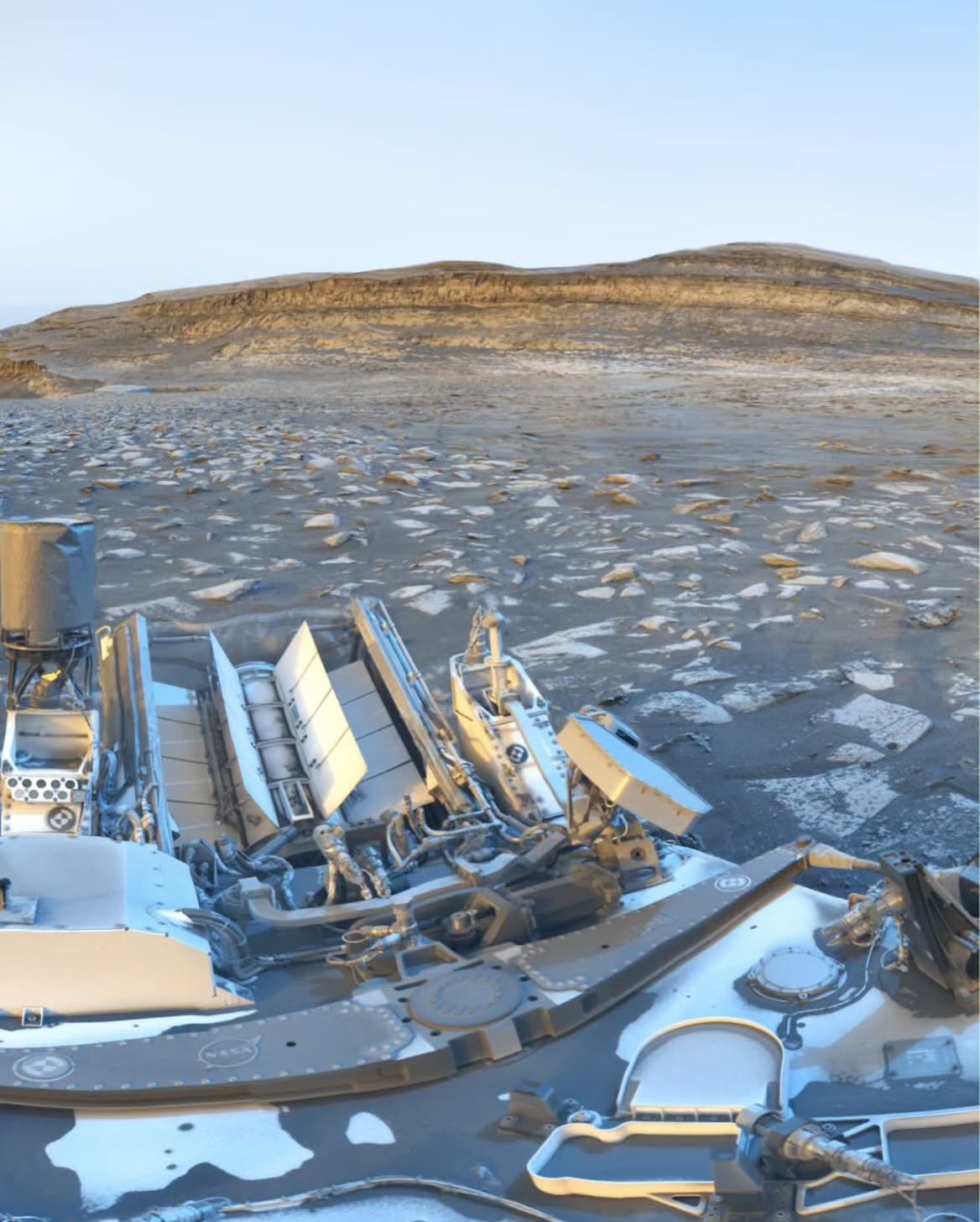
An aircraft sized robot captured a still of Mars landscape. The image shows a reddish-brown terrain dotted with rocks and icy patches. The foreground features components of the Perseverance rover, its inlets and panels still covered with Martian dust, while the soft, warm glow of early morning or sunset illuminates the atmosphere through dusty atmosphere. The Perseverance rover is the latest in NASA's efforts to explore Mars.
The Perseverance Rover: Mars explorer
NASA’s Perseverance rover is a sophisticated, car-sized robot designed to explore the surface of Mars. It was launched on July 30, 2020, and landed on Mars’ Jezero Crater on February 18, 2021. The rover is equipped with a suite of scientific instruments to search for signs of ancient microbial life, collect and cache Martian rock and regolith (soil) samples for potential future return to Earth, and characterize the planet's geology and past climate. The rover's design is a marvel of engineering, built to withstand the harsh Martian environment. It features a mast with cameras and scientific instruments, a robotic arm for sample collection, and a drill to extract core samples from Martian rocks. The rover's power source is a Multi-Mission Radioisotope Thermoelectric Generator (MMRTG), which converts the heat from the natural decay of radioactive isotopes into electricity. The rover has a similar design to the earlier Curiosity rover but carries more advanced equipment which allows it to see and act accordingly. The rover also has a helicopter, not something you'd imagine. Perseverance carries the Ingenuity helicopter, which is designed to test powered flight in Mars' thin atmosphere. What makes the rover distinct is its sophisticated autonomous navigation system. This system allows the rover to make decisions about its path and avoid obstacles in real-time, aiding in sample collection and science operations.
The quest for sign-of-life evidence: Question of water, rock, ice, and dust.
Mars exploration is part of a broader quest to understand the potential for life beyond Earth. Scientists believe that Mars, which once had flowing water and a thicker atmosphere, might have harbored microbial life in the past. Of the dozens of rovers and landers sent to Mars, Perseverance is among only a handful intended to collect samples that, it is hoped, will be returned to Earth for study. NASA also expects to collect more rocks than any other rover, which may contain evidence of ancient life. These samples will provide valuable insights into the planet's geological history and the potential for past habitability. Humans have long been fascinated by Mars due to its similarities with Earth. Mars is a planet with two moons, like Earth's one. It is now known that Mars has a vast expanse of ice, including a polar ice cap. In the future, the ice could be a source of water. The understanding of climate change on Mars will help scientists understand climate change on Earth as well. The rover's exploration of the Jezero Crater, which once held a lake and a river delta, is expected to provide critical evidence of past water activity.
WhereIt’s been
Drilling into the Red Planet
Perseverance had a number of high-profile firsts in its first two years. In the first months of deployment, the rover collected samples from a rocky outcrop on the Jezero Crater. The samples represented 3.5 billion years of Martian history. Using its drill, the rover collected two core samples from a rock dubbed Roubion. The core samples, roughly the size of a piece of chalk, were placed in a metal tube. In a later step, changes in the tube color indicate that it was hermetically sealed and that samples are locked in for future analysis. These samples will help scientists understand the geological processes that shaped Mars' surface.
Ingenuity helicopter
In May 2023, NASA's Ingenuity helicopter went above and beyond. Its 54th flight found it perched on the base of a rock formation, mapping out the environment below. Ingenuity is a technology demonstration to test powered, controlled flight on another planet for the first time. It is a small, lightweight helicopter with a dual-use camera, equipped with a high-resolution camera for navigation and a color camera for photography. At 1.8 kilograms, it is a tiny explorer that can't carry a lot of scientific equipment. However, it can help explore difficult terrains that the rover cannot reach and provide aerial photographs for the rover's research.
Solar-powered engineering
NASA delivers some of the best examples of solar-powered rovers. While battery-powered rovers were novel during the early moon landings, current rovers are more technologically advanced. This means it is unlikely that a battery-powered rover would last more than a few days. The Perseverance rover's power system uses a Multi-Mission Radioisotope Thermoelectric Generator (MMRTG), which converts the heat from the natural decay of radioactive isotopes into electricity. The rover's power source is designed to last for the duration of its mission, which is at least two Earth years (about one Mars year). Additionally, the MMRTG is designed to provide a steady supply of power, even during periods of extreme cold or darkness, ensuring that the rover can continue to operate in the harsh Martian environment. Solar-powered engineering is a delicate investment that requires maintenance and correction. In the future, scientists may work on a hybrid system that incorporates both solar and battery power. In the future, solar-powered rovers will have more efficient batteries and more advanced systems for collecting and storing energy. Solar-powered rovers are more expensive and require more maintenance. They also have shorter lifespans than battery-powered rovers. However, they are more efficient and provide a longer lifespan.
On the way to Mars
The mission to send the Perseverance rover to Mars began in the early 2000s. NASA selected the Jezero Crater as the landing site because it was believed to have once held water. The rover's landing system, called the Sky Crane, was designed to lower the rover to the surface using a tether system. The rover's mission is expected to last at least two Earth years, during which it will explore the Jezero Crater and collect samples. The rover is managed by NASA's Jet Propulsion Laboratory. The rover includes several instruments and laboratories designed to aid in its scientific missions. These instruments include an X-Ray spectrometer, a Sherloc instrument and a PIXL instrument. Each instrument plays a specific role in the rover's scientific endeavors. Scientists are eager to study the samples collected by the Perseverance rover to determine if Mars once harbored life. The rover's samples will provide valuable insights into the planet's geological history and the potential for past habitability.
Exploring Mars with your own eyes
A trip to the red planet isn’t available yet, but you can get a taste of mars right from at home. Depending on your interest in Mars, you could read up on future Mars missions. For the most immersive experience, NASA's Perseverance Rover simulator is available. This simulates the actual rover experience, offering a chance to get behind the wheel and command the rover remotely, aiding scientists in their work. A NASA live feed is available, including where to see the most recent images and videos from Mars. The NASA Perseverance Rover Goals Chart shows how important it is to have precise objectives and goals. For those who cannot access the simulator, this resource is a helpful tool to understand how scientific exploration is carried out. If you are just interested in staying informed, you can follow the rover's progress. In 2025, once the samples have been collected, the next step will be to return the samples to Earth. It will take this long, as the return mission itself is an enormous engineering challenge. The Red Planet has long been the subject of both scientific and popular imagination. As an educational, scientific, and technical effort, the mission will teach us about Mars and the broader universe. For many people, Mars will remain a distant and mysterious planet. Whatever the case, the Perseverance rover is a testament to human ingenuity, curiosity, and our unending quest for knowledge. Perseverance will be remembered as an engineering triumph and scientific milestone, offering a glimpse of what lies beyond our home planet.
Questions readers ask
What kind of camera equipment does Perseverance have to capture images like the Mars sunrise view?
The Perseverance rover is equipped with a variety of cameras, including the Mastcam-Z, which is capable of capturing high-resolution, color images and videos. This camera system is mounted on the rover's mast and can zoom in and out, as well as take panoramic shots, offering detailed views of the Martian landscape. The camera used to capture the Mars sunrise view is likely one of these high-quality imaging instruments.
Is the dust on the rover’s components a problem for its operations?
The dust on the rover's components is a natural occurrence on Mars due to the planet's dusty atmosphere. While it can affect some operations, NASA has designed the rover with this in mind. The dust can reduce the efficiency of solar panels if the rover had any, but Perseverance uses a Multi-Mission Radioisotope Thermoelectric Generator (MMRTG) for power, which is not affected by dust. The rover's cameras and other instruments are also designed to function despite the dust.
How does the Ingenuity helicopter enhance Perseverance's mission?
The Ingenuity helicopter is a separate but complementary addition to the Perseverance mission, designed to test powered flight in Mars' thin atmosphere. Ingenuity can scout ahead, providing images of the terrain that the rover can't see from its current location. This information helps the rover team plan the rover's route and identify points of interest for further investigation.
What makes the Jezero Crater a significant location for Perseverance's exploration?
The Jezero Crater is significant because it once held a lake and a river delta, making it an ideal location to search for signs of ancient microbial life. The presence of water in the past suggests that the crater may have harbored habitable conditions, and the sediments deposited there could contain preserved biosignatures. The rover's exploration of this area is expected to provide critical evidence of past water activity and potential past life on Mars.
Can the Perseverance rover collect samples from the icy patches it encounters?
The Perseverance rover is equipped with a drill and a robotic arm designed to collect rock and regolith (soil) samples, but it is not equipped to collect ice samples directly. However, the rover's instruments can analyze the composition of the icy patches, and the data collected can provide valuable insights into the presence of water and potential past habitability.
Related deep dives
Similar reads based on topic and creator.

Recent articles
Fresh deep dives from the latest Reels we unpacked.




Comments
Be the first to comment.