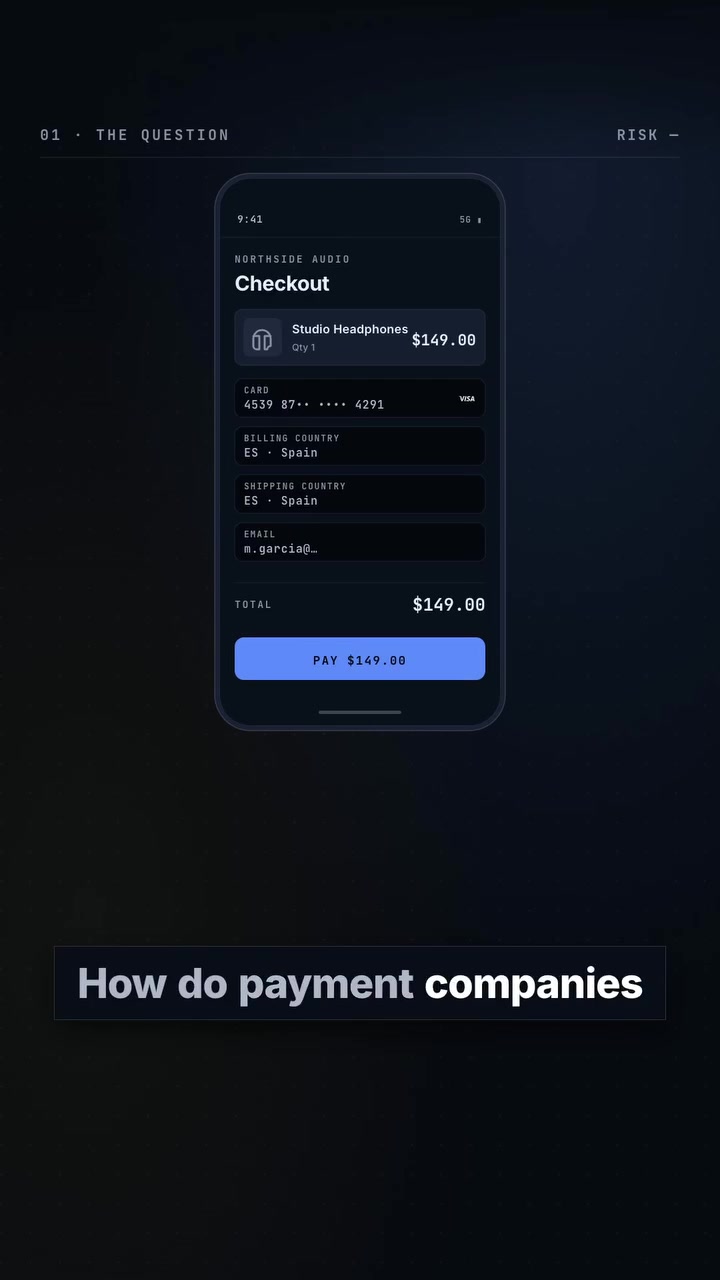
The Risky Truth Behind a $149 Payment Attempt
A purchase of Studio Headphones for $149 from Spain surfaces a common question: is this transaction fraudulent? The answers are anything but straightforward. The obvious rules—like matching cardholder names and IP addresses—break quickly. A cardholder might use a spouse's card, a company card, or a virtual card. An IP address might originate from a VPN or a corporate network, rather than the customer's actual location. These leads prompted a deeper look into the complex mechanisms payment companies use to evaluate risk.
What It Is: The jumble of signals behind a payment
Payment companies rarely ask a yes-or-no question to determine if a transaction is fraud. Instead, they sift through dozens, sometimes hundreds of imperfect clues to assess risk. It's a process best understood as a web of signals—each nudging a probability that determines the likelihood of fraud. These might include card history, device information, IP address, billing and shipping countries, email reputation, 3D Secure results, and card network signals, among others. Each signal carries a weight in the final risk assessment. Payment companies don’t block transactions based on individual signals; they combine many of them to form a probability. If that number sits around 50/50, the transaction might be challenged with additional verification, such as 3D Secure. This involves the customer confirming the payment through their banking app, a code, or biometrics. Once a payment passes verification, it still might be disputed later, often because it wasn’t actually made by the card holder. Suspicious IP addresses and hidden card origins often hit the headlines, but the reality is far more complicated. A customer might be traveling, using a VPN, or connected through a corporate network, making their IP address unreliable. Likewise, it’s common for a customer to be in one country while their card was issued in another, rendering the issuing country an unreliable signal.
The Bottom Line: The Risk Landscape
Payment fraud detection is a nuanced situation, where no single signal can definitively identify fraud. Payment companies know that they need to walk a tightrope between security and customer experience. It’s about balancing the need to stop fraud with the goal of not inconveniencing real customers. Because of these complex dynamics, payment fraud detection doesn’t end at checkout. Companies continue learning from disputed transactions and chargebacks, using this information to improve future risk assessments. The goal is to protect against fraud without blocking legitimate transactions. It's a delicate balance, one that hinges on the constant analysis and combination of diverse, imperfect signals.
The Dangerous Allure of Student and Travel Card Users
One of the most common red flags is when the billing and shipping countries don’t match the issuing country. This might sound suspicious, but it’s a scenario many expatriates, students, and digital nomads face. For example, a student from France studying in Germany might use a card issued in France. This mismatch alone isn't proof of fraud; traveling students use cards from their home countries all the time. Yet, it’s enough to make a payment system pause and run through the rest of its signals.
How to separate good from bad signals
The key is layering these signals: device information, payment velocity, account age, and email reputation, among others. Card history is particularly crucial. If a card has successfully paid the same merchant repeatedly, this lowers the risk. Conversely, if a card is used across multiple accounts in a short period, that raises the risk. Each signal is like a piece of evidence in a court case, nudging the probability in one direction or another. It’s this jury of signals that decides the fate of a transaction.
How to KEEP YOUR PAYMENTS FROM BEING REJECTED
Merchants and consumers alike can take steps to navigate this complex landscape. If your payments are frequently challenged, confirm your customer details, including your billing and shipping addresses. If you’re a business owner, make sure your checkout process is transparent and secure. This includes providing clear instructions for customers and implementing fraud detection systems that won’t overly disrupt the customer experience.
- Get Ready for Verification: If a transaction is flagged as high risk, be prepared for additional verification steps, like 3D Secure.
- Keep Your Details Updated: Ensure your billing and shipping addresses, as well as your card details, are up-to-date. Inconsistencies can sometimes trigger fraud alerts.
- Card Training: If you frequently travel or use VPNs, consider using a card that’s commonly used in those locations, if possible.
False Positives and False Negatives
Evaluating high-risk transactions is a double-edged sword. False positives and false negatives are both costly. A false positive is when a legitimate transaction is blocked, inconveniencing a real customer. A false negative is when a fraudulent transaction is approved, costing the merchant or consumer. In this case, the client passed the additional verification but their transaction still got returned as a chargeback. The money was moved, and it still became a chargeback two weeks later.
Questions readers ask
What are the main signals used in payment fraud detection?
Payment fraud detection uses a variety of signals, including card history, device information, IP address, billing and shipping countries, email reputation, 3D Secure results, and card network signals. Each of these signals contributes to the overall risk assessment, helping to determine the likelihood of fraud.
How do payment companies handle transactions with a 50/50 risk assessment?
When the risk assessment is around 50/50, payment companies often challenge the transaction with additional verification methods like 3D Secure. This involves the customer confirming the payment through their banking app, a code, or biometrics. Even after passing verification, the payment might still be disputed later, which is why ongoing monitoring is crucial.
Why are suspicious IP addresses not always a reliable indicator of fraud?
Suspicious IP addresses can be misleading because customers might be traveling, using a VPN, or connected through a corporate network. These factors make the IP address unreliable as a standalone indicator of fraud. Hence, payment companies look at a combination of signals rather than relying on a single data point.
What happens to the information from disputed transactions and chargebacks?
Information from disputed transactions and chargebacks is used to improve future risk assessments. Payment companies continuously learn from these instances to enhance their detection mechanisms, aiming to protect against fraud without disrupting legitimate transactions.
Why do students and travelers often trigger fraud detection systems?
Students, expatriates, and digital nomads often trigger fraud detection systems because their billing and shipping countries don't match the issuing country of their card. For instance, a student from France studying in Germany might use a French-issued card, which can raise red flags even if the transaction is legitimate.
How do payment companies balance security and customer experience?
Payment companies must balance the need to stop fraud with the goal of not inconveniencing real customers. They do this by using a combination of diverse, imperfect signals to assess risk and continuously learning from disputed transactions. This approach helps to protect against fraud while maintaining a smooth customer experience.
Related deep dives
Similar reads based on topic and creator.




Recent articles
Fresh deep dives from the latest Reels we unpacked.




Comments
Be the first to comment.