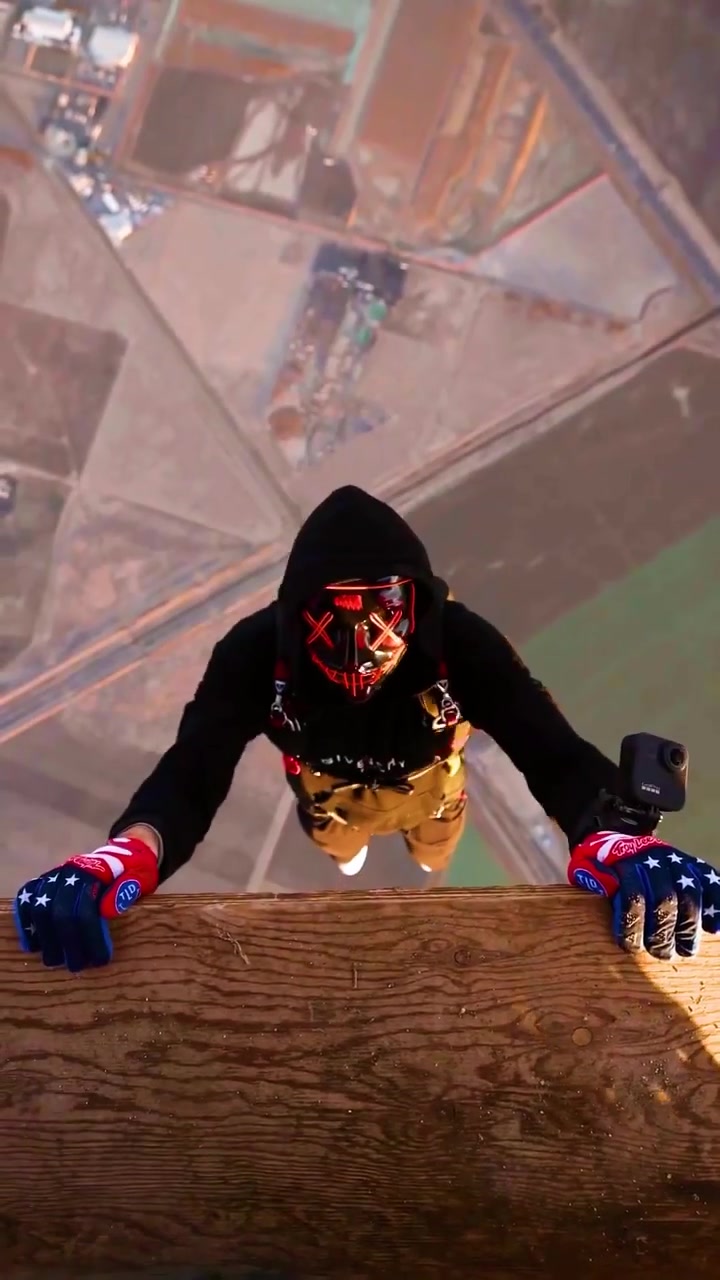
Ahead of the Curve, Elaborated for Posterity PARKOUR IN THE DESERT. A person stands atop a wooden beam, a red mask covering their face with distinctive 'X' markings, ready to launch off into the desert landscape below, relative anonymity, and the thrill of gravity. It's a high-stakes spectacle that lives in the heart of parkour. But what makes this neon-emblematic stunt unique and the perfect package?
The Distinctive 'Parkour Stunt' With a Mask
Parkour involves navigating urban environments through a mix of running, climbing, and jumping. It's about moving from one point to another, as swiftly and creatively as possible. It's a blend of athleticism, acrobatics, and audacity. In this case, the athlete's outfit is more than a mere addition to the cityscape challenge. The mask itself is a statement, further elevating parkour from a training regimen to a more expressive sport. It's a riff on the all-dressed-in-black style, signaling the complete immersion in the sport. The desert terrain takes the sport outside the city. Contrasting with the typical urban backdrop, the desert offers sharp, open vistas. More than aesthetic appeal, the desert setting brings new challenges. There’s no concrete jungle to hide in. There’s only the air in between desert rocks and the beach in the distance. The desert environment strips away all surface designations and props. It's the parkour artist and a wooden beam. It forces the observer to focus squarely on the movement and the spirit of the sport.
Redefining Urban Acrobatics
The absence of urban structures means the athlete has to be the designer in close collaboration with the setting. The parkour athlete is the creator and the creation. The simplicity of the desert creates a blank canvas, amplifying the illusion of urban parkour in a non-urban setting. The desert landscape presents a new challenge, a bold statement in the sport’s evolution. A wider frame: sports from street dancing to free climbing have roots in urban environments. They often grew in defiance of those spaces: skaters and parkour artists seek out cityscapes not designed for sport. The parkour athlete reclaims urban space, but in the desert, they craft their own challenges. Gymnasts and dancers know this. They surgically craft their routines in the controlled, standardized, rehearsed environments. But parkour athletes choose—to navigate their routines in unexpected, environmental settings. Yet it doesn't just move the sport to a new place: it also breaks down the barriers between spectator and athlete — the mask is a striking statement in itself, it facetiously abstracts the core spirit of parkour. It challenges the idea of the athlete. When a person in a mask is jumping through the desert, it raises the question of whether a parkour athlete is an athlete at all, or an explorer, an artist — and whether the difference matters. Since the physical challenge is an act of self-expression.
The Athlete’s Canvas
Every environment is an urban one, the parkour artist merely has to choose to challenge it. The highest point to the lowest lies in the human imagination. The desert — with its sharp contrast of top and bottom — is a natural playground for parkour athletes. The sport has always attracted those who seek to challenge perception. Masked-on-parkour-an-athlete navigates above a desert, where the path defines the practitioner. In short, the environment defines the art. The athlete is more like an artist than a gymnast. They design their own challenges. The wooden beam is the canvas, the desert, the frame. But the wooden beam also offers calm in the chaos. It's high enough to evoke fear but low enough to retain a sense of security. It gives the idea that the athlete is sculpting their environment rather than overcoming it.
SYMBOLISM IN CONTROL — THEATHERICALLY
The red mask with 'X' decorations constructs the athletes as an explorer. It separates the artist from their creations. The mask, arguably, becomes just another prop — an element of the obstacle itself. The symbolism of the red mask and its markings is theatrical. A different branding, or costume change, might as well be putting on a new play. When the sport debuted, it was a kind of art form distancing itself from organized sports — and an expression of self. The mask is a reminder of that approach, where the essence of parkour is raising and acting against the absurdity of politics and society.
Climatic Domains
The desert, in contrast to urban environments, possesses no concrete labyrinths, no hidden corners, and no man-made obstacles. Those features often influence the direction and style of parkour. The desert provides a bare canvas, with no expectations or demands, and an open invitation to the athlete to create their own world.
Breaking through Barriers
Why climb a building in a city full of buildings? Why jump over a fence in a world full of fences? Parkour is about transcending the banal. The desert environment takes the risk and desire for adventure to the next level. The masks’ vibrancy accentuates the harsh, stark beauty of the desert, a feminine body’s strength softened by an environment that's as rough as red can be.
Tips for someone hoping to try Parkour (with or without Red Mask) in a Desert
- Find the Right Terrain: The beauty of parkour is that it is adaptable, this person did it in an arid sandpit. Find your place in the world and make it your playground. Remember, the desert is harsh, both on the mind and body. Always do your homework. Be aware of the terrain and keep note of any hazards that might come your way.
- Avoid Loose Clothing: Like any sport, you’ll want to wear something with little to no friction. Consider a mask and a set of gloves to ensure no friction burns. LOOK UP: Don’t let the ground break you. Keep your eyes and mind on the prize as you soar through the air. Hat tip to the person behind the mask. Their stunt proves parkour is about exploration, breaking boundaries, and redefining what it means to move. Barbara Macdonald, a Parkour UK strength and conditioning coach said, “Parkour at its core is intended to be more of a community space, where you have a community that helps each other.
Questions readers ask
What makes the desert an appealing setting for parkour, especially compared to urban environments?
The desert offers a unique challenge because it lacks the urban structures that typically define parkour. This forces the athlete to focus on their movements and the raw elements of the environment, creating a stark contrast to the usual cityscape. The vast, open spaces and natural terrain amplify the athlete's creativity and athleticism, making each move more impactful and expressive.
How does the red mask enhance the overall spectacle of the parkour stunt in the desert?
The red mask with distinctive 'X' markings adds a layer of mystery and intensity to the performance. It shifts the focus from the athlete's identity to the movement itself, making the stunt more about the artistry and less about the individual. The mask also serves as a visual statement, emphasizing the theatrical and expressive nature of the sport.
What does the desert setting reveal about parkour as a sport and the athlete's role?
The desert setting strips away the usual distractions of urban environments, allowing the athlete to be the sole designer of their movements. It highlights the sport's emphasis on self-expression and creativity, blurring the lines between athlete, explorer, and artist. This unique environment challenges the traditional notion of what it means to be a parkour athlete, revealing the sport's deeper, more expressive side.
Can anyone attempt this type of parkour stunt in the desert, or does it require special skills?
Attempting a parkour stunt in the desert requires a high level of skill, both in terms of athleticism and familiarity with the sport. The desert's terrain is unforgiving, and the lack of urban structures means the athlete must be highly adaptable and creative. It's not just about physical ability; it's also about understanding how to navigate and interact with the natural environment.
How does the desert setting influence the observer’s experience of parkour?
The desert setting forces the observer to focus more intently on the athlete's movements and the raw elements of the sport. Without the usual urban distractions, the observer can appreciate the purity and creativity of the parkour athlete's actions. The desert's stark contrast and open vistas create a more immersive and dramatic viewing experience, enhancing the overall spectacle.
Related deep dives
Similar reads based on topic and creator.
Recent articles
Fresh deep dives from the latest Reels we unpacked.
Comments
Be the first to comment.