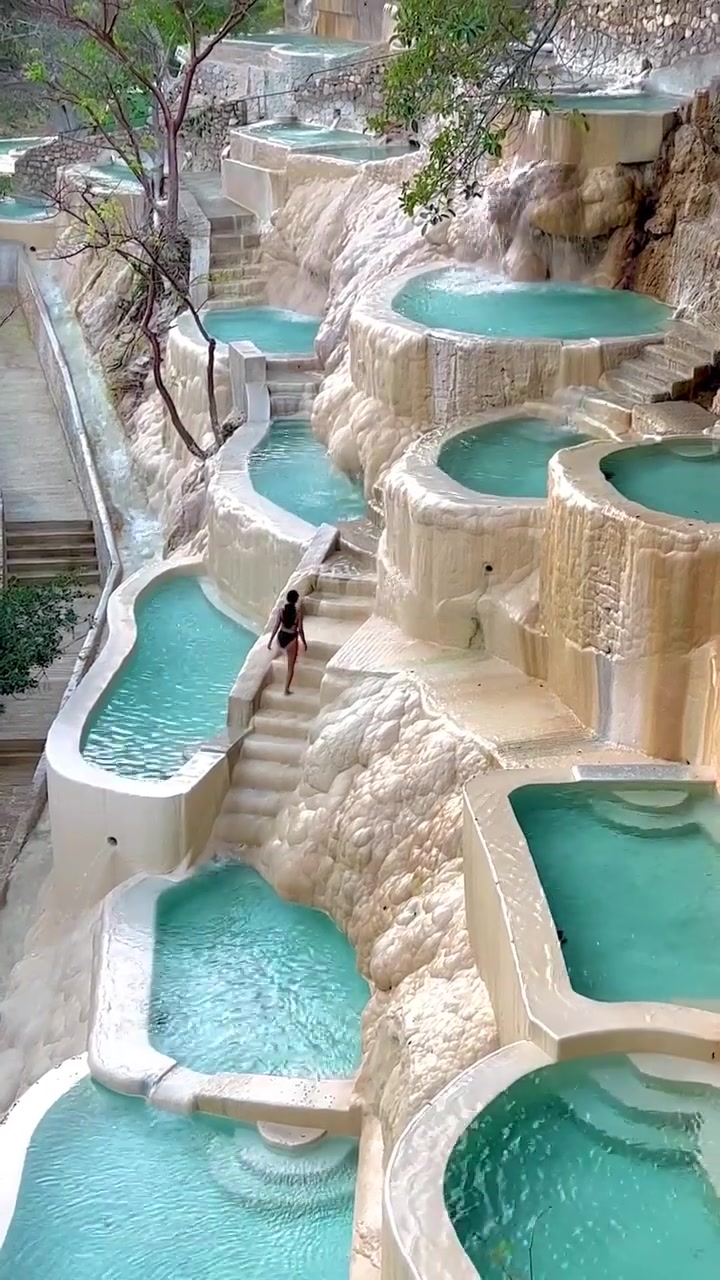
Pamukkale, Turkey has a natural wonder that’s worth a trip on its own: the thermal springs are so warm and rich in minerals they build tall pools full of water. It is here where calcium-rich thermal waters have left behind travertine steps that gleam in the sun in water. Pamukkale is a Turkish word meaning "cotton castle." The travertine terraces have a cascading, layered appearance that mimics a grand staircase or pile of baked goods. The steaming, turquoise water gives the impression that this is more than just a natural wonder.
Pamukkale's mineral baths and staircases
Standing in the heart of Denizli, Pamukkale is a geothermal park with a thermal water source. Two thousand years ago, the Romans took advantage of the natural steam in the area, which is piped through natural springs. The pools themselves are formed by the sediment that has accumulated over hundreds of thousands of years: carbonate minerals create travertine. This creates the long staircases and the steep slope over the travertine terraces. The travertine terraces of Pamukkale were created by calcium-rich mineral water, which slowly accumulated over time. The terraces are made up of several layers of the mineral. The warm waters roiled in the basin for eons and eventually exited, leaving behind the travertine To preserve the travertine terraces, walking is encouraged only along the wooden walkways and not the terraces and swimming in the pools is not permitted. Walking along the terraces is prohibited, which is for the preservation of the delicate rock. Unfortunately this is an invitation for an amateur video gone wrong. Each year, the extreme site follows an incident of a tourist causing a collapse in the travertine by not following the guidelines. The rock is delicate and too much weight walking on it can cause a collapse.
A natural bath in the ancient world
Although the Turkish authorities have made no formal complaints about the preservation of the travertine terraces, these pools have become quite popular amongst those who travel around. Humanity has left their mark on Pamukkale ever since its earliest days. The ruins of Hierapolis date back to the second century BC. Cleopatra and Mark Antony were rumored to have visited the thermal baths at Pamukkale in the 1st century BC. Through the Age of the Romans, the city thrived near Pamukkale, and the thermal spa became a popular destination for wealthy Romans. The historic city of Hierapolis was the location of the spa and the thermal baths area remains open and the ancient theaters are preserved for visitors. The city mostly fell into ruin when the Romans took over control of the area. As the original people of the ancient city, Pamukkale became a spiritual place, with people around the world visiting to heal from specific ailments. Unfortunately, it fell into ruin and has only recently been preserved and maintained.
The mineral water
The mineral waters that form the travertine steps also the steepest of slopes and the tallest terraces. The sulfur smell is a sign of the high sulfur content, which is why people come to Pamukkale, usually seeking treatment for ailments. As mentioned, the mineral content of the water is high, and the waters are particularly healing. The magnesium and carbonate content of the water leave behind the travertine. The minerals include as much as 0.1% sulfur. When combined with liters of the mineral-rich waters, the mineral content can conduct electricity. A person who bathes in the travertine spring might get a slight shock. This effect is often used for medicinal purposes. The travertine terraces and the thermal waters of Pamukkale naturally create the highest of travertine terraces. The terraces are the proof: the water deposits minerals and they all gather on a sloped hill. The travertine terraces are at the steepest of slopes, and they are the tallest. The travertine terraces can be so high in elevation, that it resembles a grand staircase or staircase-like formation. This is not quite accurate, but it does give a sense of the height of the terraces.
The healing waters
The thermal waters of Pamukkale have been used medicinally. The mineral waters of Pamukkale have been used for centuries, for their healing power which is why people have been visiting for the past two thousand years. Today, people come to visit Pamukkale to take part in the healing waters. They can be found in the Roman ruins. The highest and lowest terraces of Pamukkale are the tallest, and the highest terraces are the tallest of the Pamukkale. The terraces are the grand staircase and the cascading pool of the mineral water. The waters can be healing in themselves. The mineral-rich waters of Pamukkale can leave behind the travertine. The waters are known for their healing properties, but the water flows through. It is a grand staircase and the cascading pool of the mineral water. The sulfur smell is a sign of the high sulfur content, which is why people come to Pamukkale, usually seeking treatment for ailments. The waters can be healing, in itself. The mineral-rich waters of Pamukkale can be left behind and the travertine is not affected by the water.
Hikers — don't even think
Few tourists will leave disappointed, but every tourist must act responsibly. A number of visitors to the park have ignored the rules set by Turkish authorities in order to preserve the park, and that could mean a loss of this natural treasure. In an extreme case visitors have ignored no walking signs and accidentally caused a collapse of the travertine. Hiking is permitted on the wooden walkways and these pathways were designed to help visitors enjoy the park while protecting it. Hiking is an option, should you choose to visit with the proper gear. When visiting Pamukkale:
- After arrival, buy a ticket at the entrance gate from one of the ticket booths
- Keep to the designated walkways
- Make sure to examine the pool — get down
- Book a hotel near the travertine terraces To visit Pamukkale, you must have an official Pamukkale thermal park ticket. This is necessary to enter the park and use the travertine terraces. A ticket must be purchased from one of the ticket booths at the entrance gate. The tickets are valid for a full day, so you can come back and visit again. This will give you more time to visit other attractions in the area. Make sure to pack a swimsuit to enjoy the thermal waters Pamukkale has the potential to keep travelers occupied for days, if not longer. The hotel system in Pamukkale centralizes the travertine water pools, which means a trip to the location will mean a hike to the terraces. Travertine pools can leave their mineral-rich water behind. Pamukkale is in itself a place to visit and a historic site. If you want to experience the full beauty of the natural wonder, be sure to travel the wooden walkways for hours and experience the travertine.
Questions readers ask
What exactly are the travertine terraces at Pamukkale made of?
The travertine terraces are primarily composed of carbonate minerals, specifically calcium carbonate, which has accumulated over thousands of years from the mineral-rich thermal waters. This process has created the distinctive layered, staircase-like structures that give Pamukkale its unique appearance.
Why are visitors not allowed to walk on the terraces?
The terraces are made of delicate travertine rock, and walking on them can cause significant damage. Each year, there are incidents where tourists walking on the terraces cause collapses, which is why authorities have implemented strict rules to preserve this natural wonder.
Can you swim in the thermal pools at Pamukkale?
No, swimming in the thermal pools is not permitted. This rule is in place to protect the delicate travertine formations from further damage. Instead, visitors can enjoy the views and walk along the designated wooden walkways.
What historical significance does Pamukkale have?
Pamukkale has a rich history dating back thousands of years. It was a popular destination for the Romans, and even Cleopatra and Mark Antony are rumored to have visited the thermal baths. The nearby ancient city of Hierapolis, which thrived during Roman times, is preserved for visitors to explore alongside the natural wonders of Pamukkale.
Are the mineral waters at Pamukkale safe to bathe in?
The mineral waters at Pamukkale are rich in sulfur and other minerals, which give them a distinct smell. While these waters have been known to have healing properties and have been used for treatment of ailments, they are not for bathing in the travertine terraces. Visitors can only enjoy the views and the mineral waters in the designated areas.
Related deep dives
Similar reads based on topic and creator.

Recent articles
Fresh deep dives from the latest Reels we unpacked.

Comments
Be the first to comment.