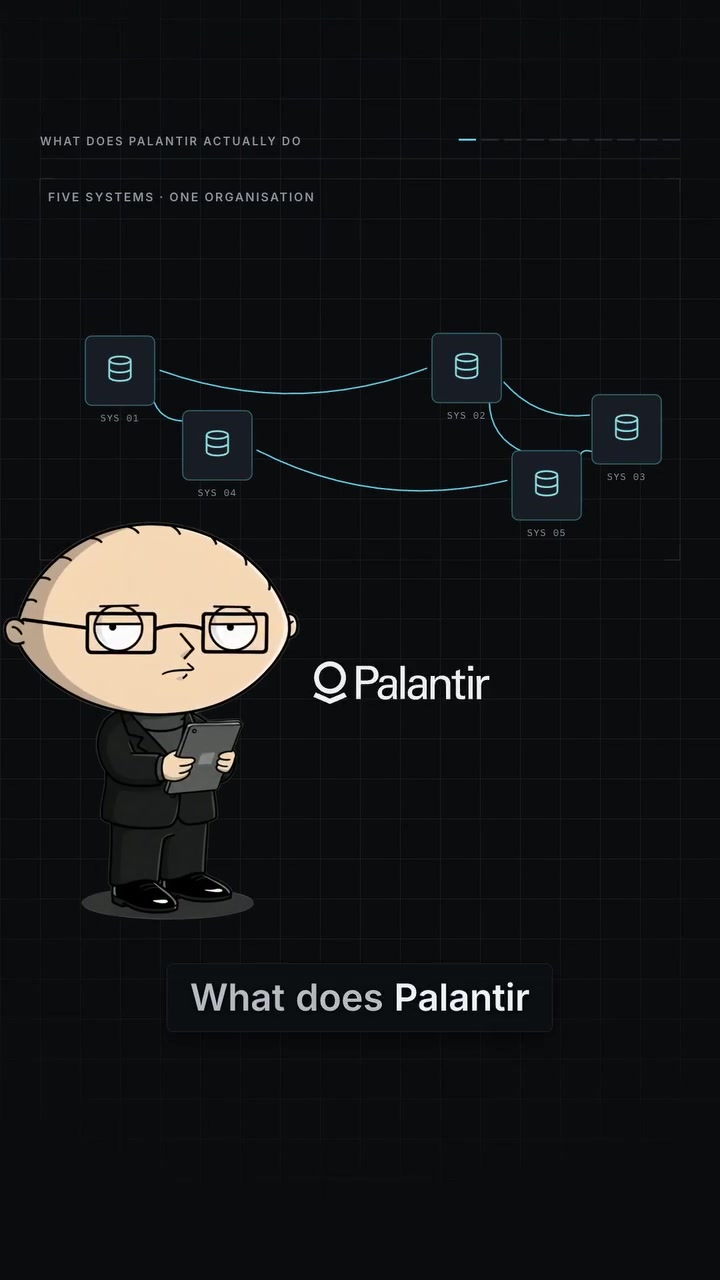
Palantir is a company in the data-engineering world. It sells software to fix a problem that sounds almost impossible: taking all the "data silos" — scattered data across an organization — and connecting it all in one place. "Five different names for the same person, no shared key," explained the narrator. The company was founded in 2003.
The software that draws red string
Palantir's software — Gotham and Foundry — can link people, places, events, documents, vehicles, and more. Gotham, which handles government and defense, was Palantir's first answer to the problem of disconnected information. Later, Foundry took on the task for businesses to connect data about orders, shipping, and inventory. Like a detective connecting clues, Gotham and Foundry allow users to start with one piece of information and follow it to the next. For example, an analyst begins with a person's name, then finds a phone number, connects it to a location, then ties the location to an event.
Connecting the dots
Palantir does not exist in a vacuum. The world of large organizations is strangled by scattered data. In response — Palantir. The company offers two main tools for bringing data together. Foundry is the commercial data platform, Gotham is used for government and defense. When building a data-driven world, Palantir solves two problems for organizations. First, the company can link different systems and data sources. Second, it addresses the lack of shared keys to connect the data.
One giant detective wall
Palantir’s technology transforms a giant maze of data into a streamlined system, moving from a messy web to an organized picture. The key concept here is ontology, which infuses raw data with real-world meaning. The ontology allows people to think in terms of objects and relationships, rather than database tables. Palantir engineers further facilitate this process with forward-deployed engineers, or FDS. Palantir engineers work directly inside customer operations, connecting data and building workflows around real problems. The process is simple: FDS engineers go inside an organization, they look at the data within, and build workflows around the data.
The Fine Print
The company caters to different types of customers with its products. Foundry addresses the needs of businesses, such as manufacturers and other large organizations. Gotham, on the other hand, is tailored for government agencies and defense departments. The primary task of Gotham is to link large databases of information with government data, allowing for a more streamlined data flow. Palantir's technology solves the problem of disconnected data within an organization. The great mystery about Palantir, Palantir is not AI. Nor is it government surveillance software. Both are aspects of what the company can do, but they do not define the company. The core of Palantir's business is connecting an organization’s data, giving it real-world meaning, and building applications and AI on top. Turn disconnected data into one operating picture.
AI enhanced data
But that's not all. In 2023, Palantir launched AIP, its artificial intelligence platform. "A language model by itself can answer questions. But a company does not just want a summarized document. It wants to know which factories are at risk of missing deliveries next week, why, and what should we do about it?” said the narrator. The artificial intelligence simplifies the complex task of tinkering with different databases, knowing what data you need to move—where you need to move it, giving it real-world meaning.
Palantir’s vision
Ask yourself, do I need Palantir’s software? If you manage a business with data silos everywhere, then Palantir may be a good option for you. If your company is missing the connections in your disparate databases, then Palantir’s software may be a good option for you. Palantir is offering big solutions to big problems.
Questions readers ask
What are the main differences between Gotham and Foundry, and who are they designed for?
Gotham and Foundry are both Palantir's software solutions, but they cater to different markets. Gotham is specifically designed for government and defense sectors, helping to integrate large databases of information and streamline data flow. Foundry, on the other hand, is tailored for businesses, addressing their needs in connecting data about orders, shipping, and inventory. Gotham was Palantir's first product, while Foundry came later to handle the commercial sector.
How does Palantir's software actually connect different data sources and systems?
Palantir uses a concept called ontology to infuse raw data with real-world meaning, allowing users to think in terms of objects and relationships rather than database tables. This is facilitated by forward-deployed engineers (FDEs) who work directly within customer operations, building workflows and connecting data to address specific problems. This process helps in turning a messy web of data into an organized, streamlined system.
What is the role of forward-deployed engineers (FDEs) in Palantir's process?
Forward-deployed engineers (FDEs) play a crucial role in Palantir's process. They work directly inside customer operations, assessing the data within the organization, and building workflows around real problems. This hands-on approach ensures that the data is connected in a way that is practical and useful for the specific needs of the organization.
Is Palantir's software primarily focused on AI and government surveillance?
No, Palantir's core business is not just about AI or government surveillance. While these aspects are part of what the company can do, the primary focus is on connecting an organization’s data, giving it real-world meaning, and building applications and AI on top of it. The company's technology solves the problem of disconnected data within an organization, turning it into one cohesive operating picture.
Why would a business choose Palantir over other data integration tools?
A business might choose Palantir for its unique ability to connect disparate data sources and systems, providing a cohesive view of an organization’s information. The use of ontology and forward-deployed engineers ensures that the data is not just integrated but also given real-world meaning, making it actionable and practical for decision-making. Additionally, Palantir's solutions are tailored to specific industries, ensuring that the needs of businesses are met effectively.
How does Palantir's AIP (Artificial Intelligence Platform) enhance the capabilities of their software?
Palantir's AIP is designed to build on the core capabilities of Gotham and Foundry, enhancing their ability to connect and analyze data. By integrating AI, Palantir can provide more advanced insights and predictions, making the data even more valuable for decision-making. The AIP can answer questions and provide recommendations based on the connected data, further streamlining the process of turning raw data into actionable information.
Can Palantir's software be used by small businesses, or is it only for large organizations?
Palantir's software is typically used by large organizations, such as manufacturers, government agencies, and defense departments. The complexity and scale of the data integration tasks it handles are generally more suited to the needs of large enterprises. However, the specific requirements and capabilities of small businesses may not always align with what Palantir offers, making it less likely for small businesses to utilize their services.
Related deep dives
Similar reads based on topic and creator.




Recent articles
Fresh deep dives from the latest Reels we unpacked.




Comments
Be the first to comment.