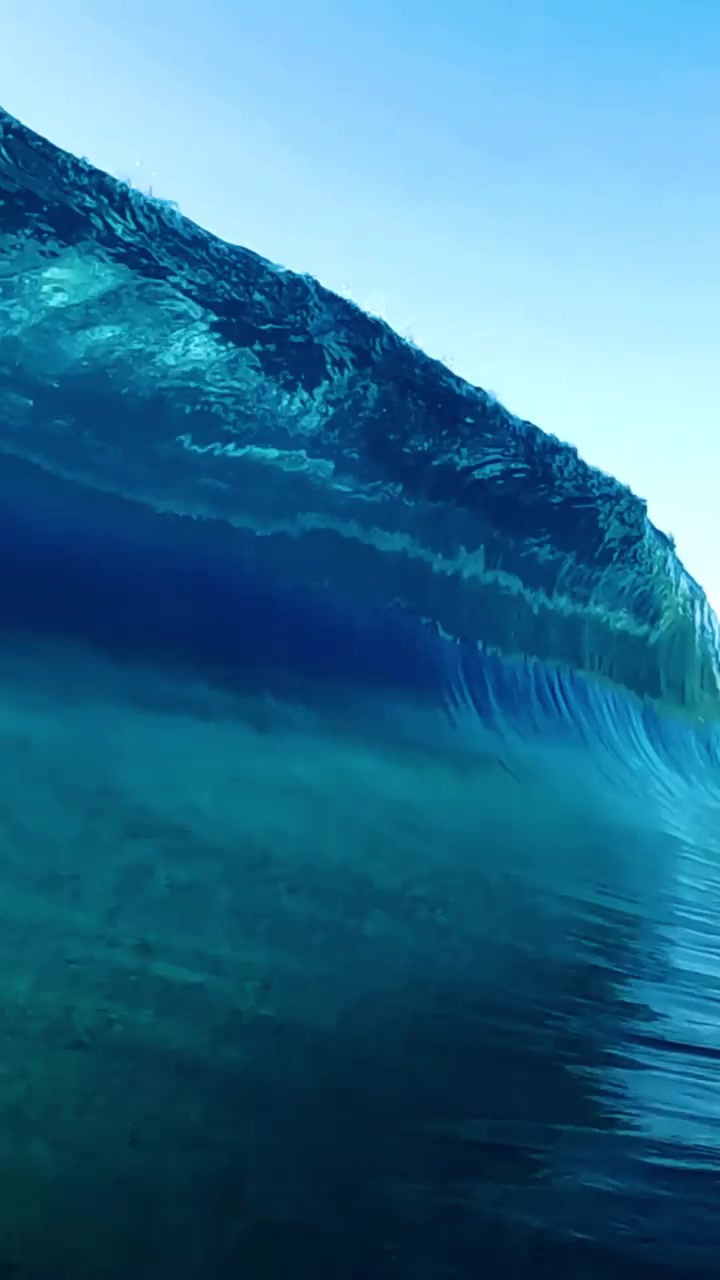
Ocean waves have a mesmerizing quality— that untamed force and symmetry, as the slightest breeze builds upon the sea pulling into towers reaching for the sky. As the wind persists and distance grows, the ocean’s turmoil amplifies to create a spectacle of crashing whitecaps, individuality flattened into a relentless, rhythmic sea. Waves have always served as a protagonist in a grand scene by simply being waves, diving to the heart of that intrigue.
Following the wave's journey
Wave creation begins when the wind blows over the ocean’s surface, creating delicate ripples that grow and spread across the water. These ripples are then pushed into full-sized ocean waves from the wind. An ocean wave keeps increasing in size and energy until their momentum falls or into obstacles in its path. What makes ocean wave formation unique is the element of mass. The ocean’s wide expanse allows for the accumulation of energy over great distances. This allows waves to form structures as they travel away from their origin point. The water particles forming wave masses circulate in a circular motion. Ocean waves vary in size, shape, and power, often characterized by their height from crest to trough and the distance between crests. Breaking waves are where a crest collapses, creating a turbulent, whitecap foam. These waves can range from gentle and rolling to towering and violent, depending on the conditions that create them.
The Magnetic Charm of Ocean Waves
The ballet of forces that make an ocean wave is enough to hold a fascination as timelessly as it is powerful. However, it is the waves’ role in our lives that elevates them from a mere phenomenon to a part of our identity. So much culture, art, and science come from understanding these waves, where, when, and how they occur. Waves have shaped mythologies, influenced literary classics, and inspired artistic masterpieces. Where there are waves, there are bold coastlines, from the rocky cliffs of Ireland to the vast beaches of the north. They have also influenced many aspects of our lives. From marine biology to ocean engineering. This constant motion thus fuels global trade, shipping, and commerce, while also feeding global fisheries.
The Science of Wave Formation
Wave Dynamics
When analyzing every dynamic of a wave, you begin to understand that waves are formed by the transfer of energy through the water. They aren’t a movement of water itself; the water molecules merely act as a medium for the energy to travel. This is why ships can weather storms without being completely engulfed—swells are not solid walls of water. The swells move through the water without displacing it significantly. Distant Horizon is a wave feature that is easily visible across a broad expanse of water. A distant horizon wave’s crest appears and swells as the wave approaches. The closer a person gets to the ocean’s edge, the smaller the ocean swells become, eventually changing into rhythmic ripples inside the surf zone. Many ancient tribes understood the subtleties of a surging mass of water, as evidenced by the Dorset and Cherokee tribes constructs. They understood the ability of waves to travel great distances.
Energetic Power
A wave is a form of kinetic energy, and like all energy, it can be harnessed. As individuals are becoming increasingly environmentally conscious, such renewable energy solutions are more appealing. Wave energy converters work by capturing the kinetic energy of the wave and converting it to electricity. They use the up-and-down motion of swells and the oscillatory movement of water particles. Waves can also change the shorelines where they are found, such as those near Hawaii. The water particles coming in swim deep to the ocean floor in a circular motion, lifting and moving particles on distant reefs.
Water's Tension
Tension is a key player in teaching waves to maintain their structure. Surface tension describes a force on the surface of a liquid that makes its surface less flexible and more rigid to deform. The surface tension between the water molecules creates a thin layer that holds itself together. This also explains how something as large as a wave can form something so small as a droplet.
Filtering and Cleansing
Ocean waves are also responsible for the cleansing of the sandy beaches. When a wave builds to its crest, the momentum begins to break down as it starts its downward motion. When this happens, the wave's energy reduces, releasing any particles the wave carries. This is the reason why most beaches clean themselves.
Experiencing the Waves
For many, the best way to learn or understand a wave is experiencing it. Stand at the shoreline and listen to the rhythmic crashing. Smell the saltwater in the air, and listen to the natural sound of the ocean. With the help of a surfboard, the wave's power can be harnessed. It’s the surfer’s ability to read the wave’s shape and motion. They can detect the way the movement of the water changes, the speed, the crests, and the troughs, and navigate the waves to perfection. Wave riding can be dangerous for surfers. This is why many surfers learn how to assess the waves as they approach the shore, and how they interact with the reefs. Due to interference and the friction caused by the reefs, the swells’ speed decreases. This changes the swells’ direction in a predictable manner, pushing them and forcing them to break. As the ocean’s surface tension can change rapidly, good surfers prepare for this. They can also tell how deep the wave is by the height of the crest.
The Necessary Gear
When surfing, surfers often use a leash to keep their surfboard near them. The leash prevents a lost surfboard by keeping it attached to the ankles. Surfers also wear wetsuits that provide warmth and protection from the sun. Some beaches have controlled environments where surfers can ride waves consistently. These controlled waves take exactly the same form, ensuring a safe experience.
Understanding Our Love for Waves
Waves hold a unique place in our hearts. They embody the rhythm of life—a natural metronome that’s larger and more powerful than us. Next time you watch or engage with a wave, appreciate its complexity and the wonder of this seemingly simple natural marvel.
Questions readers ask
How exactly do ocean waves form, and what factors influence their size and power?
Ocean waves form when wind blows over the ocean's surface, creating ripples that grow into full-sized waves. The size and power of these waves are influenced by the wind's speed, the distance it travels over the water (fetch), and the duration of the wind. The vast expanse of the ocean allows waves to accumulate energy over great distances, leading to the formation of towering swells.
What is the difference between the distant horizon waves and the waves that break on the shore?
Distant horizon waves are those that are visible from a distance, with crests that appear and swell as they approach. As these waves get closer to the shore, they transform into smaller, rhythmic ripples within the surf zone. Breaking waves occur when a crest collapses, creating a turbulent, whitecap foam. This happens as waves approach the shore and the water becomes shallower.
How do ocean waves impact marine life and coastal ecosystems?
Ocean waves play a crucial role in marine life and coastal ecosystems. They influence the distribution of nutrients, help to mix and oxygenate the water, and shape the coastline through erosion and sediment transport. For marine life, waves can affect habitats, food availability, and the migration patterns of various species. Additionally, waves can impact human activities, such as fishing, surfing, and marine navigation.
Can the study of ocean waves help in predicting weather patterns and climate changes?
Yes, the study of ocean waves can provide valuable insights into weather patterns and climate changes. By analyzing wave dynamics, scientists can understand the transfer of energy through the water, which is closely linked to atmospheric conditions. This information can help in predicting storms, understanding ocean currents, and modeling climate changes. Additionally, wave data can be used to improve marine forecasts and warnings for shipping and coastal communities.
How did ancient tribes incorporate their understanding of waves into their cultures and practices?
Ancient tribes like the Dorset and Cherokee had a deep understanding of waves and their ability to travel great distances. They incorporated this knowledge into their constructs and cultural practices, using it to navigate and survive in their environments. For example, they built structures that could withstand the force of waves and used wave patterns to predict weather changes and plan their activities. This understanding was passed down through generations, highlighting the importance of waves in their lives.
What is the significance of the circular motion of water particles in wave formation?
The circular motion of water particles in wave formation is crucial because it allows waves to travel long distances without significant water displacement. This means that the water molecules themselves do not move forward with the wave but instead move in a circular path, creating the wave's motion. This dynamic is why ships can navigate through waves without being completely engulfed, as the swells move through the water without displacing it significantly. This is also why waves can travel great distances and retain their energy.
Related deep dives
Similar reads based on topic and creator.


Recent articles
Fresh deep dives from the latest Reels we unpacked.


Comments
Be the first to comment.